Imagine your city is building a new library. But when it finally opens, half of the adults say, "Ugh, how ugly! It looks like a crushed box!" The other half shout, "This isn't a library at all, it's some kind of spaceship!" That's exactly how Seattle residents greeted their new Central Library in 2004. But only a few years later, the same building became the city's most beloved place. What happened? It turns out children understood the secret of this library before the adults did.
The architect who broke all the rules
Dutch architect Rem Koolhaas was given the task: build a library for the 21st century. Instead of designing a pretty building with columns (as everyone expected), he decided to think about how people actually use libraries. He talked to librarians, readers and especially to children. He realized: traditional libraries often intimidate people. Long dark aisles between stacks where it's easy to get lost. Strict rules. The feeling that you're in a museum where you can't touch anything.
Koolhaas decided to do the opposite. His library looked like a glass puzzle of tilted boxes stacked at odd angles. When people first saw the design, many were shocked. One prominent critic wrote: "This building looks like it was assembled in the dark from random parts." Newspapers ran cartoons showing the library falling apart or exploding.
But the architect didn't give up. He said, "I'm not building a monument. I'm building a tool for people."
The book spiral and other secrets
Inside the "weird" building Koolhaas hid several brilliant ideas that children appreciated first.
The book spiral is probably the coolest invention in the library. Imagine: all the nonfiction books (about a million of them!) are not on separate floors but on one continuous ramp-road that spirals upward for four stories. You can start with books about dinosaurs on the lower level, go up to books about space, then to history, and you'll never lose a book! They all follow in order, like the cars of one long train. Librarians say that before, children often cried because they couldn't find the next books — the shelves would end and you'd have to hunt for the continuation on another floor. That problem is gone now.
The red escalators — bright as fire engines — cut diagonally through the building. Riding them, you can see all the library floors through glass walls at once. It's like a ride, only free and with books!
The Living Room — an entire floor called the "Living Room." It has soft yellow sofas, huge windows with city views, and you can sit as long as you like, even if you aren't reading anything. Many homeless people come there to warm up, students to study, retirees to meet friends. No one is kicked out. It was a revolutionary idea: a library as a second home for everyone.
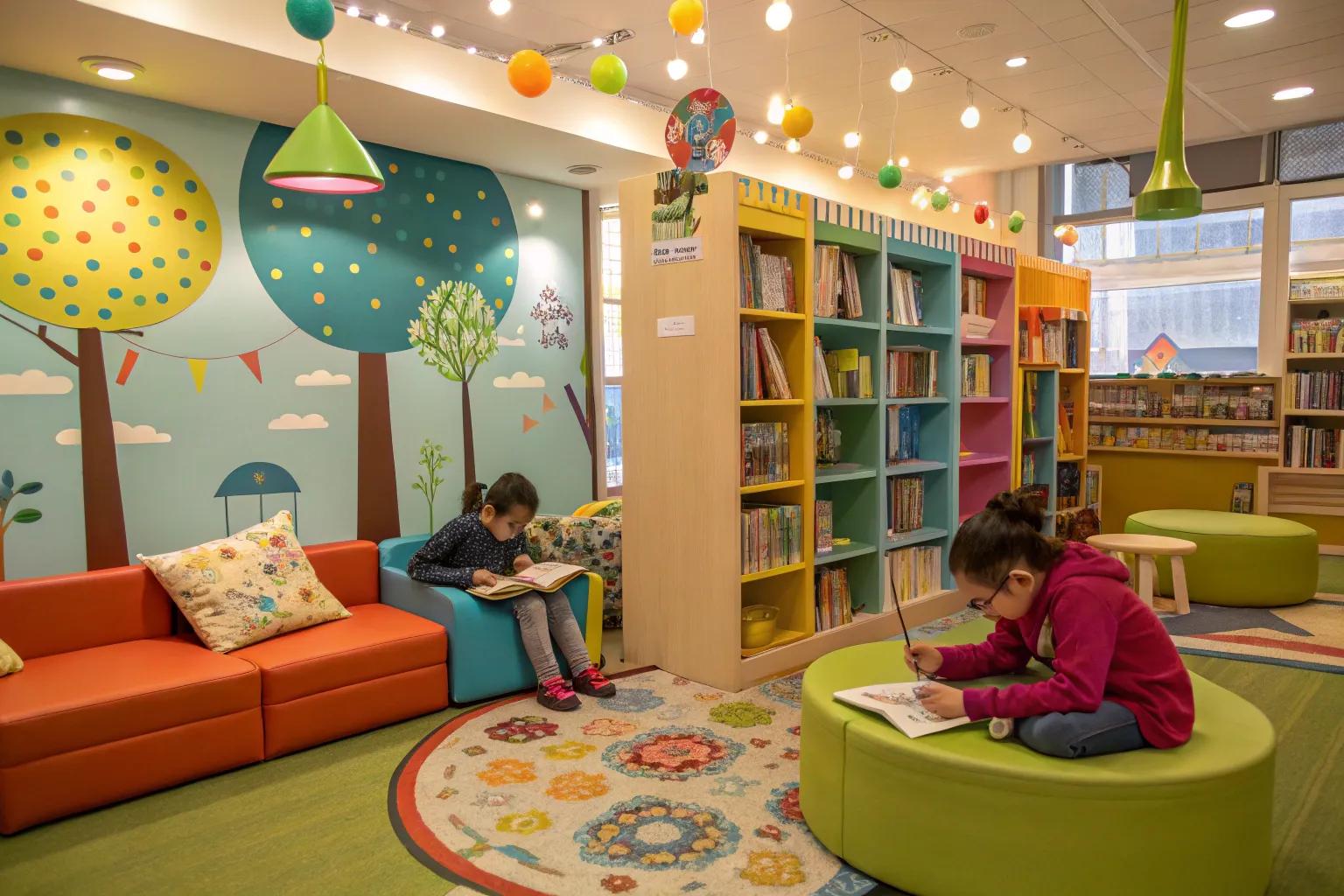
The children's treehouse floor — the children's section sits on one of the slanted levels, and the angled windows create the feeling that you're sitting in a treehouse looking down at the city. Bright colors, soft cushions, low shelves that are easy to reach.
How kids convinced the city
In the first months after opening adults still argued. But children just kept coming and... staying. They brought parents, grandparents, friends. "Mom, let's go to the library!" — a phrase you rarely heard before, right?
A teacher at one of Seattle's schools, Mrs. Johnson, said: "I couldn't get kids to go to the old library even for a grade. Now they beg their parents to take them there on weekends. One boy told me, 'It's the only place I feel smart and happy at the same time.'"
Gradually adults began to understand too. The library became the most visited building in Seattle — more than 2 million visitors a year! That's more than the famous Space Needle. Architects from around the world came to see the "library of the future." And those same critics who called it ugly began writing pieces about how brilliant it is.
What the building taught us to think differently
The story of Seattle's library teaches an important lesson: sometimes what seems strange and incomprehensible is simply new. Adults often fear change because they're used to the old. But children look at the world with fresh eyes. They don't think, "A library must look like this." They think, "Oh, red escalators! Cool! Oh, you can lie on the floor and read! Awesome!"
Today this library is one of the most photographed in the world. It has won numerous awards. But the greatest prize is the lines of children on Saturday mornings waiting for the doors to open so they can race to their favorite floor.
Rem Koolhaas, the architect, once said, "I always knew the children would understand me. They aren't afraid of tilted walls and strange shapes. They just want things to be interesting. And I built them an interesting place."
So if someone ever tells you something is "too weird" or "too unusual," remember the library that everyone hated at first. Sometimes the best things in the world look unfamiliar. They just need a chance.