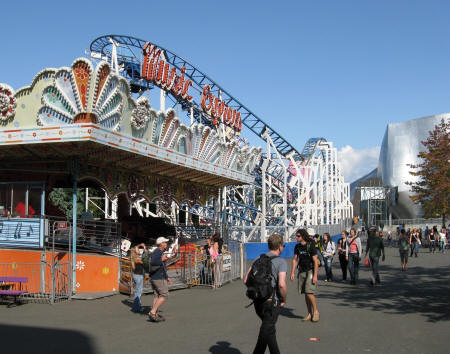
Imagine this: every summer you go to the same park. There are little slides where you race down screaming, cars you can crash into without consequences, and ice cream that melts faster than you can finish it. You know every corner of the place. And then, one day, you come back—and it’s gone. Instead of a carousel, there’s a fence. Instead of laughter, there’s silence. That’s what happened to thousands of children in Seattle in 2011, when Fun Forest closed.
Where This Magic Forest Came From
The story starts long before you were born—in 1962. Back then, Seattle hosted a World’s Fair, often called the “Century 21 Exposition.” It was a huge event: people came from all over the world to see achievements in science and the future. For the fair, a whole mini-city was built—today it’s called Seattle Center. And there appeared the famous Space Needle, a tower shaped like a flying saucer on a pedestal, still looking down on the city from above.
But alongside the science pavilions was also an area for entertainment. During the fair, it was called “The Funway”—something like “a gateway to fun.” There were carousels spinning, rides running, and children tugging on their parents’ hands to go one more time. When the fair ended, most of the buildings were demolished or repurposed. But the amusement area was kept. It was renamed Fun Forest—“Magic Forest”—and it continued operating. Year after year, decade after decade.
For almost fifty years, this small park was a place Seattle children visited with their grandparents, mothers, and friends. Here they rode roller coasters, laughed in a room of warped mirrors, and won stuffed bears in shooting galleries. It was affordable—which matters a lot, because Seattle has always been a city of very different people: the wealthy and the not-so-wealthy, newcomers and locals, families with plenty of money and families who count every dollar.
When the City Said “No”
In 2010, city officials announced that Fun Forest would close. They rolled out a major plan to redevelop the entire Seattle Center—something beautiful and modern, with new buildings and new spaces. The rides didn’t fit into that plan. Officials said the park was outdated, that the equipment was old, and that this place could be used better.
Many families were upset. Parents who had ridden those rides themselves as kids now brought their children there—and then suddenly it was supposed to disappear? People wrote letters to the city council, gathered signatures, attended meetings, and said, “Don’t touch our park.” Children made posters. Local newspapers ran articles with headlines like “Who does the city belong to—kids or developers?”
But the voices weren’t heard. In January 2011, Fun Forest closed forever. The carousels stopped. The lights went out. Workers began dismantling the structures.
This is the sad part of the story. But what comes next is more interesting.
What Grew in Place of the Carousels
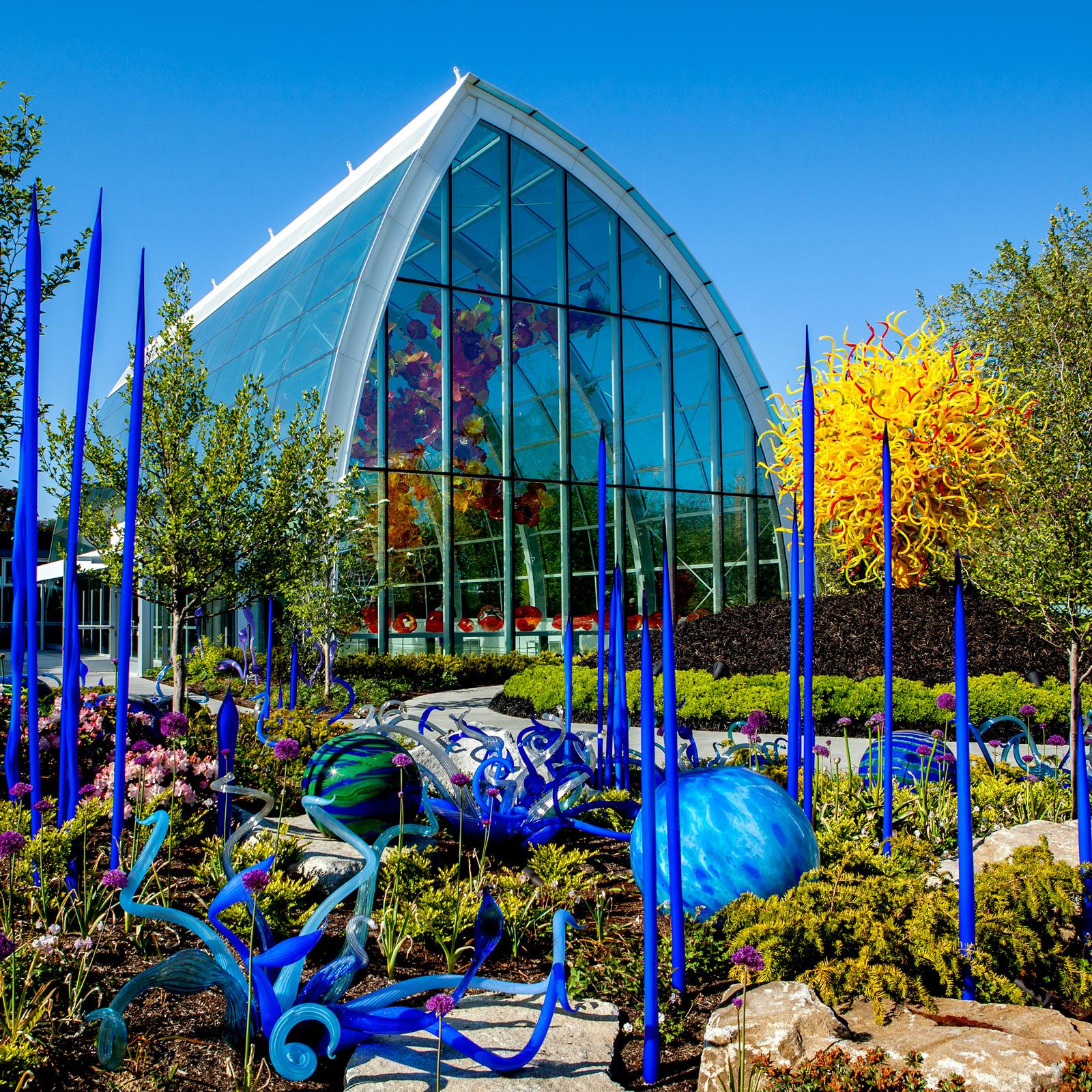
After a year and a half, in May 2012, a completely different place opened on part of the former Fun Forest site—Chihuly Garden and Glass, which can be translated as “Chihuly Garden and Glass.” It’s a museum and garden devoted to the work of American artist Dale Chihuly, who creates unbelievable sculptures from colored glass. His works look like sea creatures, like flowers from another planet, like frozen fireworks.
From an ecological standpoint, the replacement seems like a good move: instead of gas-powered engines and electric rides, there are living plants, quiet pathways, and glass installations in the open air. Less noise, less pollution, more greenery. City environmentalists were pleased—Seattle Center was becoming “greener,” in the literal sense.
But there’s an important question that needs to be asked. Fun Forest cost very little—just a few dollars per ride—so any family could afford it. A ticket to Chihuly Garden and Glass is about twenty-five dollars for an adult and also a significant amount for a child. Sure, it’s a beautiful place. But it’s beautiful for those who have money. And children from lower-income families, who used to be able to come to Fun Forest and feel like everyone else, now look at the new garden from behind a fence.
So the story turns out to be strange: environmentally, it’s better—but socially, it’s more complicated.
A Big Question for a Small City
This story about Fun Forest isn’t just about carousels. It’s about how cities change and who decides what public space should be. Seattle Center is land that belongs to all residents of the city. It was built with taxpayers’ money back in 1962. That means every Seattle resident—rich and poor, adult and child—has a say in what happens there.
But in practice, it turns out that voices are heard unequally. Architects, investors, and city officials often speak louder than children with posters. Polished projects with renderings and presentations persuade better than memories of how great it was to ride the rides with mom.
Environmentalists, by the way, also aren’t always in agreement. Some say, “The garden is better than rides—less waste and less noise.” Others push back: “Real ecology is when everyone can use green space, not only those who bought a ticket.” This is called “environmental justice”—the idea that clean air, beautiful parks, and green spaces should be accessible to everyone, not just affluent people.
What Remained and What Changed
Today, Seattle Center is a large area that still has plenty of free things to do. There are fountains, lawns, playgrounds, and outdoor concerts in the summer. The Space Needle still looks down on the city. Nearby, the Museum of Pop Culture is open, with its incredible architecture, reminiscent of crumpled foil.
But Fun Forest is gone. And the children who, in 2010, drew posters saying “Don’t close our park” are now adults. Some of them became activists and take part in city meetings—on other issues now, but with the same spirit: “This city belongs to us too.”
The “Magic Forest” story teaches an important lesson: sometimes what looks like an improvement is only an improvement for some people. And before saying “it got better,” it’s worth asking: better for whom? For the environment—or for all the children in the city? Those two answers don’t always match. Noticing that difference is already a very grown-up—and very important—idea.