Imagine that every autumn, salmon appear in Seattle’s rivers. They swim in from the ocean, make their way into city streams — and then suddenly start acting strangely: circling in place, losing their balance, and dying a few hours later. It happened again and again. And no one — not fishermen, not scientists, not city officials — could figure out why for a long time.
Fish that died after the rain
Seattle is one of the few major cities in the world where wild salmon still enter directly into city streams. That, in itself, is astonishing: around roads, houses, and shops — and in the water, real wild fish swim along. Residents are very proud of it. For Seattle, salmon is almost a symbol, living proof that nature and the city can coexist.
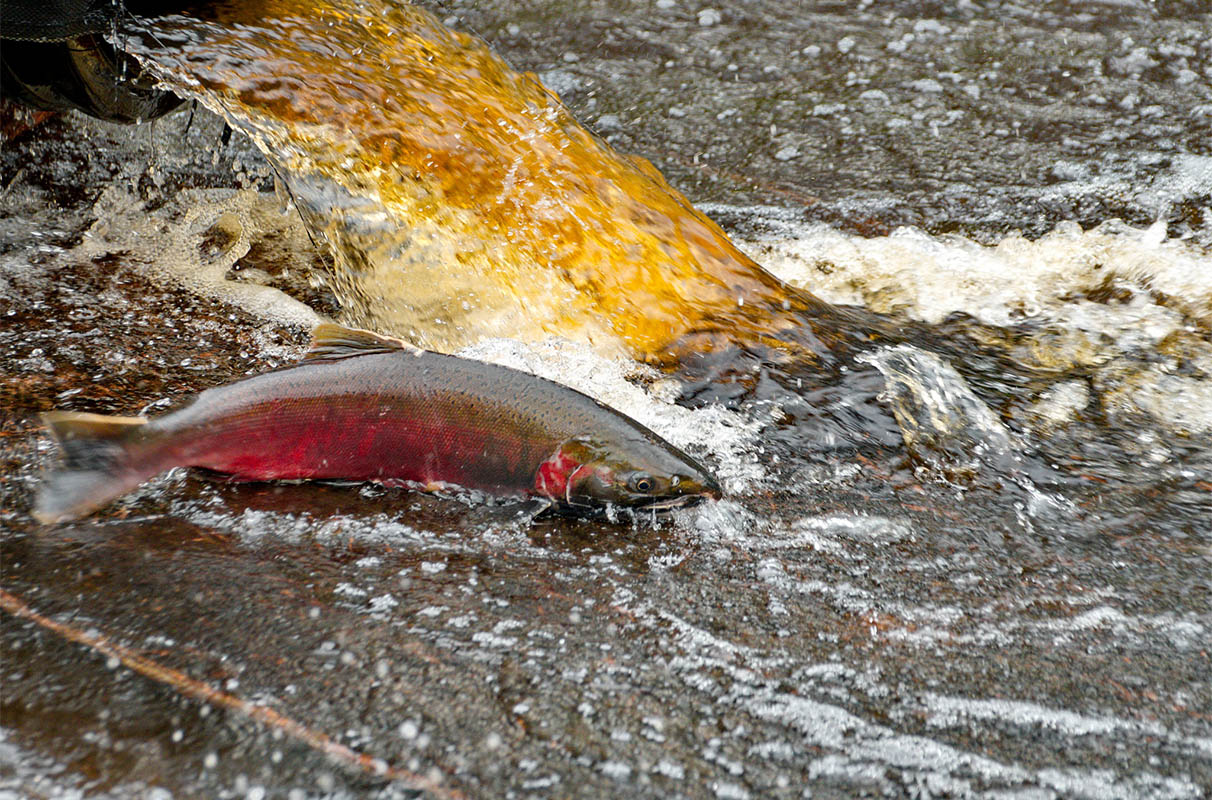
But starting around the 1990s, scientists began noticing something troubling. In autumn, when the first heavy rains begin, coho salmon (also called silver salmon) started dying right in the streams. And not all fish at once — specifically those that entered the city waterways after a downpour. Salmon from forest rivers a few hours’ drive from the city felt perfectly fine. And the urban ones were dying.
Scientists checked everything they could think of. Water temperature. Oxygen levels. Bacteria. Industrial waste. Lawn fertilizers. Cleaning agents. Nothing fit. The riddle remained a riddle for more than twenty years.
A detective with a microscope
In science, there are moments that feel a bit like detective stories. Exactly such a moment arrived in 2020 in the University of Washington laboratory in Seattle.
Researcher Zhengyu Tian and his supervisor, Edward Kolodziej, decided to approach the problem differently. They took water from a city stream after the rain and began, quite literally, removing from it different substances one by one — as if they were solving a complex puzzle, taking out piece after piece. And at some point, the fish stopped dying.
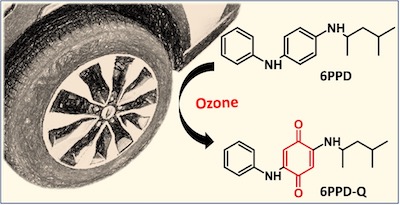
The remaining substance was completely unexpected. It was a chemical called 6PPD-quinone. It’s found in car tires — absolutely all of those produced in the world. Manufacturers add it specifically so the rubber doesn’t crack and wear down too quickly. Every time a vehicle drives on the road, tiny particles from the tire remain on the asphalt. And when it rains, all that dust is washed into storm drains, from there into streams — and then, right where the salmon swim.
The discovery was published in one of the world’s best-known scientific journals, Science. Scientists were stunned: a substance that exists in every car on the planet turned out to be lethal to one species of fish. And in such tiny quantities that detecting it without special equipment is practically impossible.
Tire against fish — and what came out of it
So what can you do? Ban cars? That’s impossible. But the story proved not to be so hopeless.
In 2023, the state of Washington passed a law — the first in the world — requiring tire manufacturers to find a replacement for the dangerous chemical. It’s not easy: you have to come up with something that protects rubber just as well, but doesn’t kill fish. Scientists and engineers are already working on it. Some companies say new compounds could appear within the next few years.
At the same time, the city continues restoring streams. Special filters are being built to hold back contaminated water before it reaches the fish. In some places, they’ve already managed to reduce the concentration of the dangerous substance enough that salmon can feel normal again.
It’s reminiscent of other stories that first seemed hopeless. When scientists found that lead in gasoline harms children’s health, many said it couldn’t be removed — too expensive and too difficult. But in the end, they did it. When it turned out that some plastics release harmful chemicals, at first it also seemed that things had gone too far. But gradually, rules changed.
Why it matters — even if you live far from Seattle
It seems to me that there’s something very important in this story — not just about fish and tires. It’s about how sometimes danger hides in the most ordinary things we see every day and never consider dangerous. Cars are everywhere. Tires are everywhere. And for a long time, no one — not scientists, not manufacturers, not governments — simply didn’t think about what happens to tiny bits of rubber after it rains.
The salmon in Seattle’s city streams turned out to be something like a living indicator — like the canary in a mine that miners used to take with them to find out whether poisonous gas was in the air. The fish noticed what people had missed.
And another thought: the discovery wasn’t made by some secret, heavily funded laboratories. It was a small university team that simply kept looking very persistently for an answer to a question that other people had almost stopped asking. Sometimes you just have to not give up — and keep asking, “Why?”