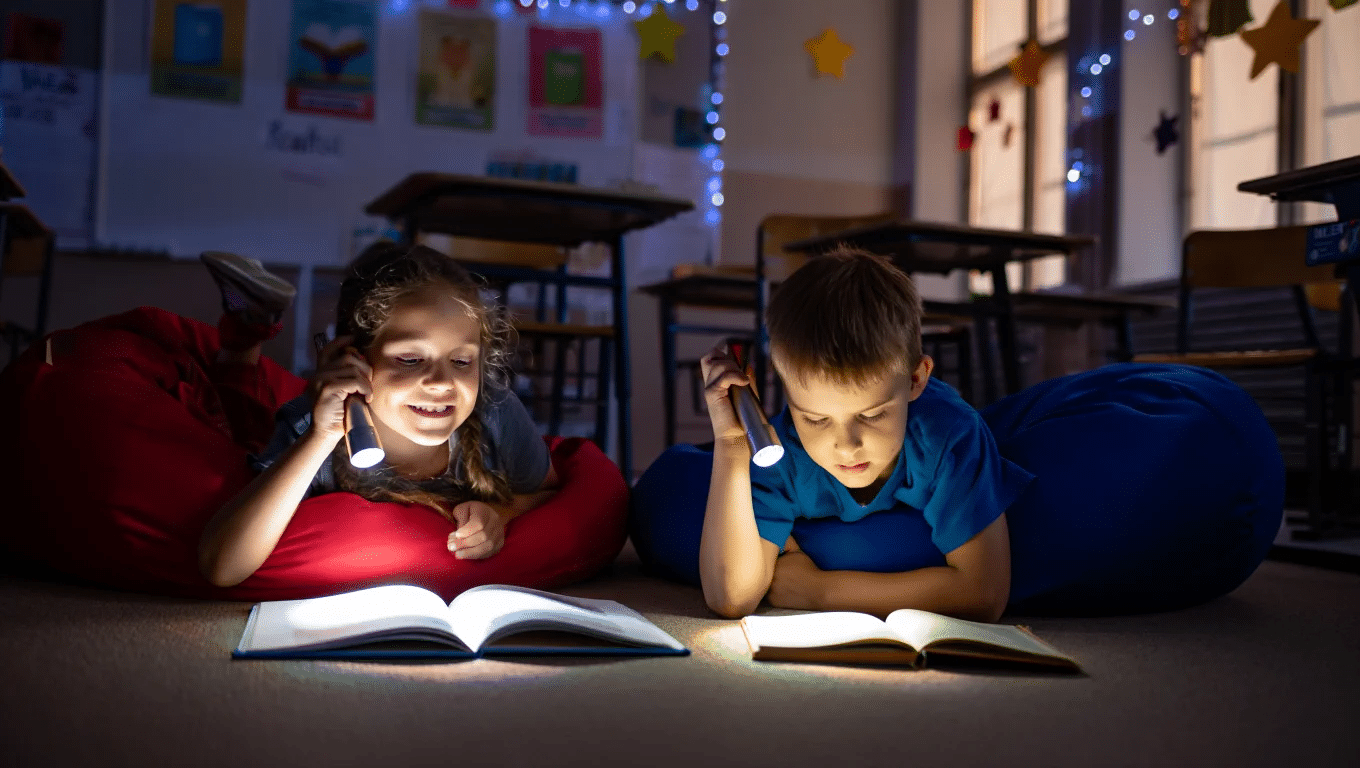
Imagine waking up in the middle of the night inside a bookstore. All around you, dozens of other kids sit in sleeping bags, reading by flashlight and whispering about their favorite stories. Sounds like an adventure from a book? But it really happened in Seattle in the early 2000s, and that one night changed a whole city.
At the time something sad was happening across America. Huge bookstore chains that looked like shopping malls were opening everywhere and “eating” the small cozy neighborhood bookshops. Small shop owners couldn’t compete with big companies that sold books more cheaply. One by one closed the very places where clerks knew every customer’s name, where you could sit in an armchair and read, where the owner could recommend exactly the book you’d love.
When the adults didn’t know what to do
In the Fremont neighborhood of Seattle there was a small bookstore, Fremont Place Book Company. Its owner, an elderly woman named Carol, announced she would have to close the shop in a month — she could no longer afford the rent. For many families in the area it was more than a shop. It was where children came after school, where author visits happened, where you could find books about protecting nature and justice that the big stores didn’t carry.
Adults sighed and said, “What a shame, but nothing can be done. That’s business.” They planned a farewell party and to say goodbye to their favorite place. But a group of kids from the local elementary school thought differently.
Ten-year-old Maya and her friends from the book club hatched a plan. They called themselves the Book Rescue Brigade. Their idea was simple but bold: if adults wouldn’t listen to words, maybe they’d notice actions? The children decided to hold a Read-In — they would sit in the shop and read for 24 hours straight, not leaving. They wanted to show the whole city how important the shop was.
The night the kids didn’t sleep
On Friday evening, when the shop was supposed to close at 9 p.m., children with their parents began to arrive instead. Each had a sleeping bag, a flashlight, favorite books and snacks. Carol, the owner, didn’t understand at first. Then Maya explained: “We won’t leave until the city understands this store needs to be saved.”
By midnight there were 47 children in the shop. Some read aloud to younger kids. Some made posters: “Books Bring Neighbors Together,” “Small Stores — Big Heart.” Parents took turns keeping watch, but the kids insisted they would do the reading themselves all night.
A local journalist who lived nearby came to see what was happening and wrote a piece. By Saturday morning a crowd had gathered at the store. People brought coffee, donuts, and more children joined the marathon. Television crews came to report. By Saturday evening there were over a hundred kids, and their story ran across the state news in Washington.
How reading turned into a movement
But the most interesting part came afterward. Adults, seeing how much these places mattered to kids, began to act. A group of parents and neighbors created a cooperative — where many people jointly own the business. Anyone could buy a “share” in the bookstore for $100 and become a co-owner. In two weeks 340 people had contributed. The shop was saved.
The story didn’t end there. The kids’ idea inspired other Seattle neighborhoods. Over the next five years twelve new independent bookstores owned by their communities opened across the city. It was remarkable because across America such stores were closing, while in Seattle they sprang up like mushrooms after rain.
Why this matters for the planet
You might ask: what does this have to do with nature and ecology? It turns out, quite a lot. These new bookstores operated differently. They created a book-exchange system among neighbors — if you finished a book, you could bring it to the store, get a “book credit” and trade it for another used book. That meant one book could be read by five, ten different people instead of collecting dust on a shelf or ending up in a landfill.
The Book Rescue Brigade kids helped install hundreds of little “Little Free Libraries” across Seattle — mailbox-sized houses where people leave books for others. Imagine walking down the street, spotting a cute wooden box, opening the door — and there are books! You take one, leave another. No money, no paperwork. Just neighbors sharing stories.
These bookstores also became places that taught people to care for the environment. They sold books about climate, hosted meetings for environmental groups, and organized seed swaps for community gardens. One shop even created a “Book Bike” — a cargo bike used to deliver orders around the neighborhood without a car or exhaust.
Shops where everyone is equal
There was another important reason these shops became special. Big chains mostly stocked books that were already popular — safer for business. Small independent stores could choose books about anything: kids from different countries, girl scientists, families that look different, people fighting for justice.
At one of these shops, Red Balloon Bookshop, there was a special shelf called “Voices That Must Be Heard.” It held books by writers from communities rarely represented: Native Americans, immigrants, people with disabilities. The owner said, “Every child should find on the shelf a book where the hero looks like them.”
These shops became community hubs. In the evenings people read poetry, discussed ways to improve the neighborhood, and raised funds for families in need. When the 2008 economic crisis hit and many lost jobs, the bookstores created a “Generosity Board” — a bulletin board where people could offer or request help. “I’ll teach your child to read in exchange for help fixing my roof.” “I’m giving away children’s clothes my kids have outgrown.” Books united people not just through stories but in real life.
What happened to the kid rescuers
Maya, the girl who organized that first read-in, grew up and became… what do you think? A librarian? No! She became an architect who designs public spaces. But she says that night in the bookstore taught her the most important thing: “I realized kids can change the world. Not when we grow up — right now. You just have to see the problem and figure out what you can do.”
Many of those children stayed in Seattle and continue to care for their neighborhoods. Some opened cafes using only reusable dishes. Some created programs teaching kids to repair bikes. Some became teachers and take their classes to bookstores, telling this story.
Fremont Place Book Company still operates more than 20 years later. A photograph of that night — dozens of children with flashlights and books — hangs on the wall by the entrance. Beneath it a plaque reads: “A revolution began here. Weapons: books and stubbornness.”
Why this matters to you
Maybe you live far from Seattle. Maybe your town has no bookstores that need saving. But this story teaches something important: small places where people gather are vital. It could be a bookstore, a library, a park, a cafe where neighbors meet. When those places disappear, a city becomes just a collection of houses where people don’t know one another.
This story also shows you can care for the planet in many ways. You don’t have to immediately save whales or plant forests (though that’s great too!). You can start small: share books instead of always buying new ones, support small neighborhood shops that don’t generate much waste or ship goods long distances, create places where neighbors can meet and help each other.
Today Seattle is known for having one of the highest numbers of independent bookstores per capita in America. Tourists come specifically to see these cozy shops. But locals know the secret: these aren’t just stores. They are places where the city remembers that people matter more than profit, where stories are passed from hand to hand, where neighbors become friends.
And it all began with a group of kids who simply loved to read and weren’t afraid to tell the adults: “We disagree. We will fight.” They took flashlights, their favorite books, and showed that sometimes the bravest thing to do is simply stay where it matters and not leave until others understand why that place is special.