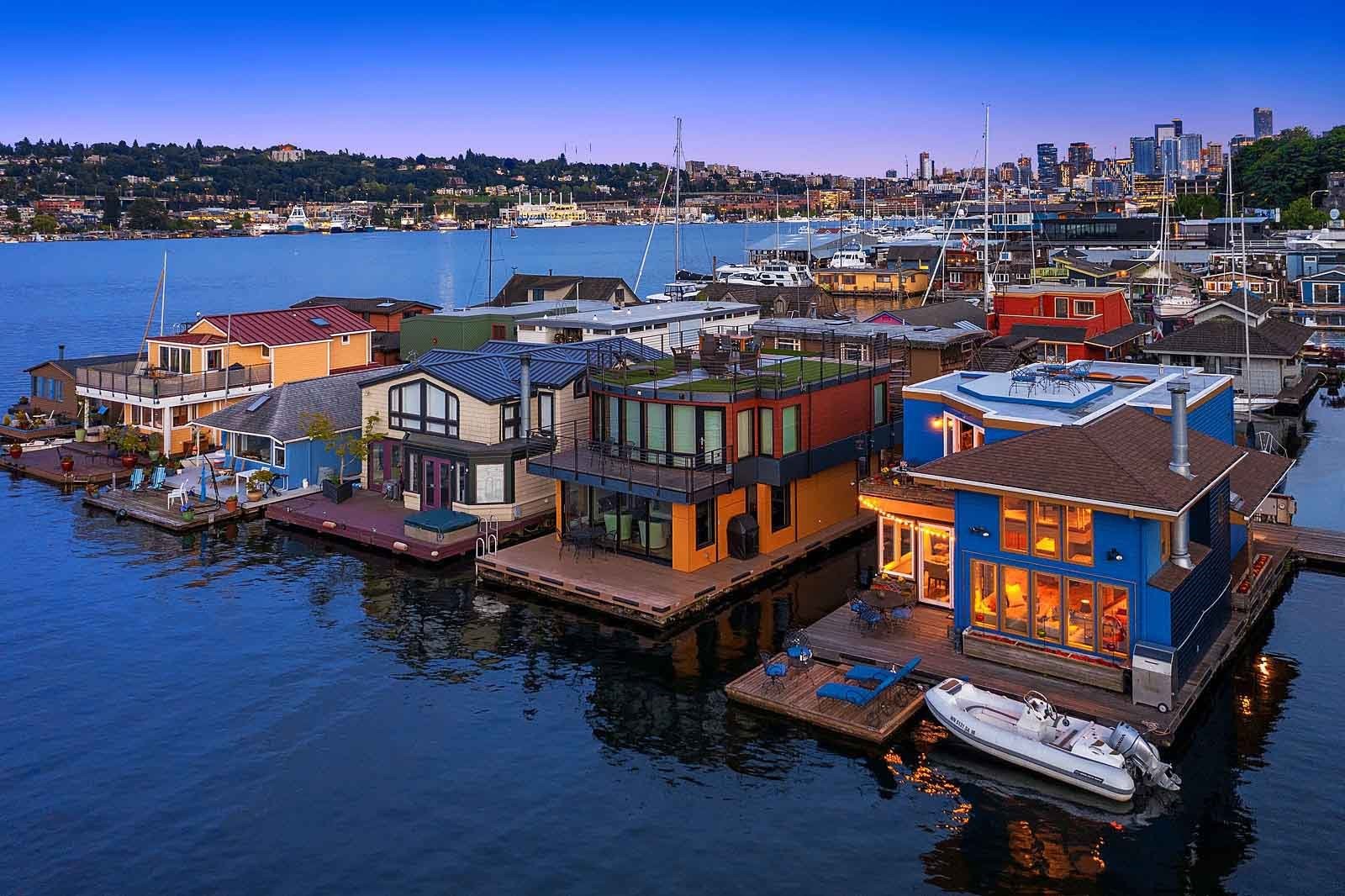
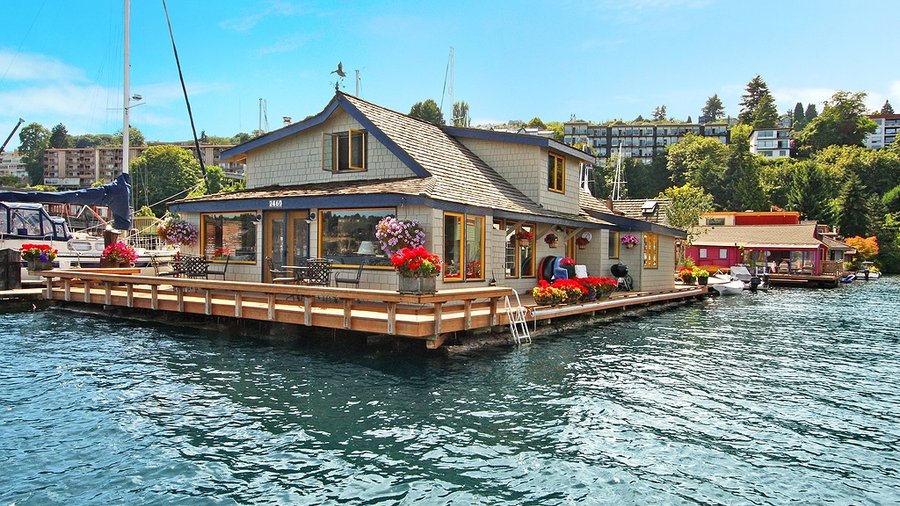
Imagine waking up in the morning—and instead of asphalt outside your window, you see water. Ducks swim right past your kitchen. When a big ferry goes by, your house gently rocks, as if it’s saying, “Good morning.” That’s pretty much what every day begins like for a few hundred families in Seattle—living not on land, but right on Lake Union. This isn’t a fairy tale and it’s not a movie. It’s a real floating neighborhood, with an amazing—and a bit sad—story.
Who Thought of Living on the Water
Floating homes on Lake Union have existed for more than a hundred years. At first, fishermen and workers moved in—people who needed affordable housing near the water, where they earned their living. No frills, no flower-filled balconies—just wooden houses on pontoons, modest and practical.
But in the 1960s and 70s, everything changed. Artists, musicians, students, and anyone who wanted to live a little differently from everyone else began moving into the floating homes. Why? Because rent was extremely cheap. For a few dollars a month, you could get a little house right on the water—with a view of the sunset, with the quiet lapping of waves, and with neighbors who shared your way of seeing life. It was a small free-spirited village in the middle of a big city. People here knew one another by name, threw parties on the docks, and fixed each other’s boats just like that—friendly, without fuss.
By the 1970s, Lake Union was home to several hundred such houses. It seemed like nothing could destroy this little paradise.
When the House Became the Accused
But in the early 1970s, city officials declared that floating homes were an environmental disaster. And they had reasons to say so.
The problem was that most of the houses weren’t connected to the city sewage system. Everything that went into the pipes—sewage, household waste—ended up directly in the lake. The water in Union grew dirtier and dirtier. Fish disappeared. The smell over some parts of the lake was far from romantic.
City authorities decided: floating homes had to be demolished. All of them. Completely. The lake was more important than a few hundred oddballs who had decided to live on the water.
To the residents, this felt horribly unfair—not only because they didn’t want to lose their homes. They knew something important: floating houses weren’t the only—and not even the main—culprits of pollution. Around the lake stood factories and shipyards that dumped far more dangerous substances into the water than all the houses combined. But there was no plan to tear down the factories.
Still, the residents didn’t just complain. They decided to act.
How a Floating Neighborhood Became a Defender of the Lake
The residents came together—artists, fishermen, students, elderly neighbors—and came up with a plan. They agreed to connect all their homes to the city sewage system. It cost money and required effort, but they were willing to pay that price to prove they weren’t enemies of the lake—they were its friends.
What’s more, some residents began to monitor the water quality themselves. They took samples, recorded observations, and noticed when the water grew cleaner or dirtier. Ordinary people turned into real protectors of the lake.
In 1974, city officials officially recognized the right of floating homes to exist. The neighborhood was saved. And Lake Union began to slowly revive: fish returned, the water became cleaner, and birds appeared again. Residents celebrated their victory—they managed to defend both their homes and the nature around them at the same time.
It was a real victory. But the story didn’t end there.
A Victory That Changed Everything
Once the lake became clean and beautiful, the floating neighborhood became known around the world. In 1993, the famous film Sleepless in Seattle was released, with the main character living in exactly such a house on Lake Union. Millions of people around the world watched the rocking house with its dock and thought, “I’d love to live there!”
And then a new problem began.
Prices for floating homes started to rise—slowly at first, and then faster and faster. Artists and students who had moved here because it was affordable could no longer afford to stay. Their homes were bought by wealthy people, turned into luxurious residences with panoramic windows and modern kitchens. Today, some floating homes on Lake Union cost more than a million dollars.
The neighborhood that had once been home to free-spirited, not-very-wealthy people became one of the city’s most expensive addresses. Those who saved the lake—fishermen, artists, musicians—mostly no longer live along its shore. They won their fight for the water, but lost their place in it.
The Lake Remembers
The story of the floating neighborhood on Lake Union is a story about how “victory” can look different. On the one hand, the lake really did get cleaner. That’s true, and it matters. Fish came back, the water became clearer, and today you can kayak on Lake Union and even see the bottom.
But on the other hand, the small community of people who loved this place and fought for it fell apart. Their spot was taken by people who simply had more money. That’s what a nice-sounding word calls “gentrification”—when a neighborhood becomes better, prettier, cleaner, but the people who made it that way can no longer afford to live there.
Maybe the most honest lesson of this story sounds like this: to truly save a place, you have to think not only about the water or the air, but also about the people who love that place. Because a place isn’t only a lake. It’s also neighbors who know you by name, and the smell of someone’s cooking from the next dock over, and parties out in the open, and the feeling that your home is partly yours—and partly shared.
Today, Lake Union is beautiful and clean. But sometimes, locals say, long-time residents come down to the shore and look at the water—and remember what the neighborhood used to be. A little noisy, a little untidy, but alive. Just like the lake itself, a long time ago.