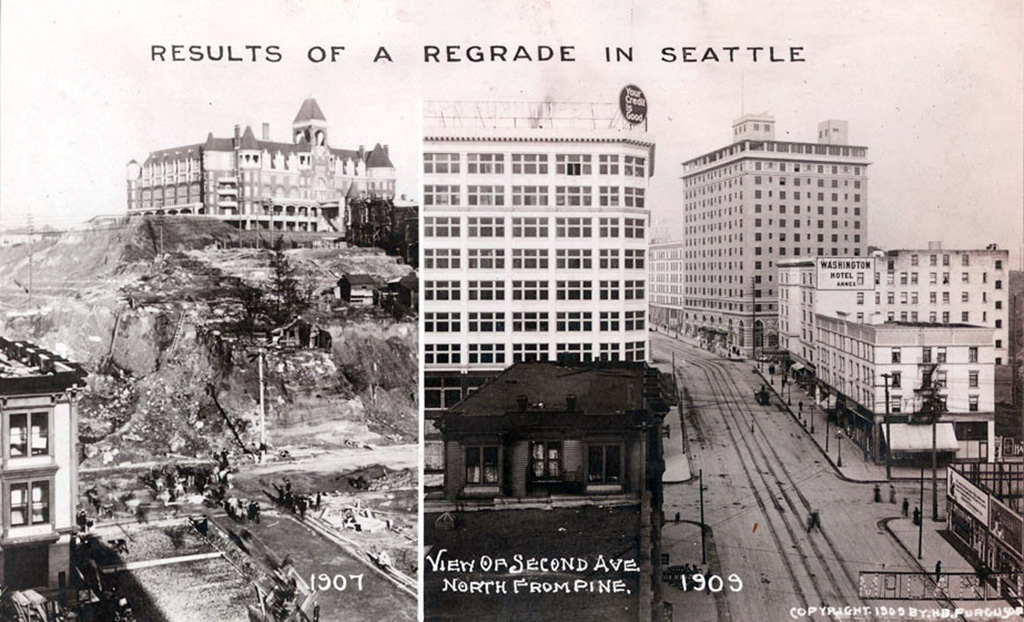
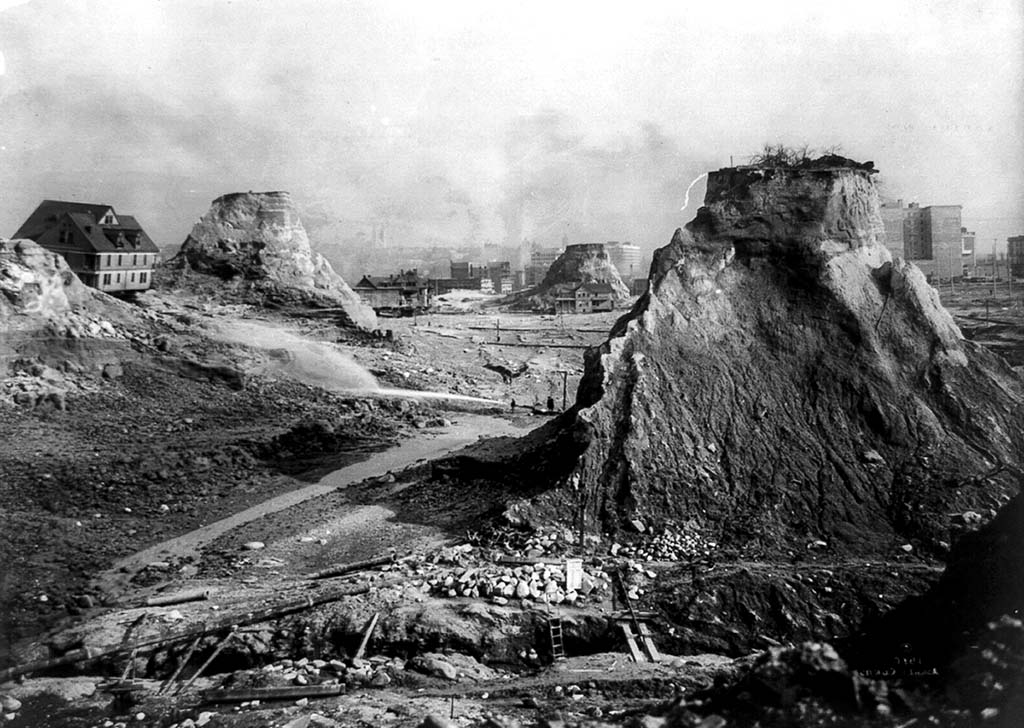
Imagine a big hill right in the middle of a city. Now imagine that adults decided to get rid of it not with shovels or explosives, but with... water! That’s what happened in Seattle more than a hundred years ago. A hill called Denny Hill literally dissolved under powerful jets of water and washed into the bay. This story is about boldness, ingenious engineering, stubborn residents, and how even the smartest ideas can sometimes come at too high a cost to nature.
Why the City Needed to Remove the Hill
In the early twentieth century, Seattle was growing fast. People came from all over the country, building homes, shops, and ports. But right in the center, next to the business district, stood a tall, steep hill—Denny Hill. It was so high that climbing it was very difficult, especially for horses and wagons. The streets were almost like amusement-park rides.
City officials decided that the hill was getting in the way of the city’s growth, so the land needed to be flattened. This is called regrading—changing the shape of the land to make it level. The project’s leading figure was city engineer Reginald Thomson. He believed that a level city was a convenient city, and he set to work with great determination.
Interestingly, there was even a large hotel on top of the hill, called the Denny Hotel. It was demolished in 1906 because both the hill and the building stood in the way of ambitious plans.
Giant Water Cannons
Now for the most interesting part: how exactly did they remove the hill? The engineers used a technique called hydraulic mining. Put simply, it was like a giant garden hose with tremendous water pressure!
Here’s how it worked:
- Water was drawn from the lake and the bay and forced through pipes under enormous pressure.
- Workers aimed powerful jets at the hillside, and the water was so strong that it washed away the earth—just like you might wash down a sandcastle with a hose.
- The mud flowed into long wooden flumes, like enormous water slides.
- The muddy water carried the earth down the flumes and pipes to Elliott Bay.
The work took place in two stages: the first from about 1898 to 1911, and the second in the late 1920s, ending in 1930. Just think: they didn’t remove the hill in a day or even a year, but over several decades. It was like taking apart a giant sandcastle—but instead of building it up, they had to dismantle it.
New Land from an Old Hill
So where did all that earth go? It wasn’t dumped into the void. The washed-away soil and silt filled part of the bay’s shallow waters and became new land! Warehouses, roads, and railroad tracks were later built there. In effect, one part of the city was made from another. The hill disappeared, leaving level ground in its place, and new waterfront lots nearby.
It’s a little like moving sand from one bucket to another: one place has less, and another has more. Only here, we’re talking about millions of cubic meters of earth, moved not with toy shovels but by powerful jets of water.
Stubborn Little Houses on Pillars of Earth
And now for the funniest part of the story. Not all the residents agreed to give up their homes for the grand plans. Some property owners simply refused to sell. So the workers washed away the earth around their houses, leaving each one standing on a tall pillar or tower of soil, like an island in the middle of a level field.
These remnants are sometimes called “spires” or earth columns. People even came up with a joking name for the houses: “spite houses.” Imagine everything around you being leveled, while your home stands high on a pillar of earth, and you have to climb a long staircase to get to it! Eventually, these little islands were usually cut away too, but the stories about them lived on.
The Cost of Change: What People and Nature Lost
Now let’s think about the sad side of this story. Washing away the hill changed a great deal:
- Residents lost their homes. People had to move, and some didn’t want to leave the places they called home.
- The shoreline changed. The earth washed into the bay covered shallow waters where fish, birds, and small animals had lived. This shallow area is called the intertidal zone, and it is always teeming with life.
- Muddy water. The enormous amount of soil in the water made the bay cloudy, which could harm the creatures living there.
I think this story reminds us that the same idea can be both brilliant and a little sad. Engineers came up with a very clever method, but back then few people thought about what the land, water, and nearby animals might feel.
What We Can Learn from This Story
Today, the Denny Hill site is a neighborhood filled with homes, offices, and cafés. It’s easy to get around: the streets are almost level. But if you look closely at a map or walk through the nearby streets, you’ll notice that there are still hills nearby. They seem to remind us: “We were here once too—and everything used to look like us.”
This story teaches us two things. First, people can solve very difficult problems when they combine boldness with ingenuity. Second, before changing nature, it’s worth asking: “Who else lives here, and how will this affect them?” Then future big projects can be not only clever, but kind, too.
What do you think: if you were asked to build a new city neighborhood, how would you do it so that it was convenient for people and gentle on nature?