Imagine that there is a huge hill in front of your house, and you decide to get rid of it. Not with shovels or machines, but with ordinary water—as if you were washing away a sandcastle with a hose. It sounds like a fairy tale, but that is exactly what happened to one hill in Seattle, a city in the northwestern United States. People washed it into the sea, and the earth became new shoreline. Let’s take a look at how this was even possible.
A City Hindered by a Hill
At the end of the nineteenth century, Seattle was growing rapidly: new residents arrived, and houses, shops, and a port were built. But the city stood on hills, and one of them, Denny Hill, was especially steep and high. It was named after the Denny family, among the first settlers in the area.
Walking up such a hill was difficult, and it was even harder for wagons and the first automobiles. Horses grew exhausted, while wheels slipped in the mud. The city seemed to be divided into parts: the port and business district were below, while new neighborhoods were above, making travel between them inconvenient.
The townspeople thought: “What if we removed the hill?” The idea was bold, but not crazy. At the time, many cities around the world were leveling land in order to build straighter streets and more houses.
Water Cannons Instead of Shovels
The city’s chief engineer was Reginald Thomson. He liked coming up with large-scale projects and believed that they required not only strength, but also ingenuity. Digging up the hill with shovels and hauling the earth away in carts would have taken decades. Thomson chose another method.
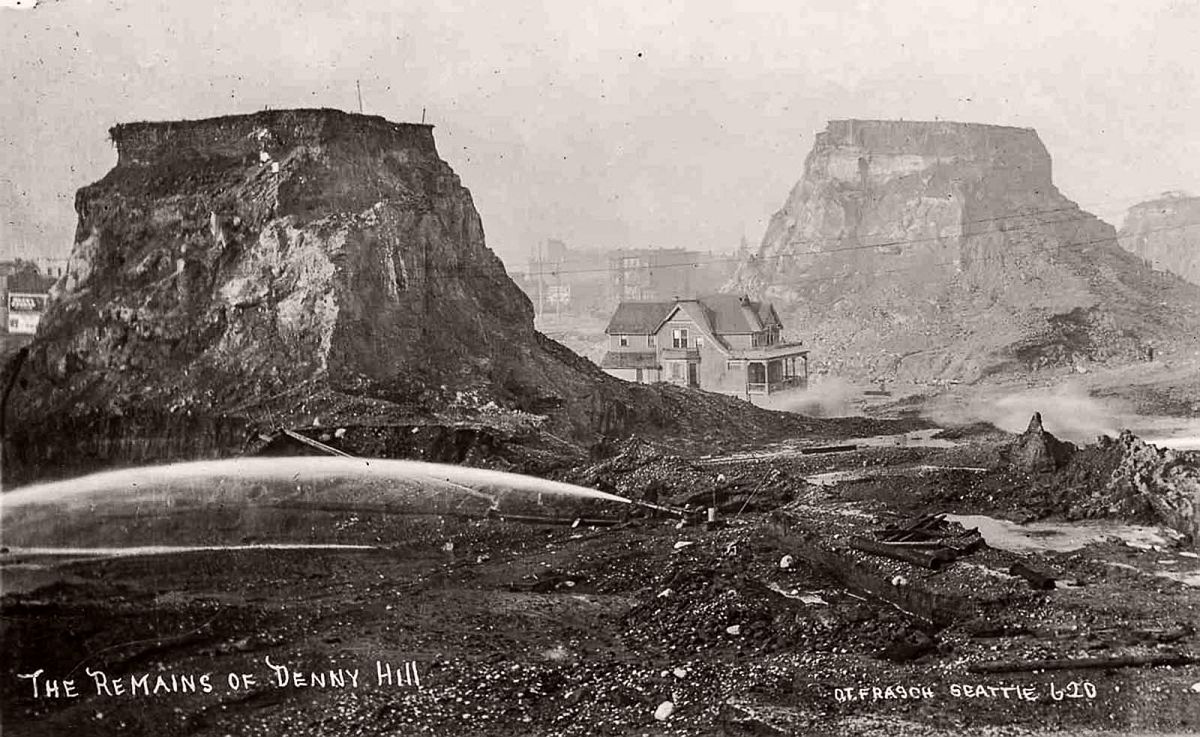
By the twentieth century, hydraulic monitors were already in use. These were enormous cannon-like pipes that blasted water under such pressure that it could wash away soil and even small rocks. Imagine spraying a pile of sand on a playground with a hose: the water cuts through the sand in layers. Here, it was the same process, only hundreds of times more powerful.
The washed-away earth turned into thick mud and flowed downhill through wooden sluices and large pipes. This process is known as sluicing. The mud reached Elliott Bay, where it was used to create fill—in other words, new land. The hill did not simply disappear; it became building material for a new place.
This did not happen in a single day. The work continued from the 1900s until the early 1930s, with interruptions. The hill was cut down in layers, and the streets became increasingly level. Roughly speaking, several dozen meters of earth were removed, and the hill was transformed almost into a plain.
Houses on “Pillars” and Stubborn Owners
Now for the funniest—and slightly saddest—part. Not all property owners agreed to sell their land. They lived on the hill and had houses, gardens, and memories there. When the earth around them began to be washed away, their properties remained standing like tall pillars with houses on top. Imagine emptiness and mud all around, while an ordinary house with curtains stands on an “earth tower,” forcing its owner to climb a staircase to reach it.
These “spurs,” as they were called, looked strange. Some owners eventually agreed, and their properties were cut down as well. Others held out to the very end. It is a good example of how large-scale projects always affect people whose views must be taken into account, even when the city wants to do “what is best for everyone.”
Today, the neighborhood is called Denny Regrade (“regrade” meaning the reshaping of a surface). It contains offices, apartment buildings, and parks, as well as the famous Space Needle and a science center. If you walk along its level streets, you would never guess that a steep hill once stood there.
What Is Good—and Sad—About This Story
The engineers of that era were extremely inventive. They figured out how to move a hill with water and create new land. Thanks to this, Seattle became easier to build in and travel through, and the city was able to grow.
But there was also a downside. The hill had been part of nature, and birds and plants lived there. People lost their homes and familiar surroundings. Elliott Bay also changed: the shoreline became different, and so much sediment entered the water that life became difficult for the fish.
It seems to me that this story teaches two lessons. First, human ingenuity can accomplish real miracles. Second, every major change should be carefully considered: Who needs it? What will we gain, and what will we lose? Good engineers know how not only to build, but also to ask themselves questions like these.
Conclusion
Denny Hill did not disappear without a trace. It was transformed into streets, houses, and a piece of shoreline. This is a story about how people used water and earth to create a new place. The next time you build a sandcastle and wash it away with water, remember Seattle: there, people did the same thing on a gigantic scale—only instead of a castle, there was an entire hill, and instead of a bucket, there were giant water cannons.