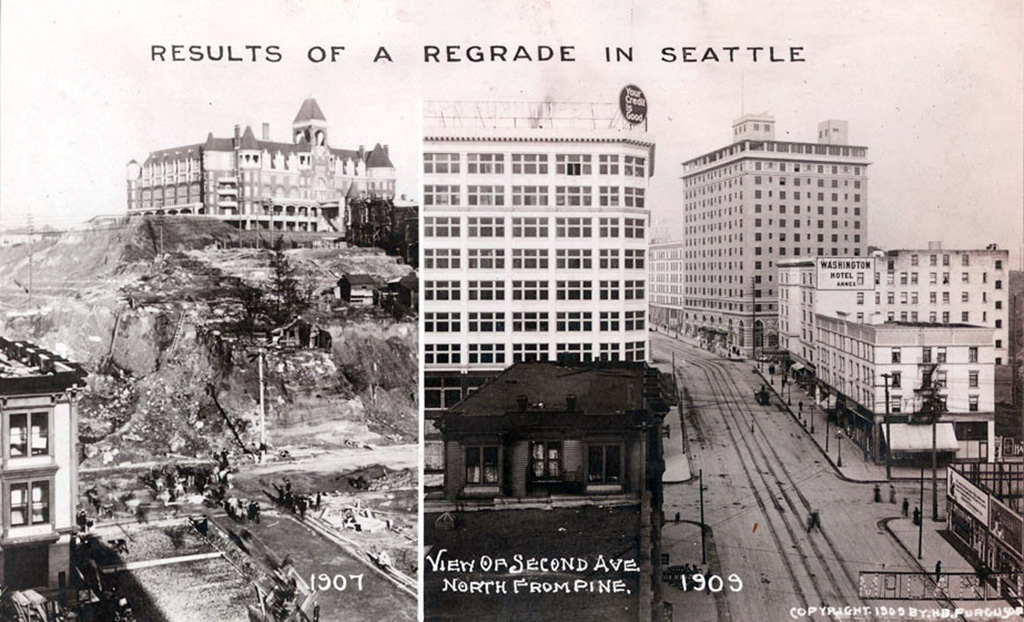
Long ago, a steep, tall hill stood in downtown Seattle. Adults decided it was getting in the city’s way and came up with a plan to wash it away with powerful jets of water. It sounds like a story about giants, but it really happened. The story of Denny Hill shows how money and dreams of a big city can literally change the ground beneath our feet.
Why the city needed to remove the hill
Imagine you’re building a city out of blocks, and there’s a big mound in the middle of the table. You can’t put blocks on it or roll a cart over it. That’s roughly how Seattle residents thought in the late 19th century. The city was growing fast: people were arriving, bringing goods and opening shops. But downtown was hemmed in between the bay and the hills.
Denny Hill stood north of downtown, and its steep slopes made it difficult to move cargo and build large buildings. Businesspeople and landowners had a simple idea: if the hill were removed, the land could be sold and developed at a profit. More space meant more shops, offices, and money. Economic plans were the main driving force behind this enormous project. Work began as early as 1898 and wasn’t completed until around 1930, so it went on for more than thirty years.
How they washed the hill away
Now for the most interesting part: how do you get rid of an entire hill? Digging it up with shovels would have taken too long, so engineers came up with a plan to use water. They laid pipes and set up special “water cannons”—hydraulic monitors. Powerful jets of water burst from them, washing away the earth.
You might know what this looks like: you spray a sandcastle with a garden hose, and it turns into a runny mess that trickles downhill. This was just the same, only on a huge scale. The loosened earth flowed down chutes and through pipes and, together with the water, into Elliott Bay. New land emerged where there had been water, and piers and warehouses were later built there. The hill, several stories high—about as tall as a 12-story building (around 36 meters)—slowly disappeared. In its place came level streets that were easy to walk and drive along.
Interestingly, many of these projects were overseen by engineer Hiram Chittenden, who built a great deal in Seattle. People argued over whether it was the right thing to do: some liked the wide, level streets, while others mourned the old hills.
An unexpected result: an empty neighborhood
You might think that after all that work, the neighborhood would immediately become the city’s busiest place. But things turned out differently. The area known as Denny Regrade remained half-empty for a long time. Many lots stood without buildings; weeds grew there, or they became parking lots.
Why did that happen? Businesspeople’s projections had been too optimistic. They invested a lot of money, but people and companies weren’t in a hurry to move there. Then the Great Depression began—a time when many people had no money, and no one was rushing to build anything new. As a result, the neighborhood looked like a wasteland for many years. People even called it a “scar” on the city.
How the neighborhood came to life many years later
It was only decades later that the story changed. In the late 20th and early 21st centuries, a new economy took off in Seattle: computer and internet companies. One of the best-known, Amazon, chose the former Denny Regrade neighborhood for its offices. The level land, convenient location near downtown, and vacant lots came in handy.
Today, tall buildings stand here, cafés and shops are open, and thousands of people walk the streets. The very lots that once lay empty have become one of the city’s busiest business districts. It turns out that the level land, prepared with such great effort, eventually came in useful—just not as quickly as the first developers had hoped.
What we can take away from this story
I think this story is both amazing and a little sad. On the one hand, people managed to do what seemed impossible: wash away an entire hill. On the other, a beautiful natural hill disappeared forever, and the expected gains came only many years later. This story reminds us that plans, like hills, don’t always lead where we expect. It’s worth thinking carefully about what we’re changing and what we might lose.
And yet even the boldest projects leave their mark. When you walk around modern Seattle, remember that beneath your feet is land once washed into place by water from giant cannons, and where a steep slope stood, an entire city of the future has since grown.