Seattle was once home to a much-loved basketball team called the SuperSonics. Then the team moved to another city, and many people were very sad. But the huge building where the games were played didn’t disappear. In fact, it got a fascinating new life—and this story has a little sadness, a little courage, and a lot of care for the environment.
Who Were the SuperSonics, and Why Were They Called That?
The name “SuperSonics” was chosen back in 1967. Seattle is home to the big airplane company Boeing, and back then people there dreamed of a supersonic passenger plane that could fly faster than sound. “Sonic” means “sound,” and “supersonic” means “faster than sound.” So the team’s name came from airplanes, not animals, as many people think.
The team played in Seattle for 41 years. Its colors were green and gold. And in 1979, the SuperSonics won the National Basketball Association (NBA) championship—the biggest prize in American basketball. The whole city celebrated, and fans still hold on to the jerseys and pennants from those years.
A Sad Day: The Team Moves Away
In 2006, the team’s owner sold it to a group of businesspeople from Oklahoma City. In 2008, the SuperSonics moved there and became the Oklahoma City Thunder. For fans, it was like your best friend suddenly moving to another state: she’s still alive and well, but she no longer lives nearby, and you can’t meet up after school.
Seattle fans didn’t give up right away. They held rallies, wore green-and-gold jerseys, and asked for the team to stay. But the decision had already been made. On the other hand, an agreement between the city and the new owners meant that the name “SuperSonics,” the famous colors, and the team’s history stayed in Seattle. That means that if a basketball team ever returns to the city, it can use the name again. So far, that hasn’t happened, and no one knows when it will.
The Hat-Shaped Building and Its Second Life
Now for the most interesting part—the building. The arena where the SuperSonics played was built in 1962 for the Seattle World’s Fair. The famous Space Needle was built for that same fair. It looks like a flying saucer on a long stick. The arena was unusual, too: it had a huge, beautiful roof that looked like a big hat.
When the city lost its team, the building could simply have been demolished, as happens to many old buildings. But local residents decided otherwise. The builders worked a real miracle: they carefully propped up the old roof with temporary supports and dug the ground inside the building much deeper—about 50 feet down. Then they built a new arena right under the old roof, as if they had built an entire new house beneath a hat. The historic roof stayed in place, which meant that tons of old materials didn’t have to be thrown away and replaced with the same amount of new materials. That’s good for the environment, because making concrete and steel takes a lot of energy and releases a lot of harmful gases.
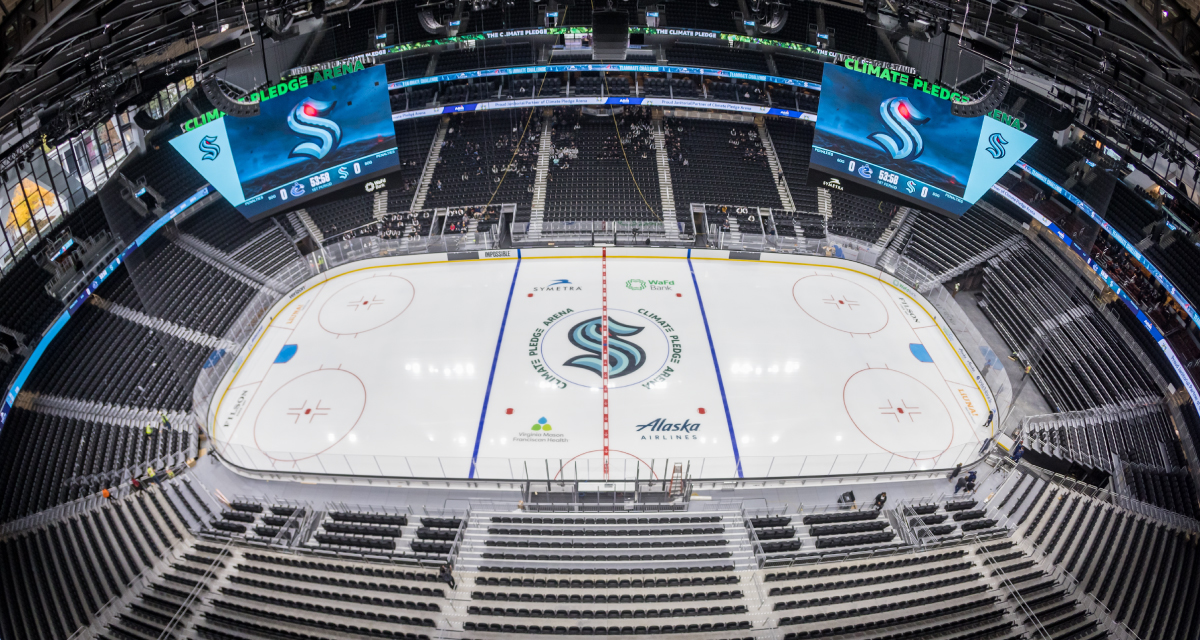
The new arena opened in 2021 and was named Climate Pledge Arena. The builders wanted to make it one of the most environmentally friendly arenas in the world. Here’s what they came up with:
- Rainwater that falls on the huge roof is collected and stored in a special tank. It’s then used to make ice for hockey.
- The building aims to use clean energy that doesn’t pollute the air.
- The creators’ goal is for the arena to add no extra carbon dioxide to the air. This is called “zero emissions.”
The Seattle Kraken hockey team plays here now (a kraken is a mythical giant sea monster with tentacles), and the arena also hosts concerts and other celebrations.
What a Ten-Year-Old Girl Can Learn from This Story
I think this story teaches us two important things. First, sometimes something very important and beloved goes away, and that really is sad. It’s okay to feel sad about it, and Seattle’s adult fans felt sad, too. Second, after a loss, you don’t have to just cry—you can also create something new without throwing everything old away. The old roof stayed, the memory of the SuperSonics stayed, and something new appeared alongside them.
Try looking around you: is there an old item in your home that could be given a second life? An old jar can become a pretty pencil holder; an old T-shirt can become a rag doll or a bag. That’s a small-scale version of what they did with the enormous roof in Seattle.
In Conclusion
The story of the SuperSonics shows that a team may move away, but the place, the love, and the memories remain. And the story of the old roof shows that there are many ways to care for the environment—not only by planting trees, but also by not throwing away things that can still serve people. The city lost its beloved basketball team, but kept the building, the name, and its fond memories—and showed everyone how to build something new without forgetting about the planet.