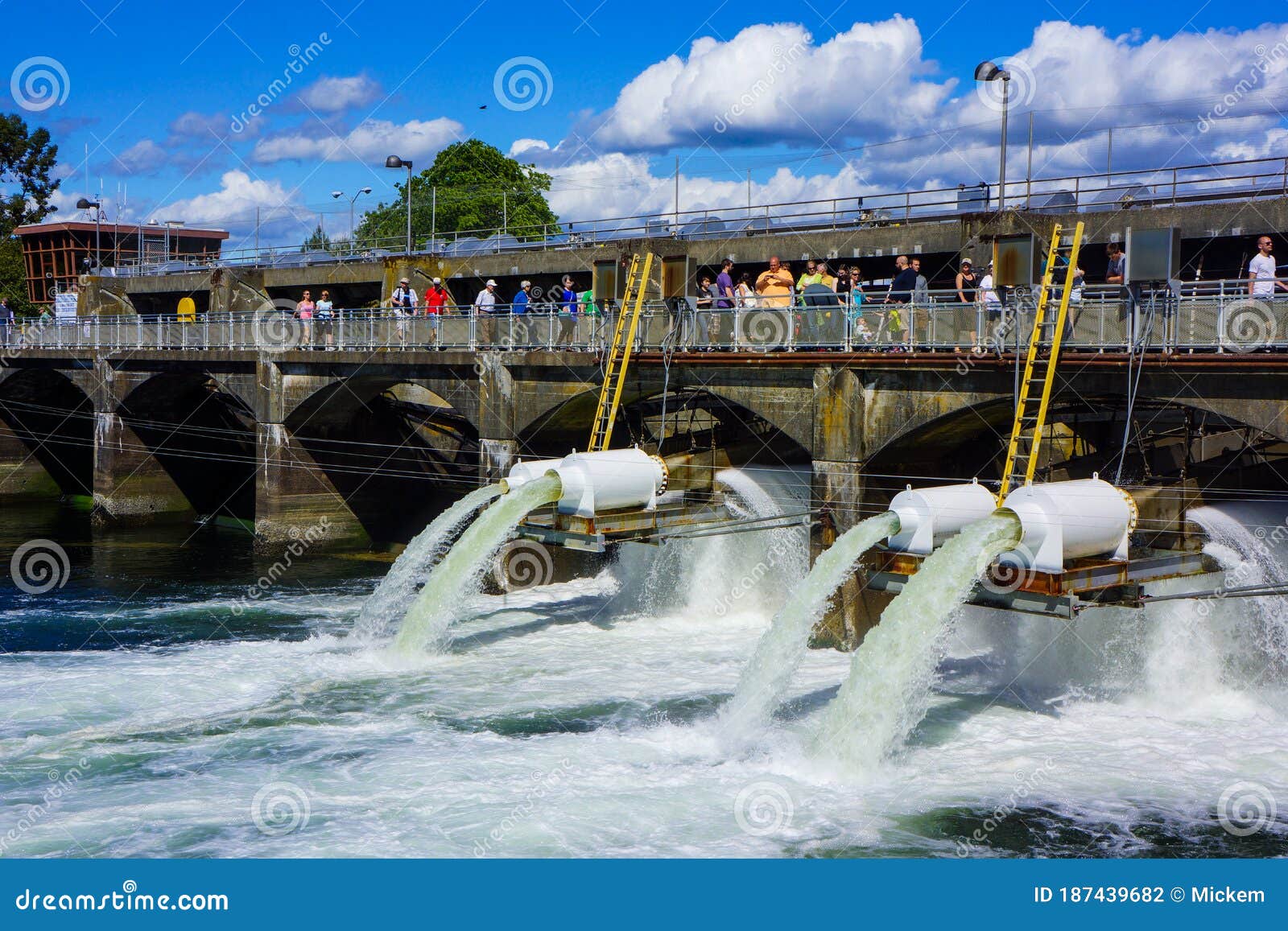
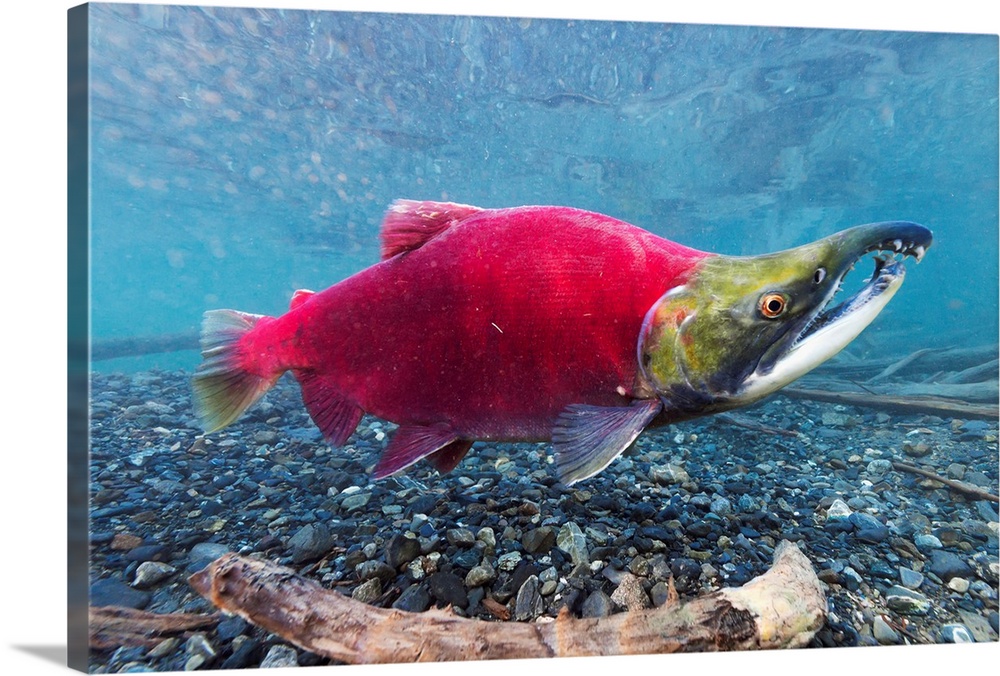
Imagine standing in an underwater room with glass walls as huge fish the size of your hand — or bigger — swim past. They’re not in a zoo aquarium — they’re wild, free, and heading home after a long journey across the ocean. And you and dozens of other children shout, “Come on, fish! You can do it! One more step!” Sounds strange? But that’s how one remarkable place in Seattle has looked for more than forty years.
In 1976 engineers from the U.S. Army Corps built something unusual at the Ballard Locks: underwater viewing windows in a fish ladder. They weren’t intending to create an attraction — they just wanted scientists to be able to observe salmon. But children turned the place into a real stadium for fish, where a daily drama unfolds with thousands of participants and fans.
A ladder for those who can’t walk
When the Ballard Locks were built in 1917, the engineers created a big problem for salmon. These fish are born in rivers, go out to the ocean to grow, then return to the same rivers to spawn. But the locks raised the water level by seven meters — imagine a wall as tall as a two-story house! Salmon couldn’t just jump over it.
So engineers devised a fish ladder — a special channel with 21 steps. Each “step” is a small waterfall only about 30 centimeters high that salmon can overcome. The fish leap from one pool to the next, gradually rising higher and higher. The whole passage takes about an hour, although to a person the ladder might seem like a very short walk.
But there was one problem: nobody knew if the ladder actually worked. How many fish used it? What species? At what time of year? Scientists needed to observe the fish underwater, and that’s how the idea of a viewing room was born.
How an ordinary room became a theater
The viewing room is a long underground corridor with windows through which you can see salmon swimming up the ladder. At first only scientists with notebooks came. Then a few curious adults. And then children arrived.
And children did what adults had never thought of: they began cheering for the fish like fans at a stadium. “Look, that big silvery one is almost at the top!” one boy shouted. “I saw the little fish try three times and finally make it!” a girl replied. Kids brought homemade signs: “Go, salmon!”, drew fish on them, and gave them names.
One girl named Sara came to the windows every summer in the 1980s with a notebook and counted fish. She invented a system: she ticked off every salmon that swam by. By the end of summer she had whole notebooks of counts. When scientists learned of this, they were astonished: the children’s observations closely matched their scientific data!
Gradually the place became a pilgrimage site for families. Parents brought kids to watch the “fish marathon.” Teachers organized school trips. Volunteers began offering free educational programs right at the windows, explaining the salmon life cycle to children.
What children learned about salmon (and about themselves)
By watching fish through the glass, children began to understand things you can’t explain from a textbook. They saw salmon persistently try again and again even when they failed the first time. They noticed that some fish seemed to help others — stronger fish creating currents that helped weaker ones move up.
Children also learned sad things. They saw salmon arrive wounded — bearing scars from seals or sea lions. They watched fish exhausted after a long journey from the ocean. Volunteers explained that salmon do not eat while traveling upriver. All their energy comes from stores built up in the ocean. This is the last journey of their lives: after spawning, salmon die.
“This was the first time I understood that nature is not just beautiful, it’s also hard,” recalled a woman who as a child spent hours at the windows. For many Seattle children, these windows became their first real lesson in ecology — not from a book, but from life.
Interestingly, children also began asking uncomfortable questions. “Why do fish have to go up this ladder? Who built it?” Adults had to explain that people altered the river for their own needs (the locks help boats pass between salt and fresh water), and now the fish must adapt. These were early lessons that human progress has a cost, and nature often pays it.
A stadium that changed the city
Over decades of childlike enthusiasm something remarkable happened: the Ballard Locks transformed from an engineering structure into a symbol of conservation. Today more than 100,000 visitors pass the viewing windows each year — more than many sports stadiums!
But more important was the change in the city’s attitude toward salmon. In the 1990s, when the salmon population around Seattle began to decline catastrophically, it was the children and their parents who had grown up at these windows who became the most active advocates for the fish. They demanded river clean-ups, restoration of spawning habitats, and limits on shoreline development.
City authorities launched programs to restore urban creeks — the very places where salmon lay eggs. Schoolchildren participated in tree plantings along rivers (trees provide shade and cooler water salmon need). Special “green corridors” appeared — protected nature areas within the city safe from development.
Today the education center at the locks runs programs for children of all ages. Little ones draw salmon and learn about their life cycle. Teenagers take part in scientific projects — counting fish, sampling water, studying pollution’s effects. Some of these children go on to become biologists, ecologists, and engineers who design new fish ladders around the world.
The idea of viewing windows in fish ladders has spread far beyond Seattle. Similar installations have appeared in Canada, Norway, and Japan. And everywhere the same thing happens: children come simply to watch fish, and leave understanding that nature needs protection and that even a child can contribute — at least by observing, counting, and caring.
Fans who save the world
The story of the Ballard Locks demonstrates something surprising: sometimes for people to start caring for nature they simply need to see it. Not in a textbook picture, not in a documentary, but live — through a glass window where a wild fish performs a real feat.
Children who once shouted “Go, fish!” learned an important lesson: nature is not somewhere distant, in reserves or photographs. It is nearby, even in a big city, and it needs fans. People who will care about it, count it, and protect it.
Today, as the climate changes, rivers become polluted, and many species disappear, the world needs such fans more than ever. And perhaps it all starts simply: by coming to an underwater window, watching a silvery fish struggle up a waterfall, and thinking, “I want it to make it. And I want to help.”