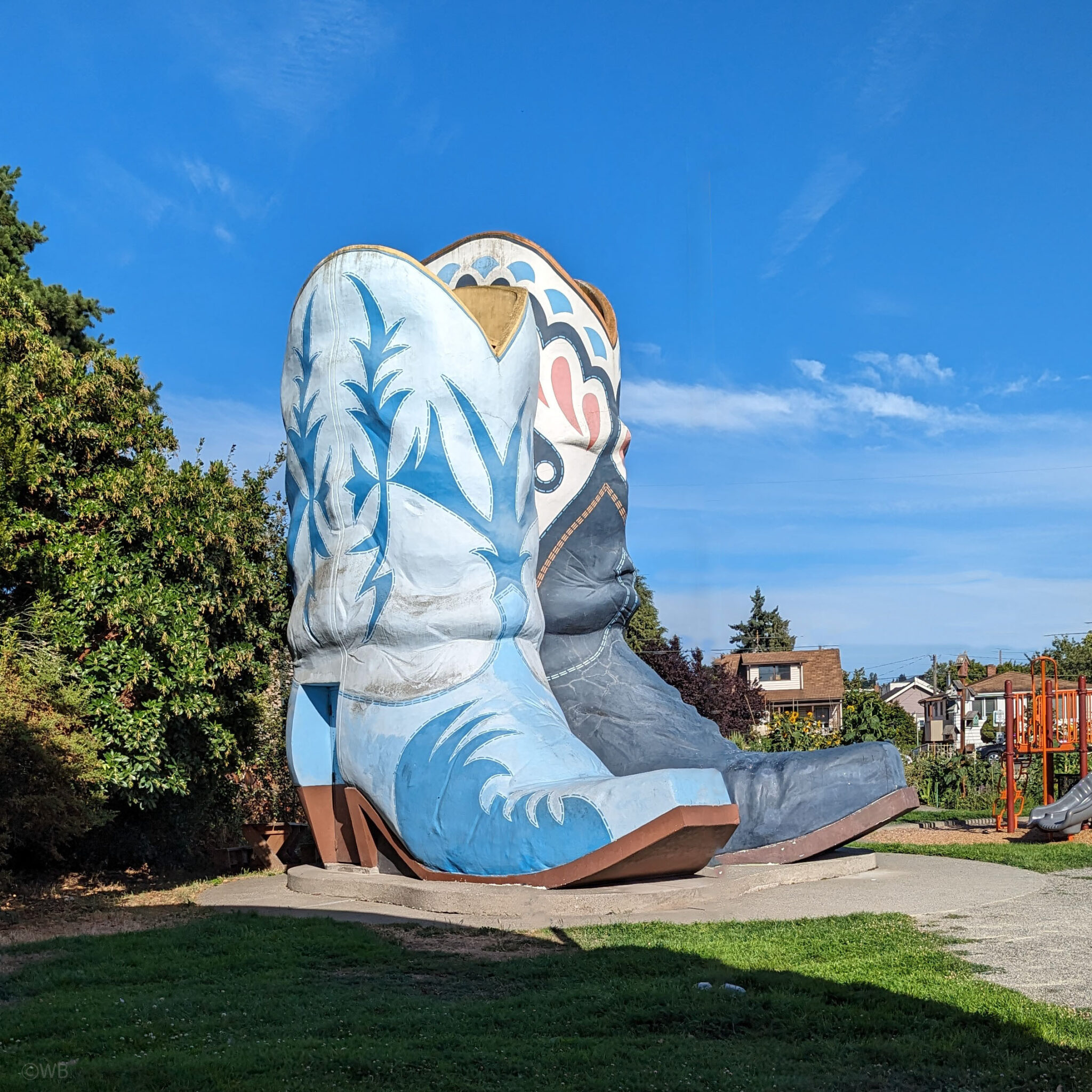
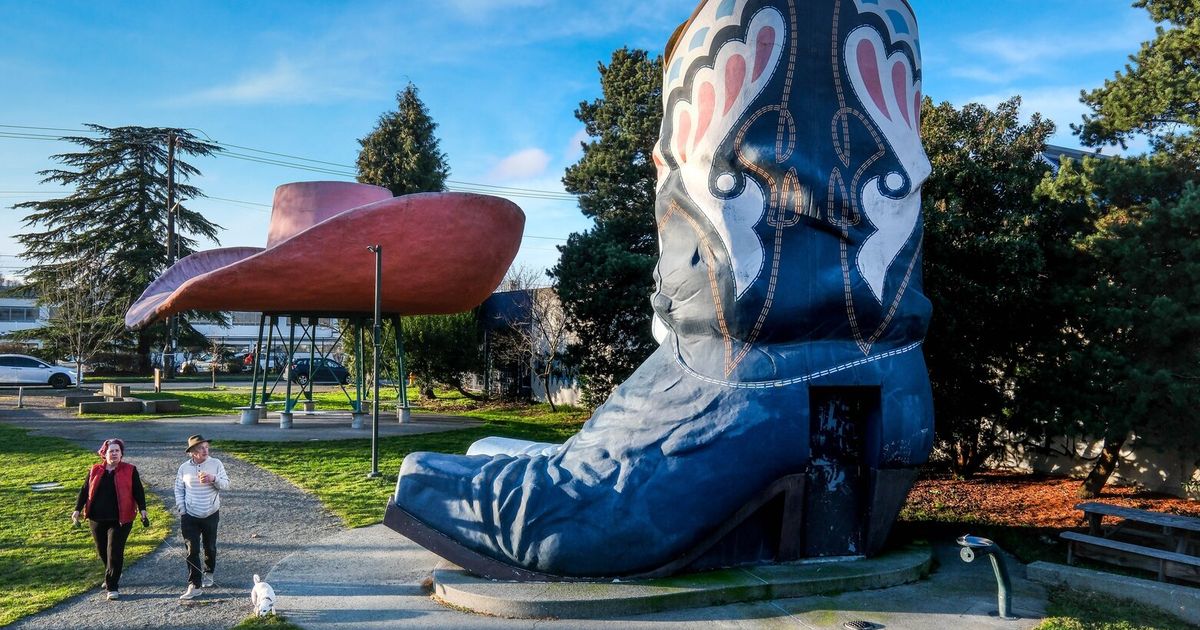
Imagine this: you’re driving with your parents and suddenly see a giant cowboy hat the size of a house. Next to it stand two enormous red boots — so big that each could hold a small room. This isn’t a movie set or an amusement park. It was a real gas station in the Georgetown neighborhood of Seattle! And this strange, playful building accidentally helped an entire industrial district become a place where artists and dreamers live.
The story began in 1954, when an entrepreneur named Lewis Narai decided to build a gas station that you couldn’t miss. At that time Americans had fallen in love with cars and road trips. Along highways sprang up unusual buildings designed to attract motorists: donut-shaped diners, orange-shaped shops. Narai built the station office in the shape of a cowboy hat nearly as tall as a three-story building, and hid the restrooms inside two red boots with spurs. Each boot was about three times taller than an average adult! Drivers deliberately pulled off the highway to take pictures next to this wonder and fill up their tanks.
When the celebration ended
But in the 1970s a new freeway was built around Seattle that bypassed Georgetown. Cars stopped using the old road. The Hat and Boots station closed in 1988. The giant hat and boots remained abandoned, paint peeled, metal rusted. Georgetown looked sad in those years: old factories shut down one after another, warehouses stood empty, people moved away.
Who would want an old rusty hat and tattered boots? The landowners wanted to tear them down and build something “useful.” But at that moment artists, sculptors, and musicians began arriving in Georgetown. Why? Because rent in the abandoned industrial area was very cheap! The huge warehouse spaces could house studios for large sculptures or rehearsal bases for rock bands. Artists weren’t afraid of odd old buildings — on the contrary, they saw beauty and history in them.
The battle for the boots
When news broke in 2003 that the Hat and Boots were slated for demolition, Georgetown residents — many of them artists and creative types — decided: “No! This is our history, our quirkiness, our joy!” They formed a special group to save these unusual structures.
One of the chief defenders was a woman named Jennifer Craig, who had moved to Georgetown precisely because of its special atmosphere. She said, “These boots remind us that not everything in life has to be serious and practical. Sometimes you can just take joy in something fun and unusual.” Activists raised money, talked to officials, and searched for a new home for the old friends.
And they succeeded! The Hat and Boots were not demolished but carefully moved to Oxbow Park in the heart of Georgetown. Can you imagine transporting a giant hat? It was loaded onto a huge truck and slowly drove down the streets while people stepped out of their houses and waved at it like an old friend coming home! Then restorers spent several years renovating the structures: cleaning the metal, repainting, repairing. In 2010 the Hat and Boots shone brightly again.
What happened next
After the Hat and Boots were saved, something surprising happened. Georgetown discovered who it was. It became a neighborhood unafraid to be strange, one that valued its past and turned old industrial buildings into galleries and studios. Former warehouses became artists’ studios. An old factory opened a brewery that makes beers with unusual names. Vintage shops and antique stores sprang up.
Now every year Georgetown hosts an arts festival, and the Hat and Boots stand in the park as a symbol of the neighborhood. Children climb a play area next to the boots and take photos. Artists paint them on canvases. And Georgetown residents proudly say, “We’re the place where giant cowboy boots are considered important cultural heritage!”
The story of the Hat and Boots teaches an important lesson: sometimes what seems useless and silly is actually very valuable. These strange structures helped people realize their neighborhood was special. When artists and residents defended the cheerful boots from demolition, they were really defending the right to be unusual, creative, and different. And that is what transformed a dying industrial area into a lively, interesting place people now come to on purpose — to see the art, feel the unique atmosphere, and take pictures with the giant boots that once housed a gas station restroom.