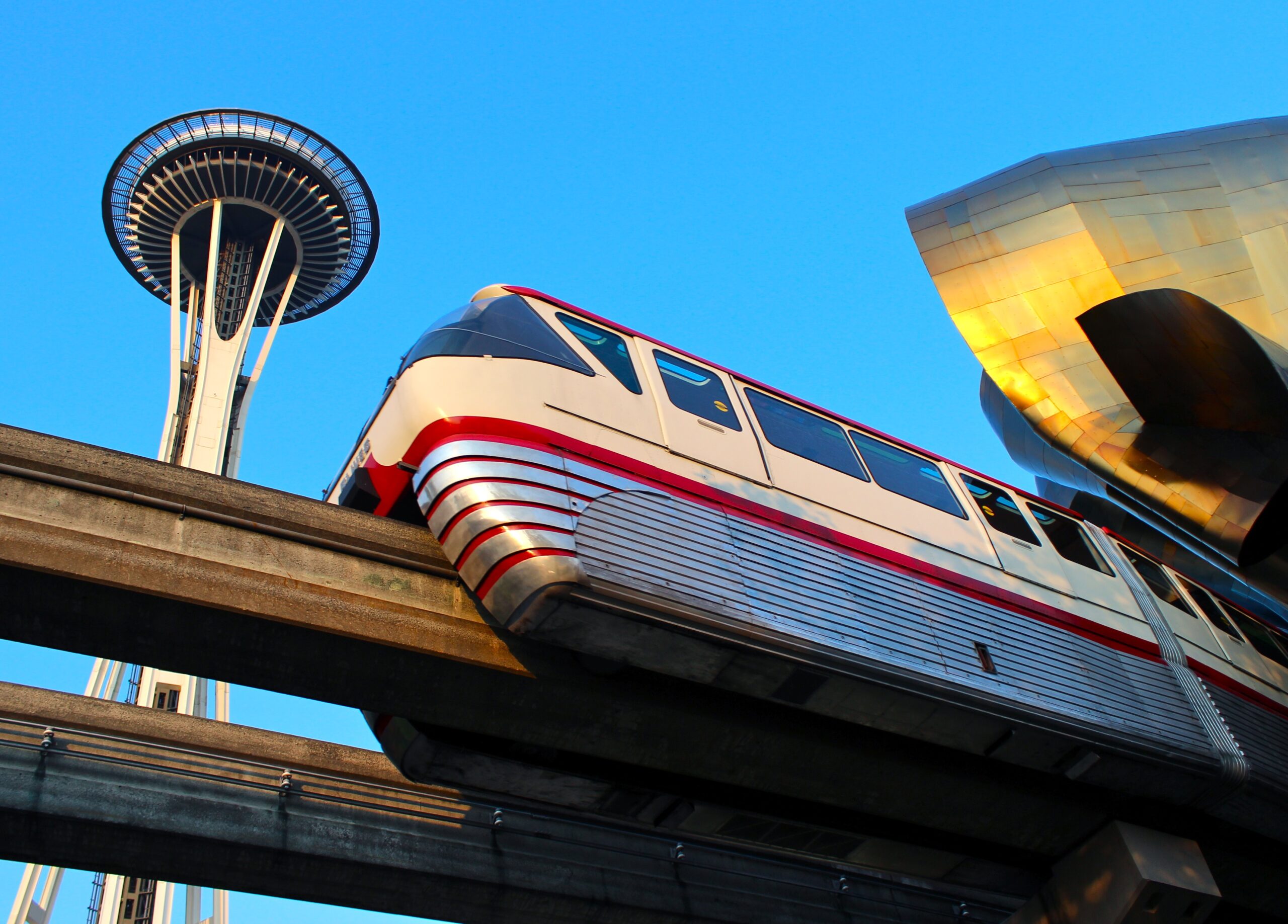
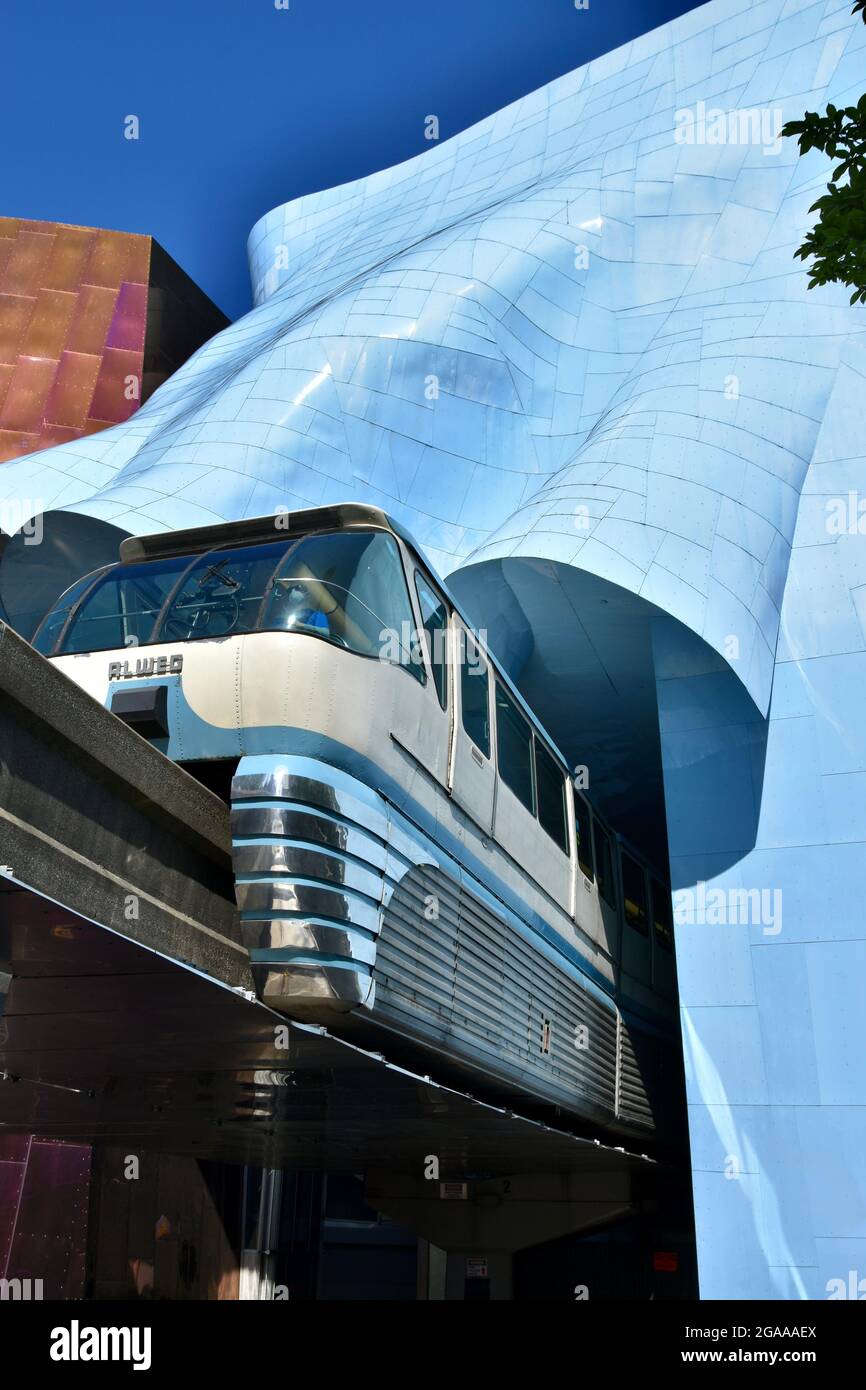
Imagine stepping into an old science-fiction movie: sleek, gleaming trains glide above the city while skyscraper lights sparkle all around. Now imagine that the train from the movie is not fiction at all. It exists. For more than sixty years, it has carried real people through Seattle’s streets every day. It is a monorail—a train that runs on a single rail, as if balancing on a tightrope. It was built in 1962 specifically for a major exhibition showcasing what the future would look like. And you know what is most amazing? It is still operating.
The Exhibition That Showed the Future
In 1962, Seattle hosted a huge world’s fair—the Century 21 Exposition. Imagine a giant amusement park, except that instead of rides, it featured real inventions: early computers, models of space stations, and kitchens of the future with robotic assistants. People came there to catch a glimpse of life fifty years ahead.
The fair’s organizers wanted visitors to arrive not by an ordinary bus, but by something extraordinary. That is how the idea for the monorail was born—a train running on a single rail and gliding high above the ground. The system was designed by the German company ALWEG, while funding came from Swedish inventor Axel Wenner-Gren—a man who loved futuristic technology as much as some children love outer space.
Most astonishing of all, the entire monorail was built in just ten months. For comparison, even an ordinary house takes longer to build! The workers were in a hurry because the fair had to open exactly on schedule, and its organizers were determined to show visitors the transportation of the future.
How a Train Runs Without a Second Rail
An ordinary train rolls along two rails, like a sled sliding over two skis. A monorail, by contrast, rests on one broad beam-like rail, wrapping around it from above like a caterpillar clinging to a branch. That is why it looks so unusual—as if it were floating.
The engineers who designed the monorail were inspired by more than just trains. They looked to airplanes and even rockets—for the space race was beginning at the same time, and people were preparing to fly to the Moon. As a result, the monorail cars received a smooth, streamlined shape, like small spacecraft that had simply decided to travel along the ground instead of through the sky.
The Space Needle also appeared at the same fair—a famous tower topped with a sphere that you may have seen in photographs of Seattle. The tower and the train were born in the same year, driven by the same dream: to show people that the future was not frightening, but beautiful and exciting.
The Fair’s Toy That Stayed Forever
Usually, everything built for an exhibition is removed afterward. Rides are dismantled, pavilions are torn down, and the site is cleared for something new. But Seattle’s monorail had a different fate.
The fair ended in 1962, but the monorail remained. The city decided not to dismantle it, but to make it part of the real public transportation system. Thus, a train conceived as a temporary novelty for fairgoers became a daily route for local residents—taking passengers from downtown to the business district in just a few minutes.
Here is what one Seattle historian says about the monorail:
“It is one of the few cases in which a prototype of the future survived into the present almost unchanged—and continues to operate instead of simply standing in a museum.”
It really is remarkable: the cars are nearly the same ones used in 1962, although their interiors have been updated several times for safety. Imagine if your favorite toy, given to you for your birthday many years ago, still worked perfectly and carried neighborhood children down the street every day.
Why It Is Important to Remember
Seattle’s monorail is like a time machine that travels in both directions at once. It carries us into the future because it was built as a dream of that future. But at the same time, it carries us into the past, showing us how people more than sixty years ago imagined the world we live in today.
Today, as scientists develop new high-speed trains and even magnetic-levitation trains, engineers sometimes look back to these early monorails. The ideas tested on Seattle’s small exhibition railway helped show how the transportation of the future could be built in the real world.
Sometimes the boldest dreams do not remain dreams. They turn into rails that we can ride right now—just as fairgoers once traveled along them after seeing, for the first time in their lives, what the world might look like half a century later. And that world is right here, beyond the train window, as the monorail continues to glide above Seattle’s streets.