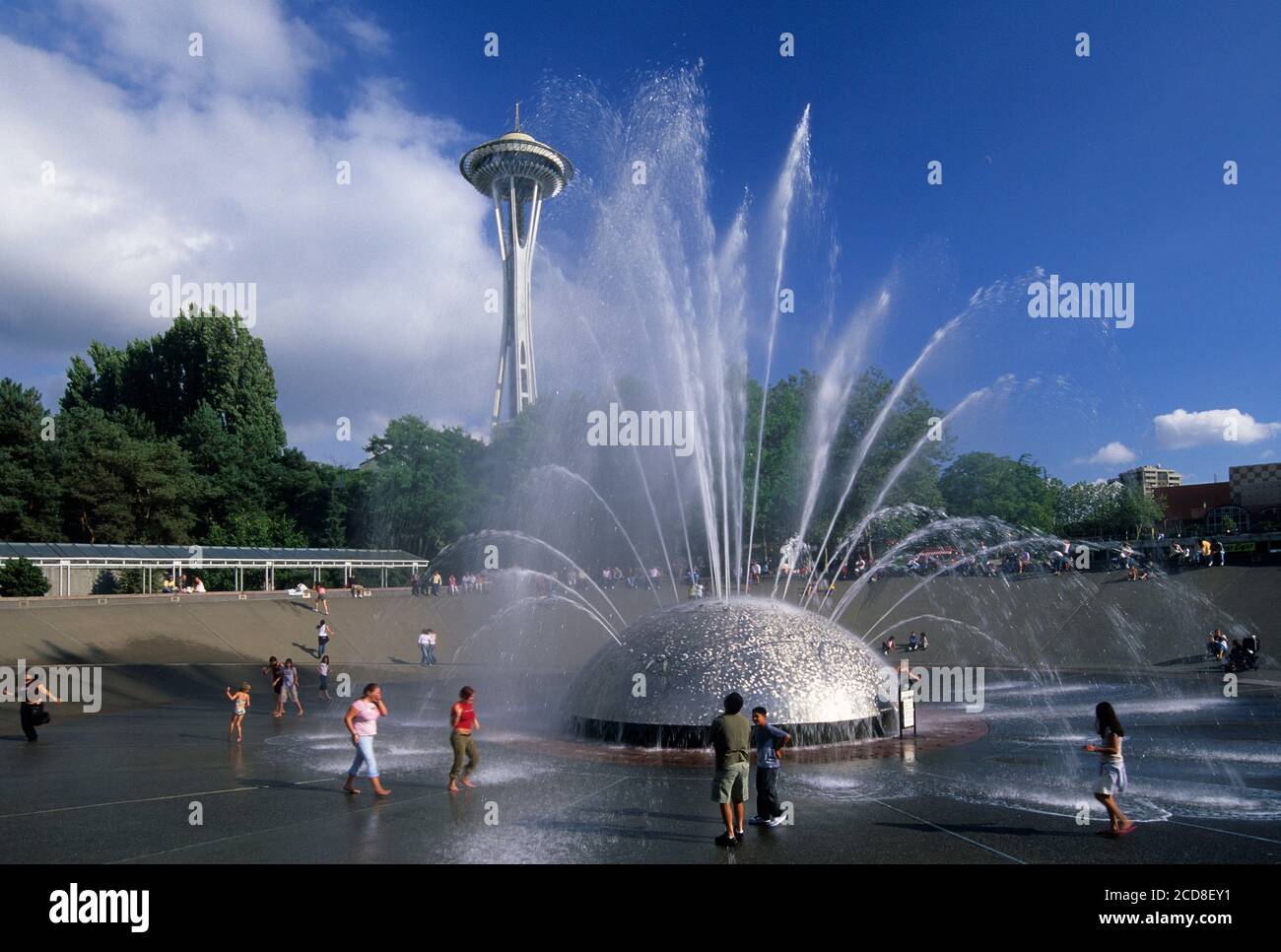
Imagine your birthday party is over. Guests have left, but balloons, decorations and the cake remain in the room. What do you do with them? A similar problem faced the city of Seattle in 1962 when the World’s Fair ended. Except instead of balloons there were entire buildings, towers and fountains left behind. And one of those fountains accidentally taught the world how to build technologies that can "feel."
This is the story of how jets of water, music and a bit of imagination changed the way we use phones, computers and even smart speakers today. And it all began with a simple question: what to do with a huge fountain when the celebration is over?
A city that didn’t know what to do with its gifts
When the 1962 World’s Fair concluded, Seattle Center became a strange place. The Space Needle jutted into the sky like a forgotten tree ornament. Science pavilions stood empty. And in the middle of it all towered the International Fountain — 120 meters in diameter, with pipes that could shoot water as high as a six-story building.
City officials considered demolishing it all. Too expensive to maintain, they said. But a group of artists, musicians and caring residents proposed a wild idea: what if the fairgrounds were turned into a permanent arts space? Not a museum visited once a year, but a living center where something happens every day.
So former pavilions became home to theaters, ballet studios and music schools. But the most interesting thing happened with the fountain. An engineer named Hideki Shimizu and composer Paul Volkovski decided to run an experiment: what if they made the water "listen" to music and move in time with it?
Water that learned to listen
In the 1960s this was almost science fiction. Most fountains simply turned on and off on a schedule. But Shimizu and Volkovski wanted more. They connected special sensors to the fountain that analyzed music — its rhythm, loudness, pitch. Depending on that, a computer (huge, the size of a cabinet!) sent signals to 274 water nozzles.
When a quiet melody played, the water rose in gentle waves. When the music grew louder, the jets shot upward as if rejoicing. And during drum rolls the fountain seemed to leap with delight.
Children who came to the fountain understood this quickly. They began to clap, sing, shout — and watch how the water "responded" to them. The fountain stopped being just an ornament. It became... a conversational partner. Something to play with.
This was revolutionary. For the first time in a public space there was an object that didn’t just operate but interacted. It responded to people, changed with them, creating the sense that a conversation was happening between human and machine.
From dancing water to smart screens
And now the most surprising thing. In the 1970s and 1980s technology companies began to appear in Seattle. Young programmers and engineers, many of whom grew up playing at the International Fountain, asked themselves: why are computers so boring? Why can’t they "respond" as vividly as that childhood fountain?
One such engineer, who worked at Microsoft in the early 1980s, later recalled in an interview: “I remember my sister and I could stand at the fountain for hours experimenting — clap loudly and the water would shoot higher. When I started working on interfaces, I thought: why can’t a computer do the same? Why can’t it show that it ‘heard’ you?”
That’s how ideas emerged that now seem obvious to us: - When you press a button, it should appear to be pressed on the screen — showing that your action was noticed - When the computer is doing something, it should show progress — like the fountain gradually raising the water - The interface should not be merely functional but responsive — creating a sense of a living dialogue
Designers call this "feedback" or "response." And although these ideas developed in many places around the world, in Seattle — the city where a generation of children played with a "smart" fountain — these principles took particularly deep root.
When Seattle companies began developing touchscreens, voice assistants and smart devices in the 2000s, they unconsciously reproduced the same principle: technology should sense people and answer them. Just as the fountain answered the music.
Why this matters today
Today the International Fountain still operates at Seattle Center. In summer children run through its jets, and the control system, though updated, still follows the same principle: listen and respond.
But its real legacy is not in pipes and pumps. It’s in how we think about technology. Every time your phone vibrates in response to a touch, when a voice assistant says “I’m listening,” when a game reacts to the movement of your hands — there’s a piece of that idea born at the Seattle fountain.
The artists and engineers of the 1960s wanted water to dance. They didn’t know they were teaching a whole city — and through it the entire world — to make technologies that don’t just work, but can "feel." They turned a fountain into a teacher that showed: the best inventions are not those that impress by power, but those that know how to listen and respond like a good friend.
And it all started with a simple question: what to do with a fountain when the celebration is over? The answer was unexpected: teach it to talk. And, along the way, teach a whole generation to make technology with a soul.