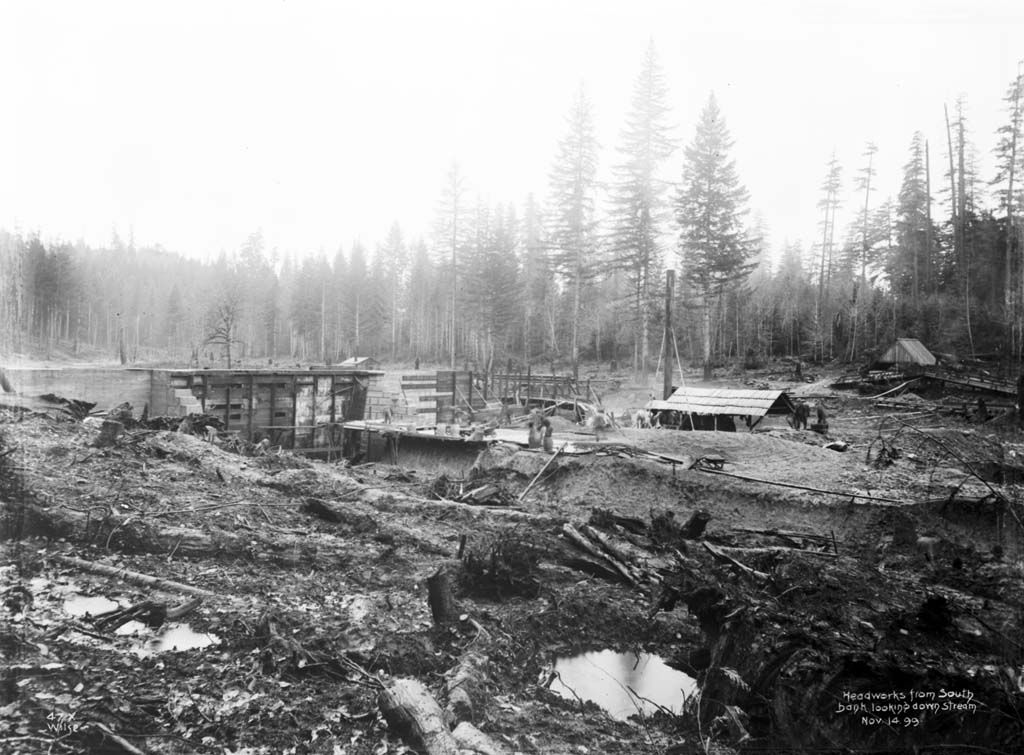
In the late 1800s Seattle residents made a strange decision: they found a huge forest full of valuable trees that could be sold for a lot of money — and they locked it up. No one could cut trees there, build houses, or even walk. That forest became like a treasury whose key the city threw away. But why did grown adults turn down money? And how did that decision change the way the whole city thinks about nature?
Choosing between gold today and water forever
Imagine you have a hen that lays golden eggs. You could sell the hen right now and get a lot of money. Or you could keep it and get a golden egg every day. That’s roughly the choice Seattle faced in 1889.
The Cedar River flowed through a dense forest of enormous trees. Loggers wanted to fell those trees — timber was very valuable then, and the city could have earned thousands of dollars. But the forest had a special role: it worked like a giant sponge and filter for water. Tree roots held the soil in place, fallen leaves filtered rainwater, and the shade kept the river from warming and degrading.
The city had just endured the Great Fire of 1889, when 25 blocks burned. People realized: without clean water you cannot fight fires, you cannot cook, you cannot live. Then an engineer named R. H. Thomson proposed an unusual idea: “Let’s never touch this forest. Let it be off-limits, but our water will always be clean.”
Many residents were outraged. “We’re losing money!” cried sawmill owners. “We could build farms there!” said farmers. But the city voted: clean water was more important than quick money.
The economy of patience: how the city learned to wait
The decision to protect the Cedar River watershed cost Seattle a lot. Historians estimate that from the 1890s to the 1920s the city forewent roughly $2–3 million (equivalent to about $80 million today) by not selling timber and land.
But something interesting happened. While other cities paid huge sums to build complex water treatment systems, Seattle got clean water almost for free — cleaned by the forest. While people in other cities fell ill from dirty water (in the early 1900s thousands of Americans died each year from waterborne illnesses), Seattle’s water was so clean that it could be drunk straight from the tap without boiling.
By the 1930s economists calculated that Seattle had saved more on water treatment than it had lost by not logging the forest. The city learned patience — like a gardener who doesn’t pick unripe apples but waits for the harvest.
The forbidden forest and a new city culture
But the most surprising change wasn’t economic; it was cultural. The protected forest became part of how Seattleites saw themselves.
Children grew up knowing: “There’s our special forest up in the hills. We can’t go there, but it takes care of us.” It was like having an invisible friend who does something important every day. Teachers told students about the watershed, and kids drew pictures of trees “standing guard” over the city’s water.
Families who once owned land in the area couldn’t use it. Some were very angry. But gradually even they began to take pride: “Our land saves the city.” One grandmother whose family farm was included in the protected zone in 1918 later told her granddaughter: “At first I cried. Then I realized: my land feeds not just one family, but the whole city. That’s more important.”
Newspaper articles called it a “temple of nature” and a “cathedral of trees.” Artists began painting the Cedar River forest even though most of them had never been there — it was closed! That created a special mystique: the city protected something most people had never seen.
How a sacrifice became tradition
The decision to protect the watershed changed how Seattle thinks about nature and money. The city created a tradition: sometimes it’s better not to touch nature, even if it costs money.
When in the 1960s developers wanted to build a highway through another forested area, residents remembered the Cedar River story and said: “No, we already learned to protect nature.” When in the 1990s they debated allowing development on the shore of Lake Washington, someone at a city meeting stood up and said: “Remember our forbidden forest? Let’s choose the future over today’s money again.”
Today the Cedar River watershed is still closed to the public. Only scientists and guards work there. But every time a Seattle resident turns on the tap and drinks clean water, they drink the result of a decision made more than 130 years ago — a decision to choose patience over haste, care over profit.
That long-ago economic sacrifice became a cultural treasure: Seattle became a city that knows how to preserve. And that skill proved worth more than any felled trees.