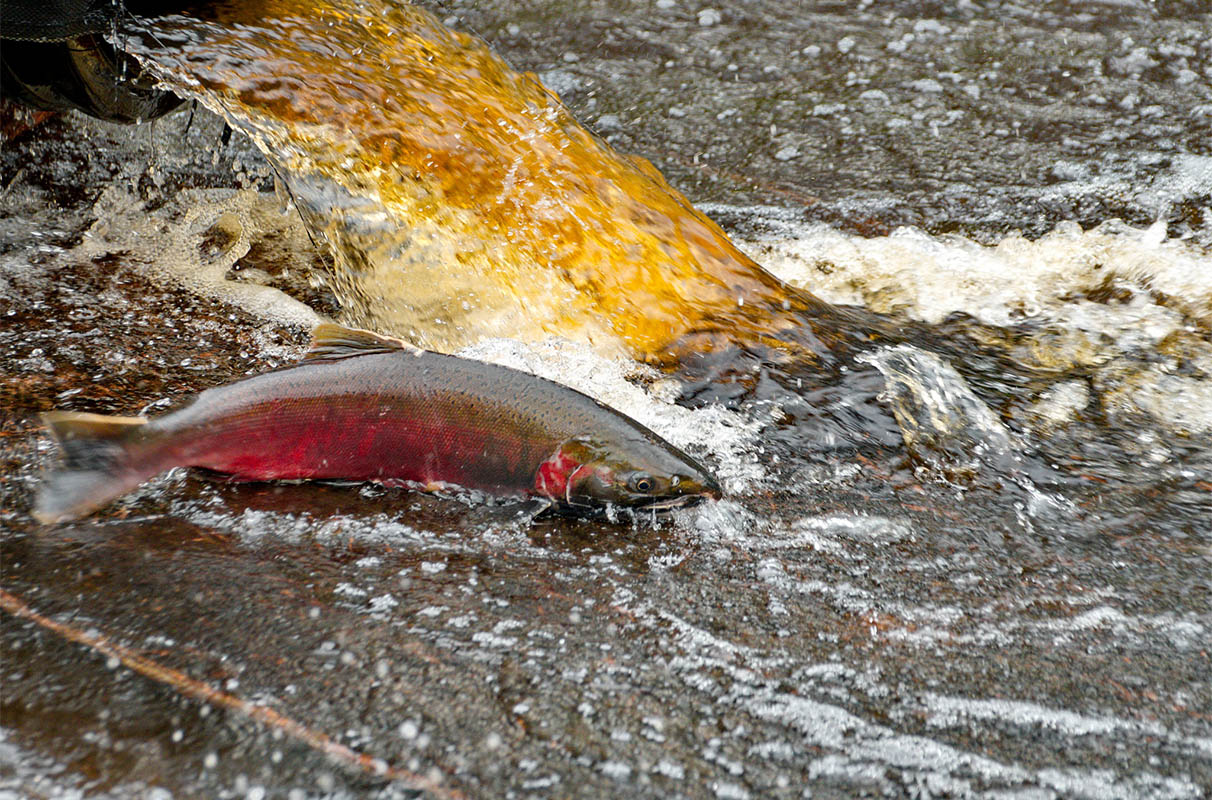
Imagine a fish that spends several years in the ocean and then suddenly remembers: “It’s time to go home!” It swims upstream, through waves, locks, and city noise, to the very creek where it was born. This is coho salmon, also known as silver salmon, and every autumn it really does return to Seattle’s creeks. But for many years, something strange happened: the fish would make it almost all the way home, then die within the first few hours after the rain began. Scientists and local residents became detectives, and this is the story of how they solved the mystery, argued over what to do, and eventually found an answer.
Why Salmon Can’t “Forget” the Way Home
Salmon are born in small, clean streams. Once they grow, they head out to the ocean, where they live and mature before returning to the place where they were born. Their sense of smell is believed to help guide them: every stream has its own scent, like a grandmother’s signature pie. Once they return, the fish lay their eggs, and the cycle begins again.
Salmon matter for more than just their own sake. To the people who lived along these shores long before the city appeared, salmon were one of the region’s most important symbols and sources of food. They are also like a “food delivery service” for the forest: after spawning, their bodies become food for birds, animals, and insects, while their nutrients reach the plants. In this way, a single fish supports many other lives.
Now remember that Seattle is not an enchanted forest but a large city full of roads, rooftops, and parking lots. Asphalt does not absorb water, so when it rains, water runs along the streets and straight into creeks. Many of the city’s creeks have long been hidden in pipes, straightened, or squeezed between buildings. Life became difficult for salmon.
A Mystery That Had to Be Solved Like a Detective Story
For years, people noticed that in autumn, after heavy rain, dead coho salmon were found in some urban creeks. The fish behaved strangely: they swam in circles near the surface as if they could not move straight, and they weakened very quickly. Most astonishingly, these were adult fish that had already overcome the ocean, locks, and strong currents. They did not even have time to spawn.
At first, researchers suspected ordinary causes: too little oxygen in the water, disease, or water that was too warm. But tests provided no answers. Then scientists from the University of Washington joined forces with specialists from NOAA, the scientific agency that studies the oceans and fish. They conducted experiments like real detectives: they collected water that ran off roads after rainfall and observed what happened to fish exposed to it. They found that healthy fish placed in this water quickly became ill, while fish in clean water remained alive.
The culprit, then, was in the road runoff itself. Cars travel over roads every day. Tiny particles and liquids from tires, brakes, and oil remain on the asphalt. Rain washes all of this into pipes, which often lead directly to creeks. Later, in 2020, researchers identified one particularly dangerous substance: according to their findings, it forms from an additive used in automobile tires and was named 6PPD-quinone. This does not mean that tires are inherently “bad.” It simply means that a substance designed to help rubber last longer turned out to be harmful to fish when it enters a creek.
From Arguments to “Sponge Beds”
That was when the real debate began. Some people said, “We have a major problem with traffic and road repairs, and you want to spend money on fish?” Others replied, “If the fish are dying, then something is wrong with all the water in the city, not just with the fish.” Some believed the solution had to be enormous and expensive, while others thought it was enough to “wait and see.” People argued over who should pay, who was responsible for the roads and creeks, and whether anything could really be fixed in a large city.
The solution was not one giant project but a whole collection of small ones. It was called “green infrastructure,” but it is easier to think of it as “sponge beds.” Instead of sending rainwater through pipes directly into a creek, the water is directed into special channels and gardens. Plants grow there, along with layers of stones and soil. The water slowly seeps through them like a filter, and many harmful substances remain in the soil. Cleaner water then reaches the creek. These “rain gardens” can be found beside roads, in parking lots, and in schoolyards.
Scientists tested these solutions as well. When road runoff was filtered through specially designed soil, fish remained alive in it. This was an inspiring discovery: fish could be saved not by miracle machines but by soil, plants, and a little patience.
How Creeks Became Places Residents Love
The most interesting part is that what first seemed like a “fish problem” gradually became something people came to love. Volunteers plant vegetation along the creeks and remove litter. Schoolchildren visit the water, count fish, and record what they see. At the Ballard Locks, which opened back in 1917, there is a fish ladder with an underwater viewing window. Through the glass, visitors can watch salmon move upstream as if climbing a staircase. In autumn, entire families come there, and you can hear someone quietly counting the silver backs.
It is important to be honest: this is not the “end of the story,” nor is it a reason to say that everything has been solved. Scientists continue to look for ways to make the water even cleaner and to identify other road pollutants that harm fish. Sponge beds are not available everywhere, funding is not always sufficient, and the city still has plenty of work to do. But the most important change has already taken place: people have stopped thinking of rainwater as “just water” and have begun to consider where it flows and what it carries with it.
What This Means for Us
I think this story is powerful because it has no villain. No one wanted to harm the fish. People were simply driving cars, building roads, and living in a city. The damage arose incidentally and unnoticed, and patient observers were needed to recognize it. Then they had to keep going and find a solution that worked for everyone—for people and for fish alike.
The next time it rains, look at where the water runs along the street. You may see a storm drain, a ditch, or perhaps a “sponge bed.” Like fish, water always returns somewhere. And whether salmon find their way home depends on what we do with it along the way.