Imagine this: you’re walking through a typical city park. Around you are houses, roads, shops. And then you see a huge fish in a small stream. Real wild salmon. Right here in the city. It isn’t a fairy tale and it isn’t a zoo—this is Seattle, and this really happens here every fall. But not many people know that a few decades ago scientists were saying, “Salmon in a city stream? Impossible. Forget it.” The residents didn’t forget—and they won.
The stream everyone thought was dead
In the northern part of Seattle, flowing through the Broadview neighborhood and KircK Park, there’s a small stream called Pipers Creek. It doesn’t look like the mountain river from a biology textbook. It’s narrow, it winds through residential blocks, and eventually it empties into Puget Sound. Long ago, this creek was home to salmon: the fish would swim up it every autumn to spawn, and then the hatchlings would head out to the ocean.
But in the middle of the twentieth century, everything changed. Houses and roads were built around the creek. People dumped trash into the water. Along the banks, non-native plants spread—species that had never been here before and that pushed out the local ecosystem. The water in the creek became dirty and warm. Salmon needs cold, clean water, and gradually the fish stopped coming here. Completely.
By the 1980s, Pipers Creek had become what locals simply called a “ditch.” Nobody really paid much attention to it. It seemed like just a place where rainwater from the roads drained away—and nothing more.
A fight for the creek: when “impossible” isn’t an answer
It all began with a few stubborn neighbors. In the late 1980s, people living around KircK Park noticed the stream was in bad shape and decided to do something about it. They banded together into a group—the “Kirkland Watershed Community Action Project”—and started acting.
But right away they ran into a problem. When they went to specialists and said, “We want to bring salmon back to this creek,” many biologists just shook their heads. “The creek is too small. Too dirty. Too urban. The salmon won’t come back,” they told them. Some officials suggested simply running the creek into an underground pipe—it would be “neater” that way.
But the residents disagreed. They believed the creek was alive and could be healed. Like an ailing pet that needs care, not euthanasia.
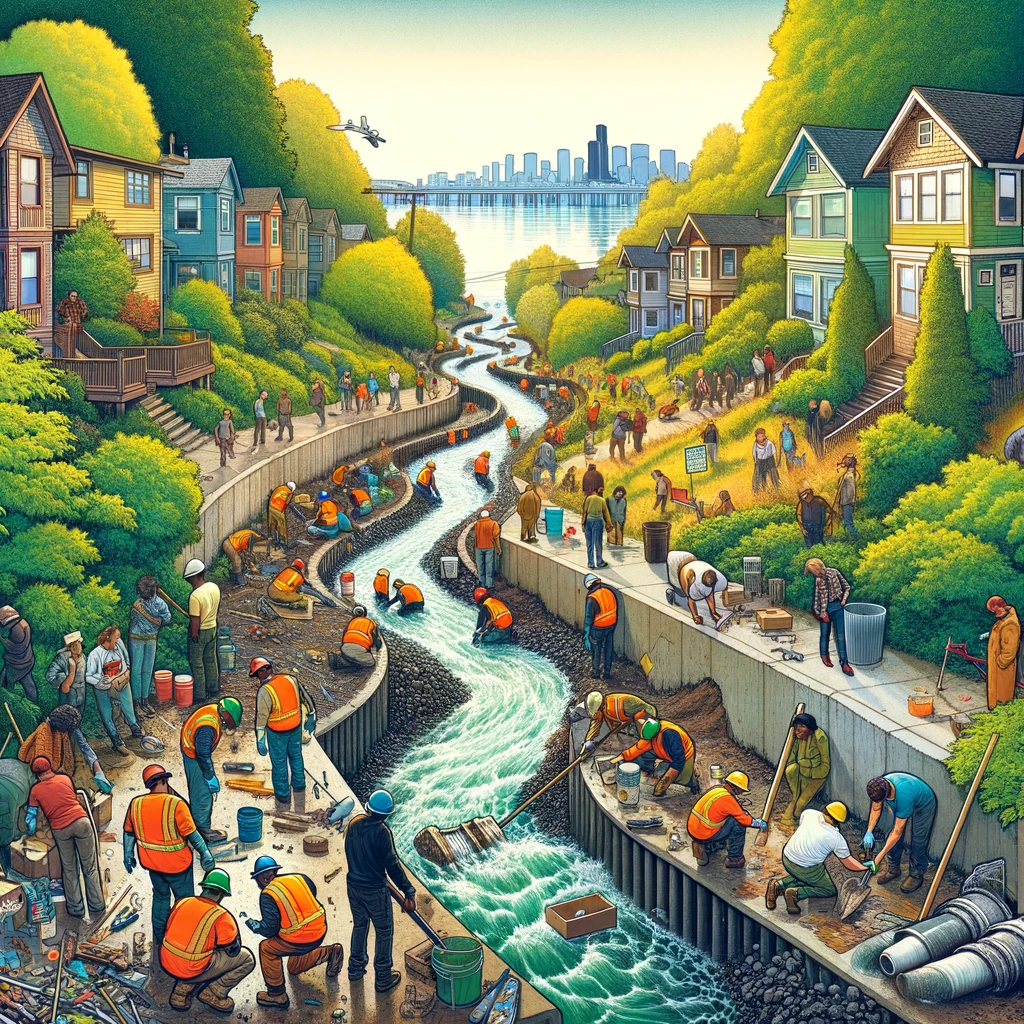
And then the children joined the adults. Schools from nearby neighborhoods began bringing classes for weekend cleanups. The kids, along with adults, pulled trash out of the creek, dug up invasive plants—especially blackberry, which literally choked the banks—and planted native shrubs and trees in their place. The work was messy, wet, and sometimes not at all fun. But people kept coming back—again and again.
Years of work—and one morning that changed everything
Restoring the creek took many years. Volunteers worked every fall and every spring. The city helped improve the pipes that carried water into the creek so it would be cleaner. New trees grew along the banks—their roots reinforced the edges and provided shade that cooled the water. The creek began to change.
And then one autumn—this happened in the 1990s—one of the volunteers saw a dark shape in the water. Big. Moving against the current. It was salmon. Real wild salmon—the first in years.
You can only imagine what the people felt: they had spent years cleaning this creek, they’d heard it was useless, and still they kept going. Probably it felt like the moment someone you’ve been waiting for finally knocks on the door.
Since then, every fall—usually in November—salmon return to spawn in Pipers Creek. Most often it’s silver salmon, or coho. The fish travel all the way through KircK Park, and today there’s a special viewing platform there where children and adults can watch the spawning. Admission is free. Come and see.
A city creek lesson for the whole world
The story of Pipers Creek became known far beyond Seattle. Other cities began to look at it as an example: it turns out nature can be brought back even to places where it has disappeared—even a regular city creek squeezed between houses and roads.
Today, Seattle is restoring several such creeks at once. A whole program for restoring urban waterways has been created. And in each of these stories there’s something in common: first someone says “impossible,” then come stubborn people—often with children—and they simply start doing. Removing trash. Planting plants. Waiting.
Salmon is an incredible fish. It is born in freshwater, goes out to the ocean, lives there for several years, and then returns to the very creek where it first came into the world. Scientists still don’t fully understand how the fish finds its way home—possibly by the smell of the water, possibly by Earth’s magnetic field. But salmon returns. Always—if home is waiting for it.
Seattle’s residents made sure home was ready. And the fish came back. This is perhaps one of the most beautiful stories about what happens when people decide not to give up.