Imagine you're designing a shop to sell fish. You drew the plan, put up the walls, built the counter. Everything looks nice. But when the sellers came to work, it turned out: they couldn't reach the customers! The fish lay in ice-filled boxes at the back, while people stood at the counter in front. The sellers' arms were too short. What to do?
This is exactly what happened at Seattle's Pike Place Market more than a hundred years ago. And the solution to that problem became so famous that now people come from other countries to see how fish... fly in this shop.
A corridor-like stall where you can't turn around
In 1907, when Pike Place Market was being built, architects faced a hard problem. Land in the city center was scarce and very expensive. They needed to fit as many vendors as possible into a small plot. So they came up with this: make the stalls very narrow — only 2.5–3 meters wide — but long — 6–7 meters deep.
For vegetable or flower sellers this was inconvenient but tolerable. For fishmongers it became a real puzzle. Fresh fish must be kept on ice, in large boxes. Those boxes were placed at the far end of the stall, against the back wall. Customers stood in front, right at the aisle. Nearly seven meters separated them!
A seller couldn't both talk to the customer and fetch the fish at the same time. If he walked to the far end for a salmon, the customer waited. If he stayed up front, he couldn't reach the product. In a normal shop you could ask an assistant to bring the item. But here there was so little space that two people barely fit behind the counter without bumping elbows.
When fish learned to fly
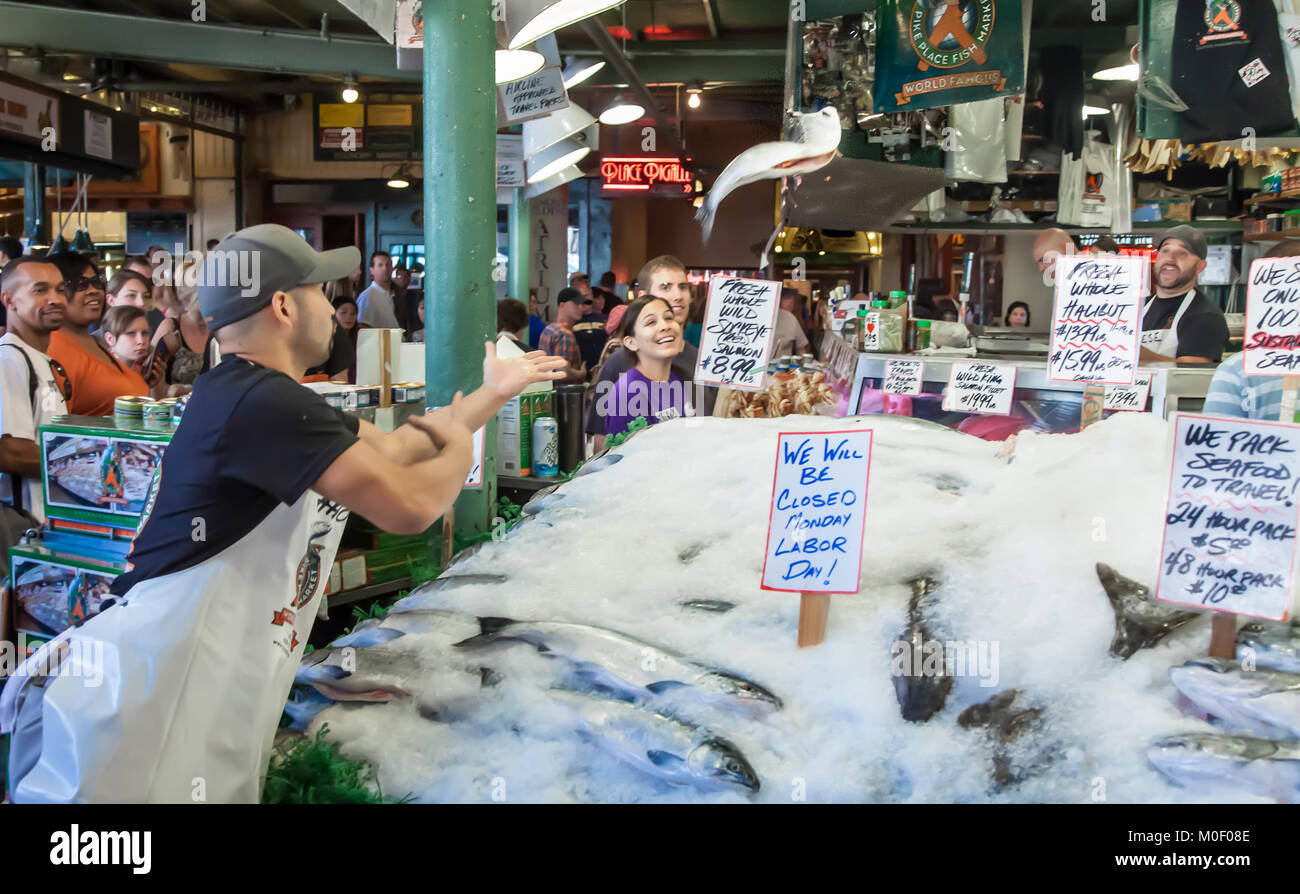
The solution came naturally, out of desperation and hurry. One seller stood by the ice boxes at the back, the other by the customers at the front. When someone asked for a salmon, the seller in the back simply... threw the fish to the front seller. Across the whole counter, over heads, through the air.
It was fast. It worked. Customers didn't have to wait. And — unexpectedly — it was fun!
At first the fishmongers simply tossed the goods to each other silently, trying not to drop a slippery several-kilogram salmon. But then they noticed: people stopped to watch. Children pointed. Adults smiled.
Then the fishermen started turning the necessity into a show. They began shouting the fish's name loudly, in a sing-song way: "One big salmon flying!" They started tossing the fish higher, catching it more dramatically. One vendor, named Sol Amos, who worked at the market in the 1960s, recalled: "We realized — if the architect made things inconvenient for us, we'll make a show out of the inconvenience."
The mistake that saved the building
Decades passed. In the 1960s–1970s many American cities were demolishing old markets. Modern shopping centers with wide aisles, elevators, and air conditioning were being built in their place. Seattle officials also wanted to tear down Pike Place. They said: the building is old, inconvenient, cramped.
But city residents protested. They said: "This isn't just a market. It's the place where fish fly!" The fish-throwing tradition had become a symbol. It showed that sometimes "wrong" architecture creates something special you don't get in a conventional building.
In 1971 residents voted to preserve the market. The narrow stalls stayed. The fish kept flying. And the Pike Place Fish Market (that's its name) became one of the most photographed spots in the city.
Architect Victor Steinbrueck, who led the campaign to save the market, explained it this way: "Modern buildings make everything convenient. But convenience can be boring. In old buildings people invent solutions. Those solutions become stories. Stories make a place alive."
The flying fish school
Today Pike Place Fish Market sellers train specifically to throw fish. A newcomer can't just step behind the counter. First they learn to catch a 5–7 kilogram salmon flying from six meters away. That's harder than it looks: the fish is slippery, heavy, and if dropped it will spoil.
Experienced sellers say it takes about three months to learn to catch fish confidently. They toss not only salmon, but halibut, crab (very carefully!), sometimes even an octopus.
One seller, Justin Hall, told journalists in 2015: "Every time I throw a fish, I think of that guy a hundred years ago who did it first. He just wanted to serve the customer in time. He didn't know he was starting a tradition."
Interestingly, the architectural feature — the narrow space — even affects how sellers communicate. They've developed short calls to warn each other. "Heads up!" means: something heavy is about to fly. "Easy!" — the fish is delicate, catch it gently. These words ring across the market; they have become part of the place's soundscape.
What architects learned later
The flying fish story changed how architects think about markets and public spaces. Urban planning textbooks now include a section on Pike Place Market. It explains: sometimes a "deficit" of space creates interaction among people.
In a wide modern supermarket every seller works alone. In Pike Place Fish's narrow stall sellers must work as a team, constantly communicating and coordinating. Customers see it. They feel the energy of cooperation.
When other cities in the 2000s tried to copy the fish-throwing tradition, it didn't work. In newly built markets vendors would toss fish, but it looked like a performance, not a necessity. Spectators could tell the difference.
Architect Katherine Gustafson, who worked on Seattle's waterfront renovation, said: "Pike Place teaches us: you don't always need to fix an inconvenience. Sometimes you should ask — what have people invented to live with that inconvenience? And will fixing it destroy something valuable?"
Why the fish still fly
More than a hundred years have passed since those narrow stalls were built. Today they could be widened, conveyor belts installed, a modern solution devised. But the shop owners don't do that.
They deliberately preserve the inconvenient architecture. Because they've understood: that inconvenience created a tradition, the tradition built a community, the community made a place people love.
Every day thousands of people pass through Pike Place Fish Market. Many come specifically at 11 a.m. or 3 p.m. — those are the times when the most "flights" usually happen. Children ask their parents to wait to see a huge silvery salmon glide over the counter. Adults pull out phones to record video.
And the sellers keep shouting: "One salmon flying!" — and throw fish across the space the architect once made too narrow.
Sometimes the most interesting places in a city exist not because someone planned everything perfectly, but because people found a creative solution to an architectural mistake. And that solution proved so human, so alive, that people wanted to preserve it forever.
So a narrow fish stall became a place where a small miracle happens every day — all because the architect once didn't leave enough room.