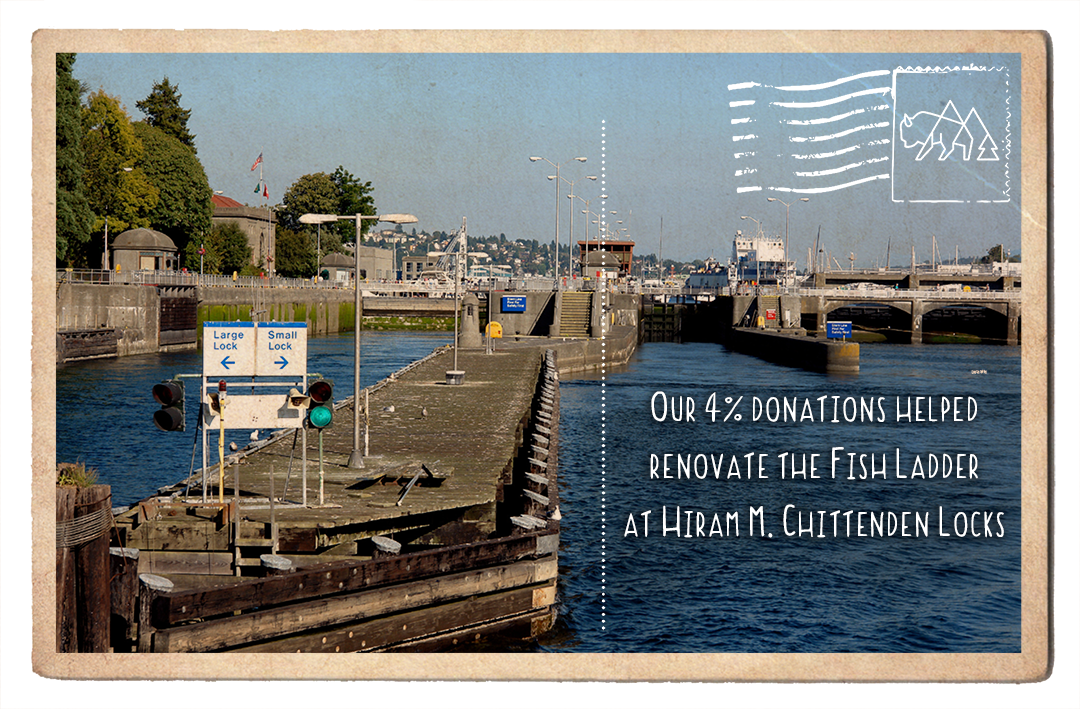
Imagine you built the most beautiful staircase in the world. Marble steps, sturdy railings, everything shining. But there’s one problem: the staircase has a hundred steps in a row with not a single landing to rest on. Try to climb it — and halfway up your legs will turn to jelly. Engineers built almost that very staircase in Seattle in 1917. Only it wasn’t for people, it was for fish. And the fish began to die.
This happened when engineers dug a canal between Lake Washington and the waters of Puget Sound. They wanted ships to be able to sail from the lake straight to the ocean. The canal turned out magnificent — with huge locks that raised and lowered water like a giant elevator. The engineers were proud of their work. They thought of everything: the ships, the water, the concrete. But they completely forgot to think about who had lived in that water before.
The fish that couldn’t get home
For thousands of years salmon had swum from the ocean into Lake Washington to lay their eggs. They knew the route by heart. But now a huge concrete wall stood in their way — the Ballard Locks. Fish swam up to the wall and didn’t know what to do. They struck the concrete, searched for a passage, but there was none.
Fishermen and people of the Duwamish tribe raised the alarm right away. “You’re killing the salmon!” they shouted to the engineers. The engineers were surprised. They thought the fish would simply find another way or adapt. But the fish couldn’t adapt. They had a map in their brains written over millions of years of evolution, and that map led them here. A salmon can’t change its route — it’s like asking you to forget the way home.
After long arguments, the engineers agreed to build a special passage for fish — a “fish ladder.” It was a series of small pools connected to each other. Water flowed from one pool to the next, creating a current. Fish were supposed to jump from pool to pool, rising higher and higher until they reached the lake. The engineers drew the plans, calculated everything, and built the ladder. They were sure the problem was solved.
But the fish kept dying.
The lesson fishermen taught
Fishermen stood by the new fish ladder and shook their heads. They watched salmon desperately try to climb it. Fish leapt from pool to pool, swam against strong currents, fought with all their strength. Some reached the middle — and suddenly turned around, gave up, and swam down. Others simply stopped moving and slowly sank to the bottom, completely exhausted.
“They’re getting tired,” said one old fisherman. He had fished salmon his whole life and knew those fish better than his own children. “You’re making them swim without stopping. They’re running out of breath.”
The engineers protested: “But we calculated the flow speed! We measured the height of each step! The math is correct!” One engineer even showed a thick folder of formulas.
“Your math doesn’t know what it’s like to be a fish,” the fisherman replied. Then he offered the engineers an experiment: “Try swimming against the current in the pool yourselves. Without stopping. Ten minutes straight.”
A few young engineers agreed. They put on swimsuits, jumped into the pool, and swam against the artificial current. The first two minutes were easy. By five minutes their arms began to ache. By seven minutes they were gasping and swallowing water. By nine minutes they climbed out and lay on the edge like jellyfish stranded on a shore.
“Now imagine you’re not swimming for ten minutes, but for several hours,” the fisherman said. “And you haven’t eaten for days, because salmon don’t eat when they’re spawning. And you’ve already swum hundreds of miles from the ocean. That’s what these fish feel.”
Resting pools that changed the world
The engineers finally understood. They felt a little ashamed — they were so proud of their calculations that they had forgotten a simple thing: all living creatures get tired. They need breaks. They need rest.
They rebuilt the fish ladder. Now between ordinary pools they added special “resting pools” — deeper and wider sections where the current was weak. A fish could swim into one, stand quietly, catch its breath, regain strength — and then continue. It was a revolutionary idea. Before that, no one in the world had built fish ladders with rest stops.
And it worked! Salmon began to climb the ladder successfully. They swam into a resting pool, stood there for a few minutes, their gills moving slowly, tails gently swaying. Then they made a burst of effort — and leaped into the next pool. Rested again. And leaped again. Step by step, with pauses, they rose higher until they reached Lake Washington.
Locals came to watch this miracle. Children pressed their noses against the glass windows engineers had installed along the side of the ladder. You could see the fish underwater — how they swam, how they rested, how they gathered strength for the next leap. One girl said, “It’s like me when I climb the stairs in our building! I stop on the landing between floors.”
Exactly. The engineers had created for fish what architects create for people in tall buildings — landings to rest on.
Knowledge that travels the world
News about the “resting pools” spread around the world. Engineers from other countries came to Seattle to see the ladder. They took photos, made measurements, asked questions. Then they returned home and built similar ladders for their rivers.
Today nearly every fish ladder in the world includes resting pools. They’re built in Norway, Japan, Canada, Russia. Everywhere people dam rivers, they are required to provide fish passages — and those passages are designed on the principle born in Seattle because of an argument between engineers and fishermen.
But the most important part of this story isn’t the technical invention. The most important part is the lesson about listening. The engineers were very smart people. They knew math and physics and could build incredible structures. But they didn’t know fish. That knowledge belonged to the fishermen and the Duwamish people, who had watched salmon for hundreds of years.
When the engineers finally listened to those who truly understood the fish, they were able to make something genuinely good. They realized it’s not enough to solve a technical problem — you have to understand how the beings you’re building for live. Even if those beings are fish.
Now, when you see a ladder with resting landings, remember: someone once had to explain to engineers that climbing without stopping is hard. That everyone gets tired. That rest is not a luxury but a necessity. And that sometimes the most important lessons come not from professors in universities, but from fishermen standing by the water watching the salmon swim.