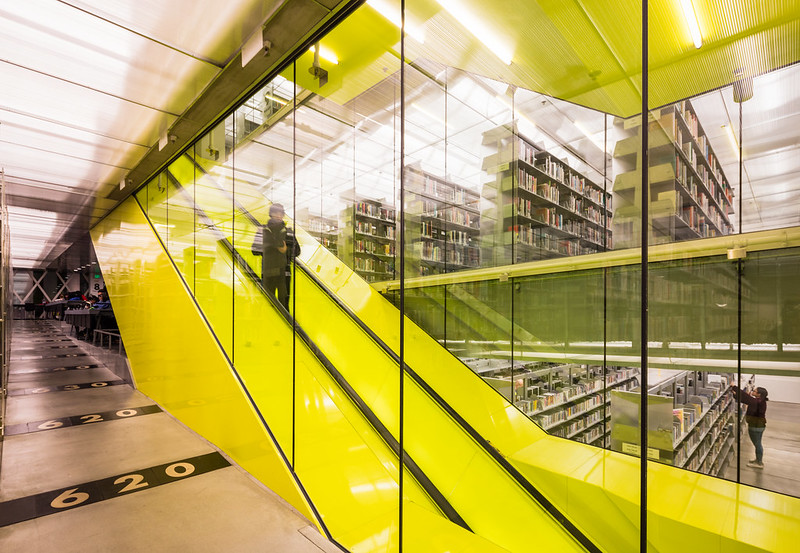
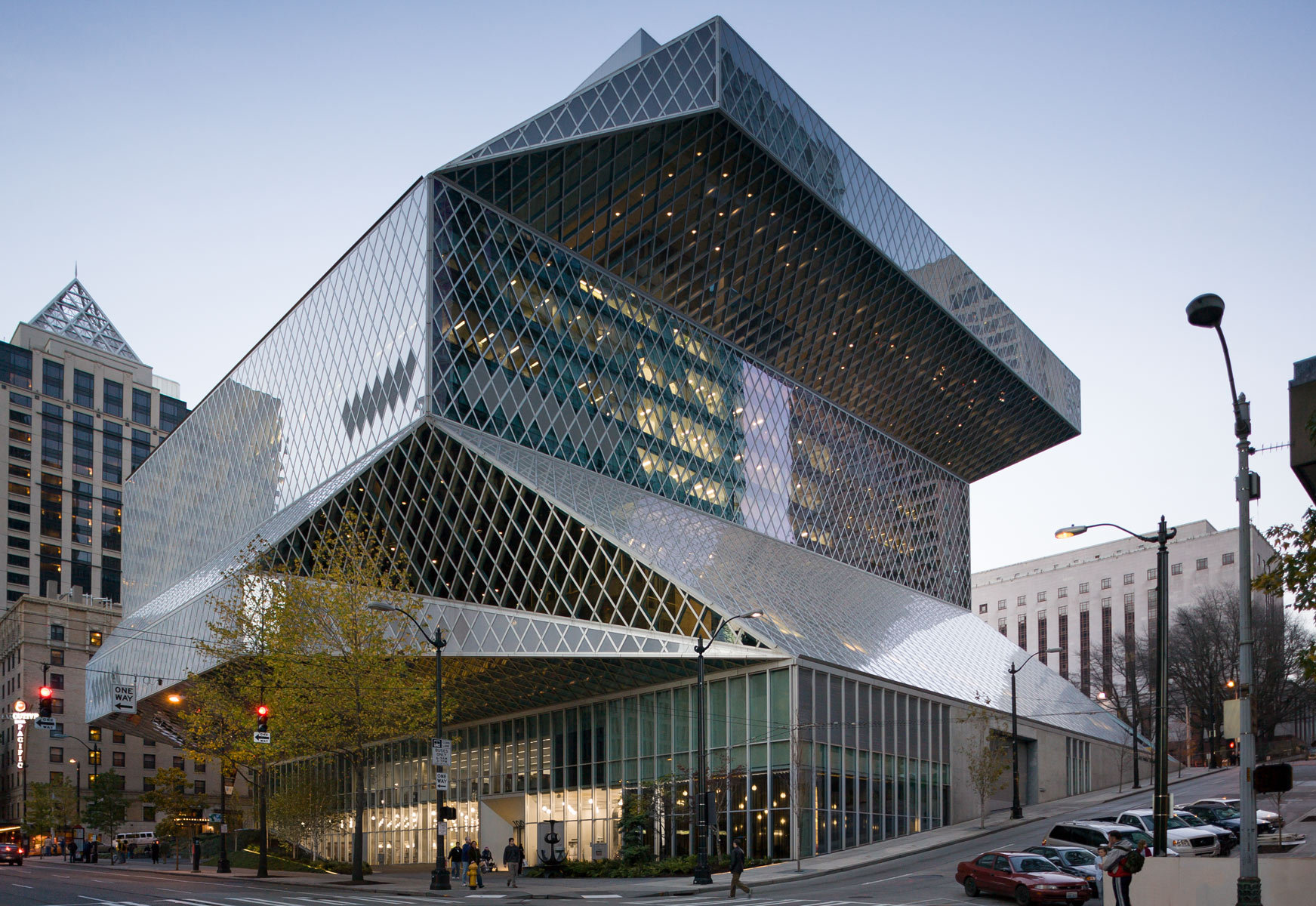
Imagine a building that looks like a giant diamond dropped from the sky right into the heart of the city. Its walls aren’t smooth and straight, but angular—like someone had stacked a massive crystal of glass and steel. Inside, there are brightly yellow halls, red staircases, and one long, long walkway that lets you move through all of human knowledge—from dinosaurs to space—without ever stopping. This isn’t a fairy tale and it isn’t science fiction. It’s a real library in Seattle, opened in 2004—and quietly changed how people around the world think about books, knowledge, and what a home for everything most important should be.
A Building Everyone Didn’t Quite Get at First
When architect Rem Koolhaas and his team showed city residents the first drawings of the future library, many were confused. A traditional library is something calm: columns, quiet reading rooms, and rows of identical shelves. Here, though, there are sharp corners, glass facets, and floors that jut forward like drawers someone forgot to push back in. Newspapers wrote, “It looks like what would happen if a building sneezed.” Some people laughed. Some got angry.
But Koolhaas was thinking about something else: old libraries were built as if books were the most important thing, and people were just visitors. Shelves everywhere, readers where they happened to be. He decided to do the opposite: first think about people—how they walk, think, search, and rest—then place the books. The result is a building that lives and breathes together with those who come inside.
Today, the Seattle Central Library is one of America’s most photographed buildings. Tourists come specifically to stand inside it and feel as if they’ve stepped into another world.
The Spiral of Knowledge: A Path That Takes You From A to Z
But the most amazing thing about this library isn’t what it looks like from the outside. The most astonishing part is hidden inside, and it’s called the Book Spiral.
Usually, books in a library are arranged on shelves by topic: a room for animals, a room for history, a room for science. To move from one subject to another, you have to leave, walk along a corridor, find the right door. Knowledge feels like it’s been cut into pieces and scattered across separate rooms.
Koolhaas came up with something different. He said that knowledge isn’t separate pieces. It’s one large river that flows continuously. And in his library, all the books—from the very first by the alphabetical catalog to the very last—stand on one long shelf that smoothly winds into a spiral across multiple floors. You start walking, and next to you are books about mathematics. Walk further and physics appears. Even further: chemistry, then biology, then medicine, then history, then art. You just keep going, and the world of knowledge unfolds in front of you like one long, long road.
It’s similar to how school subjects wouldn’t be spread across different classrooms, but along one big corridor—so you could walk from a math lesson to an art lesson, peeking into every class along the way. No boundaries. No closed doors. One uninterrupted journey.
At first, librarians were afraid: what if it’s inconvenient? What if people get lost? But the opposite happened. Readers started finding books they never would have found in a typical library—simply because they passed by and then suddenly noticed something interesting on a neighboring shelf. A girl who came looking for a book about dolphins would suddenly stop beside books about oceanography. A boy searching for something about robots would accidentally discover a section on the history of inventions.
A Library That Speaks in Color
There’s another secret of this building that not many people know. Inside, the library speaks to you in colors.
The architects chose different colors for different areas—not just for beauty, but like a real language. The huge central hall, where computers are located and librarian assistants work, is painted in a bright yellow-green. That color seems to say: “This way! Here you’ll be helped! This is where your search begins!” Service areas that only staff can enter are marked in red. Quiet reading rooms use calm, neutral tones.
If you get turned around and don’t know where to go, just look at the color around you. The building will guide you. It’s like a map drawn right onto the walls and floor.
In 2004, this approach—using color as navigation—seemed very bold. Today, the same principle is used in airports, hospitals, schools, and shopping centers around the world. And many designers say that it was the Seattle library that helped them understand: color isn’t decoration—it’s a tool.
How One City Taught the World
When the library opened, architects, librarians, and city planners from around the globe began visiting it. They walked the spiral, touched the glass walls, sat in the yellow-green hall, and thought, “What if we could do something like this back home?”
Over the next twenty years, dozens of libraries opened worldwide that took inspiration from Seattle’s ideas. They introduced open spaces instead of closed rooms, smooth transitions between topics instead of rigid boundaries, and bright colors instead of gray walls. Libraries stopped being quiet repositories and became living places where people come not only to read, but to think, meet, and dream.
Rem Koolhaas himself once said that a library is “the last truly public place in a city.” Not a store, not a café, not a cinema—exactly a library that anyone can enter, for free, simply because they want to know something new.
A Building That Keeps Teaching
The Seattle Central Library still stands today. Every year, hundreds of thousands of people visit it. Children come on tours and freeze in the yellow-green hall, looking up through the glass ceiling. Adults spend hours walking along the Book Spiral, stopping at one shelf, then another.
This story matters not only because the building is beautiful or unusual. It matters because one bold question—“What if a library could be different?”—changed how millions of people in different countries encounter books and knowledge. Sometimes the biggest changes start with one building in one city—and then quietly ripple outward across the world, like waves in a pond.