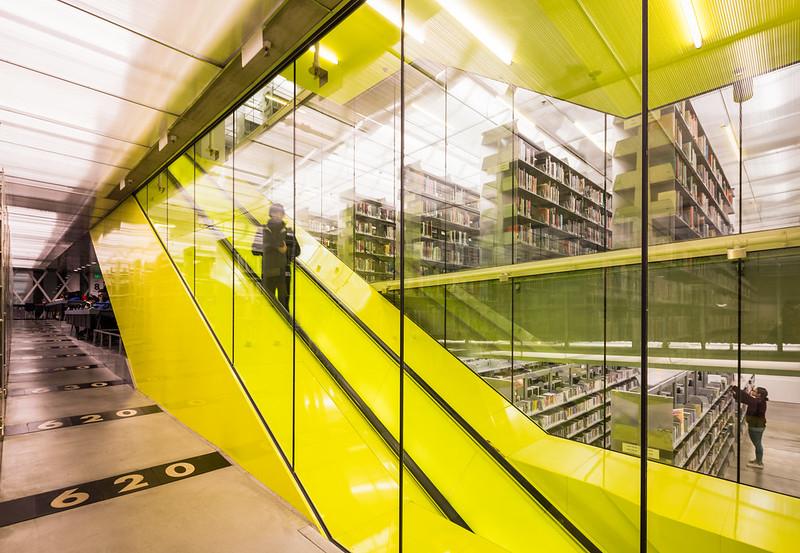
Imagine a huge, gleaming crystal in the middle of a city, with a ribbon of books inside it slowly rising upward like a mountain trail. This is not fantasy but Seattle Central Library, which opened in 2004. It was designed to change along with the books and the people who use it. Let’s take a closer look at how this unusual building works and why it is considered an engineering breakthrough.
A Building That Doesn’t Like Rearranging
When the architects began the project, they asked themselves a simple question: what happens when a library gets too many books on one subject? Usually, the books have to be rearranged: shelves are shifted, and hundreds of volumes are moved to another floor. This is slow, expensive, and very inconvenient.
The project was created by architect Rem Koolhaas and his team from OMA, together with Seattle-based LMN. They first carefully studied how librarians work with books, then decided to create a building that would not require constant rearranging.
Imagine building a city out of construction blocks. If every tower is built so that it cannot be moved, then every new idea means having to demolish half the city. But if the parts are designed flexibly, you can simply add new ones. That is how the library was conceived.
The “Book Spiral”
The main innovation is called the “Book Spiral.” Books on different subjects are not placed in separate rooms or on different floors. Instead, they stand along one continuous, gently sloping path that connects several floors. You walk along it as if traveling on a mountain switchback: here are fairy tales, then science, then history, with everything flowing smoothly from one subject to the next.
As a result, if the library acquires many new books about space, they simply take up a little more room on the path, while the neighboring books shift slightly. Nothing needs to be torn apart. You have probably noticed how shelves in a school library sometimes become overcrowded; here, the architects found a way to prevent that from happening.
It is also convenient for visitors: you can walk upward along the path and accidentally discover something completely new because neighboring subjects are placed close together.
The Glass Shell: Lacework That Holds Up the Building
From the outside, the library looks like a huge, gleaming crystal made of diamond shapes. These diamonds are made of glass and a steel frame. The frame is called a “diagrid”: it is a network of diagonal beams that resembles a spiderweb or the pattern on a lace doily.
Why does this matter? The diamond shapes are very strong and distribute weight across the entire surface, like the ribs of an umbrella supporting its fabric. As a result, there is no need to place many thick columns inside, creating a spacious, bright hall that is easy to move through.
The building also takes care of the environment. A thin metal mesh is placed between two layers of glass in the panels. It works like a light curtain: it lets daylight in but keeps the building from overheating in the sun. The more daylight there is inside, the less often the lamps need to be switched on, which means less electricity is used. The building received a “green” LEED certification, awarded for environmental responsibility. This means that efforts were made to conserve energy and resources during both construction and operation.
The “Living Room of the City”
Now, let’s talk about people. One of the largest halls on the third floor was called the “Living Room of the City.” It is a spacious place where people can sit in comfortable chairs, read, meet friends, or simply relax. Anyone can come here completely free of charge, and that is the central idea: the library belongs to everyone.
In public libraries in the United States, including Seattle, it is customary to help everyone who comes in: students who need a quiet place to do their homework, adults who need a job or advice, and people who do not have a home of their own. Such libraries often employ special staff members who help visitors find the information or services they need. In this way, the building cares not only about books but also about people.
What I Think About It
To me, the most interesting thing about this library is that it resembles a living creature. It grows, changes, lets in light like the leaves of a tree, and warms the people inside. When you enter a building like this, you cannot help wanting to speak more quietly and walk more slowly so that you do not miss anything. The place seems to say, “You are welcome here, and here you can learn about everything in the world.”
Why It Matters
The story of Seattle Central Library shows that a building can be more than just a beautiful box—it can be a smart and kind system. It saves energy by using daylight. It is convenient for books because it can “grow” without rearrangement. And it is open to people because it believes that knowledge should be available to everyone.
The next time you see an unusual building, think about what ideas might be hidden in its shape. Perhaps one day you, too, will come up with something that takes care of books, nature, and people.