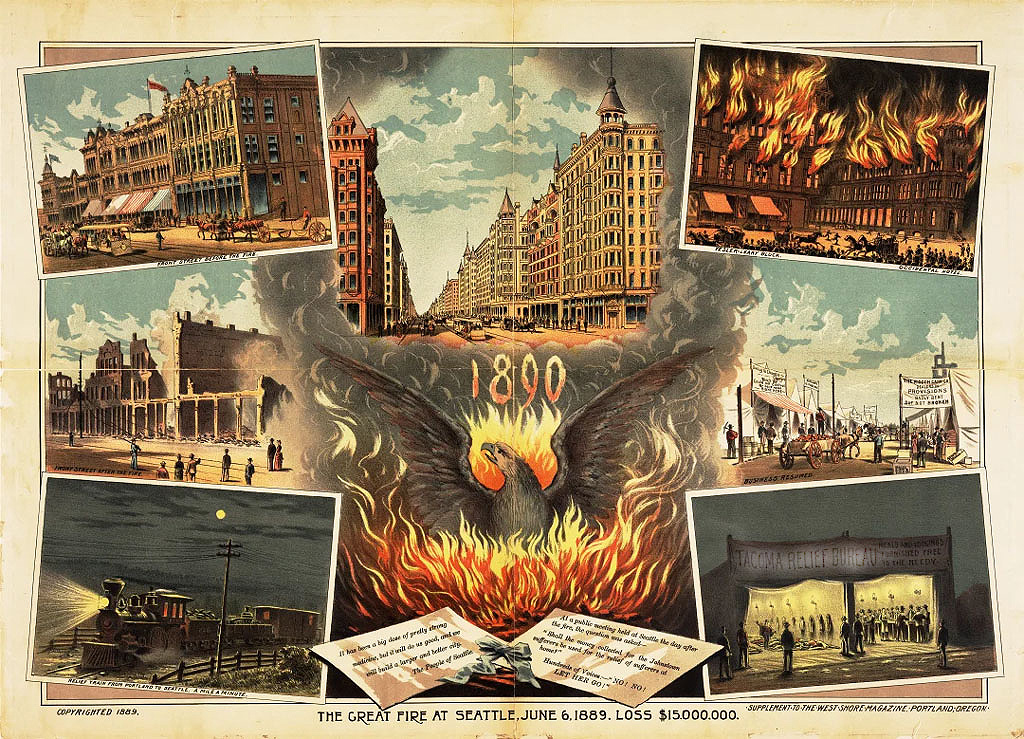
In 1889, a huge fire broke out in Seattle that destroyed nearly the entire downtown. But the most surprising part didn't happen during the fire — it happened after it. Residents decided not just to rebuild the city — they decided to raise it by a whole story! For several years people walked the city going up and down stairs between the old sidewalks and the new streets. This turned Seattle into a two-level city, and beneath the modern streets a whole underground city still hides.
The fire that started with glue
On June 6, 1889, in a carpentry shop on First Avenue, an apprentice named John Back was heating glue on a stove. The glue boiled over, caught fire, and the flames quickly spread to the wooden walls. At that time almost all buildings in Seattle were made of wood, and the streets were covered with wooden planks and sawdust. The city resembled a giant box of matches.
The fire raged for 12 hours and destroyed 25 city blocks — the entire business district. Stores, hotels, piers were burned; even rats ran out of basements straight into the bay, escaping the flames. Strangely, though, no one was killed. People had time to evacuate, and many even managed to carry out their most valuable belongings.
When the ashes cooled, residents gathered and began to consider: how to rebuild the city so this wouldn't happen again? And then someone remembered the main problem of old Seattle — a problem nobody wanted to talk about aloud.
A city where toilets worked backwards
Old Seattle had been built too low. At high tide, water from Puget Sound would rise and flood the lower floors of buildings. But the worst part was the sewage. At high tide water in the pipes flowed not down but up. Toilets in houses turned into fountains — and that was not only unpleasant but dangerous to health.
Hotel owners warned guests: "Do not use the toilet at high tide!" Some houses had special valves installed, but they helped little. People learned to check the tide schedule before going to the restroom. For children growing up in Seattle this was normal, but visitors were very surprised.
After the fire, city engineers proposed a bold solution: raise the street level by 3–9 meters (about one to two stories!). That way the streets would sit above the tide level, and the problem would disappear. Shop and property owners agreed — they were ready for anything to avoid the "fountain" toilets.
The years of stairs
But raising an entire city proved difficult. First people rebuilt buildings from stone and brick (wood was now banned). Then the city began lifting the streets, filling them with earth and building retaining walls. But building owners could not wait — they needed to open shops and earn money. So for several years Seattle lived in a strange intermediate state.
Imagine: you walk along a sidewalk at the old level, and next to you, at the height of a second floor, wagons pass along a new street. To cross, you had to climb a tall staircase, dash across the street above, then descend another stair to the opposite sidewalk. The city had dozens of such stairs — wooden, rickety, steep.
For the elderly this was a real challenge. Women in long skirts struggled up the steps. Children, however, loved the new city! They raced — who could climb and descend fastest, played hide-and-seek between levels, jumped from steps. One boy later remembered: "It was like living in a giant playground built especially for us."
Some shops operated on both levels simultaneously. An entrance on the old level led to what had been the first floor, while an entrance from the new street opened onto the former second floor. Shopkeepers ran up and down interior stairs, serving customers on both levels. One pharmacy even installed a special goods lift — a prototype of the modern elevator.
The birth of the underground city
By the mid-1890s the city had finished raising the streets. The old sidewalks ended up 3–9 meters below the new ones. At first people continued to use them — shops kept entrances open on both levels. But gradually the lower level became darker and damper. Sunlight hardly reached down because the new streets above blocked it.
After a few years the city decided to cover the old sidewalks with glass prisms and purple glass so a little light could reach below. These glass tiles were set directly into the new sidewalks. If you visit Seattle today and look carefully at the ground in the old part of town, you can see these thick glass squares in the pavement. Under them — empty space, the old 1889 streets.
But there was still little light. Lower floors were used as storage and basements. Gradually many entrances were bricked up. By 1907, after an outbreak of bubonic plague, the city officially closed the underground level, declaring it unsanitary. Old Seattle streets turned into an underworld.
Not all entrances were sealed, however. During the Great Depression of the 1930s homeless people lived in the underground rooms. During Prohibition hidden bars operated there. And during World War II the underground spaces were used as bomb shelters.
What remains today
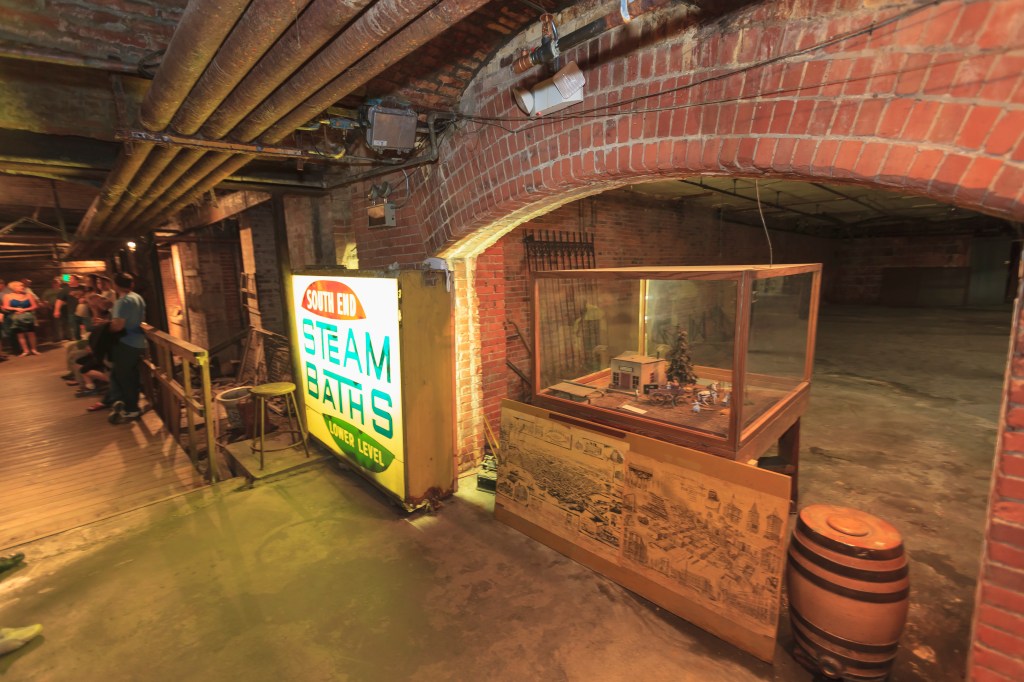
Today part of Seattle's underground is open to tourists. You can go down and walk along those very streets of 1889, see old shopfronts, and peek into rooms where people bought bread and newspapers more than a century ago. It's like a journey in a time machine.
Guides show the old toilets (the ones that worked backwards!) and tell stories about life in the two-level city. The old glass prisms in the underground ceiling have even been preserved — when you look up from below you can see people walking above and light filtering through the thick purple glass that is over a hundred years old.
But underground Seattle is not just a museum. It is a reminder of how a city coped with disaster. People did not simply rebuild after the fire — they solved the main problem that had plagued them for years. Yes, for several years they had to climb stairs and live in a strange two-level city. But in doing so they created modern Seattle, where toilets work properly and beneath your feet a whole ghostly city from the past hides.
Lessons from the city of stairs
The story of Seattle's fire and its underground city teaches an important lesson: sometimes disasters provide a chance to fix old mistakes. If not for the fire, Seattle residents might have continued living with flooded basements and strange toilets, because raising the entire city had seemed too difficult.
The story also shows how people adapt to the most unusual circumstances. The years of stairs were inconvenient, but people coped. Children turned the stairs into playgrounds, shopkeepers learned to work on two levels, and the city gradually, step by step, rose to a new height.
Today Seattle is a modern city of skyscrapers and high technology. But under its streets the memory of the time when the whole city was one big staircase between past and future still lives. And that memory reminds us: even the toughest problems can be solved with creative approaches — even if it means raising an entire city by one story.