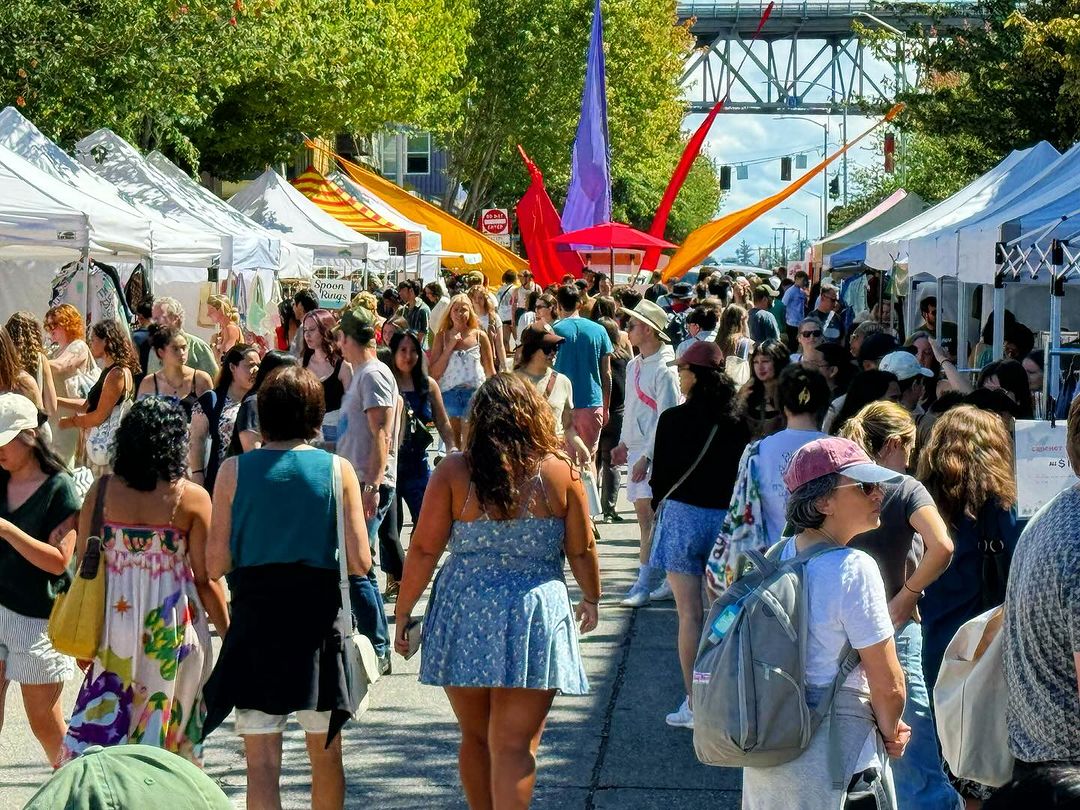
Imagine that every Sunday morning a whole little town appears in one neighborhood of a city. There are streets, shops, cafés, musicians on the corners. People stroll, buy vegetables, look at artists’ paintings, eat hot waffles. And by evening this little town... disappears. Completely. As if it had never been. The next morning the same spot is an empty square, a parking lot, or a park. And a week later the town returns again.
This is not a fairy tale. This is the true story of how, in 1990, a group of ordinary people in the Fremont neighborhood of Seattle solved a very unusual problem: how to build a town that can be assembled and disassembled every time like a Lego set? And why did this become so important that hundreds of cities around the world copied the idea?
A problem nobody noticed
In the late 1980s the Fremont neighborhood in Seattle was a rather poor area. Many shops had closed, and people drove to other parts of town to shop. The artists, makers, and craftsmen who lived there wanted to sell their work, but they couldn’t afford to open real shops. Renting a space was expensive. You had to pay for electricity, heating, repairs—every month—even if you sold nothing.
A few people—among them a woman named Kathleen Warren—thought: what if the market ran only on Sundays? One day a week. People would come, set out their goods, sell, and then pack everything away in the evening. Sounds simple, right?
But when they tried it, it turned out to be very hard. Regular market tents were heavy—they had to be hauled by truck. Tables broke from constant assembly and disassembly. Sellers had to bring everything with them: goods, chairs, even lighting if the day was cloudy. By the end of the day people were so tired they didn’t want to come back the next week.
The first market in 1990 was very small—only 15 vendors. The organizers realized: if they didn’t come up with something clever, the market simply wouldn’t survive.
Engineers with hammers and ideas
Then something interesting happened. The people organizing the market were not professional engineers. They were artists, musicians, teachers. But they began to think like engineers: how to make everything lighter, faster, and more convenient?
First they invented “smart tents.” A typical market tent weighed about 30 kilograms—like a big suitcase packed with books. One person could barely lift it. The market organizers found a new material—lightweight aluminum and a special fabric. The new tent weighed just 7 kilograms! A child could carry it. And it folded into a bag the size of an umbrella.
Then they came up with a “numbering system.” Each vendor was given a permanent spot with a number. You arrive on Sunday, find your number painted on the ground (they used special paint) and set up your tent there. No arguing, no jostling, no disputes over where to stand. Everything ran like clockwork.
The cleverest idea was the electricity solution. Some vendors needed blenders for smoothies, electric hotplates for cooking, lamps to light their goods. But how do you bring electricity to an open square that must disappear by evening? They invented “mobile power stations”—large battery packs on wheels that could be charged at home and then brought to the market. Each battery could power 3–4 tents for a whole day.
Another problem was trash. When hundreds of people come, they leave a lot of waste: coffee cups, napkins, bags. The organizers didn’t want the neighborhood to get dirty. They set a rule: each vendor must take their trash with them. And to make that easy, they designed special foldable trash bins that attached directly to the tent. At the end of the day the vendor simply removed the bag and carried it away.
How the disappearing town taught the world
By the mid-1990s the Fremont Sunday Market had become famous. More than 200 vendors came, and up to 10,000 visitors showed up every Sunday! But the most interesting part came later.
People from other cities—Portland, San Francisco, even Canada—came to see how it worked. They photographed the tents, took notes, talked to the organizers. Then they returned home and set up their own markets using the same system.
It turned out that the “disappearing town” solved many problems at once. Young artists and makers who couldn’t afford a storefront could start a business. They only needed to buy a lightweight tent for $100–$150 and pay a small fee of about $15 per day for a spot. That was 20 times cheaper than renting a real shop!
Neighborhoods with these markets came alive. People returned on weekends, met their neighbors, and supported local makers. This mattered not only economically but also for making people feel part of a community.
By 2010 there were more than 5,000 Sunday and Saturday markets in the United States alone modeled after Fremont. The idea of “mobile commerce” spread even further: food truck festivals, mobile book fairs, and even temporary art schools that travel to different neighborhoods appeared.
A pocket-sized city is about people
Today the Fremont Sunday Market operates year-round, except for the coldest winter days. Some vendors have been there for more than 30 years. The children who came with their parents in the 1990s now bring their own kids.
The story of this market teaches an important lesson: sometimes the smartest solutions don’t come from professionals with diplomas, but from ordinary people who really want to make a change. The artists and musicians of Fremont didn’t know complicated engineering formulas. But they asked the right questions: “How to make it lighter? How to make it cheaper? How to make people want to come back?”
And this story also shows that a true invention isn’t always something huge and complex like a rocket or a skyscraper. Sometimes it’s a simple smart idea that makes people’s lives a little better. A tent that weighs like a cat instead of a sheepdog. A battery on wheels instead of miles of cables. A number painted on the pavement instead of morning disputes.
The city that can hide in your pocket taught us: if you have an idea and the desire to implement it, you can change not just your neighborhood but the whole world. One lightweight tent at a time.