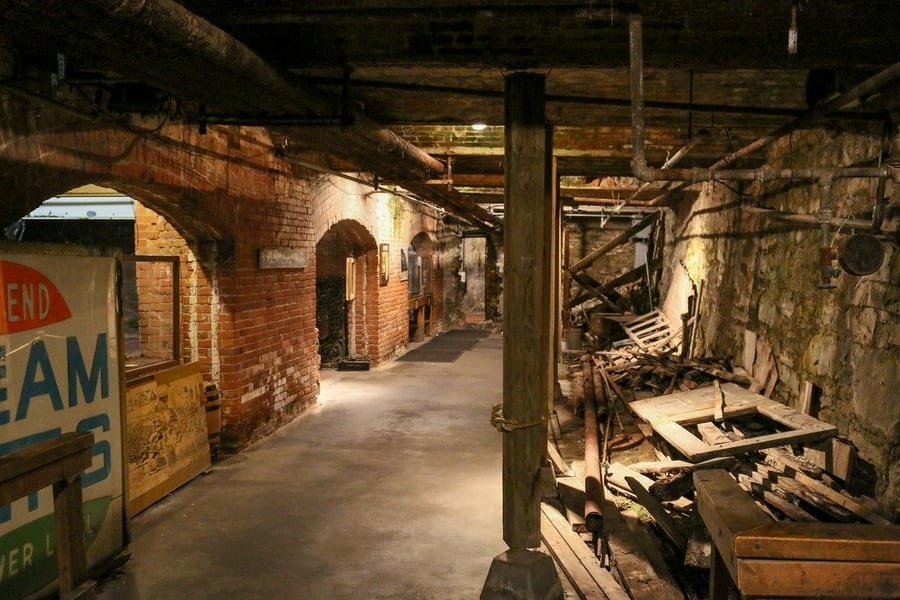
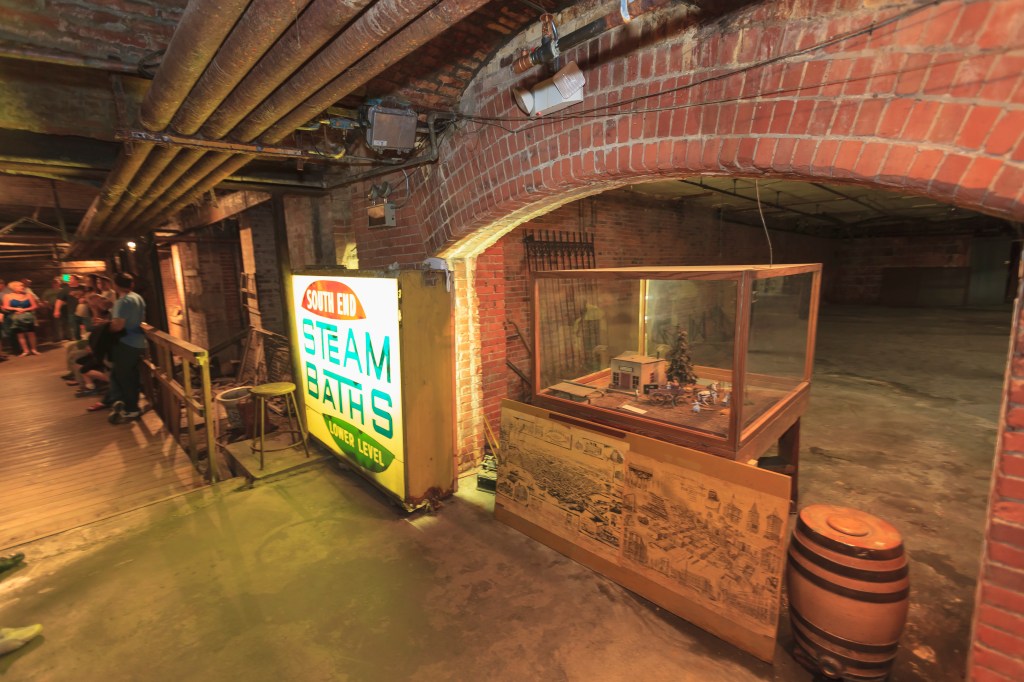
Imagine that beneath the sidewalk you walk to school on there is a whole street with old shops, doors and even toilets. Sounds like a fairy tale? But in Seattle it's true. Beneath the modern downtown lies an entire "Underground Seattle" — real streets and buildings that were simply buried and a new city built on top more than a century ago. This story began with a massive fire and one very quick decision, for which the city is still paying today.
When Seattle decided not to repair but simply to cover the problem
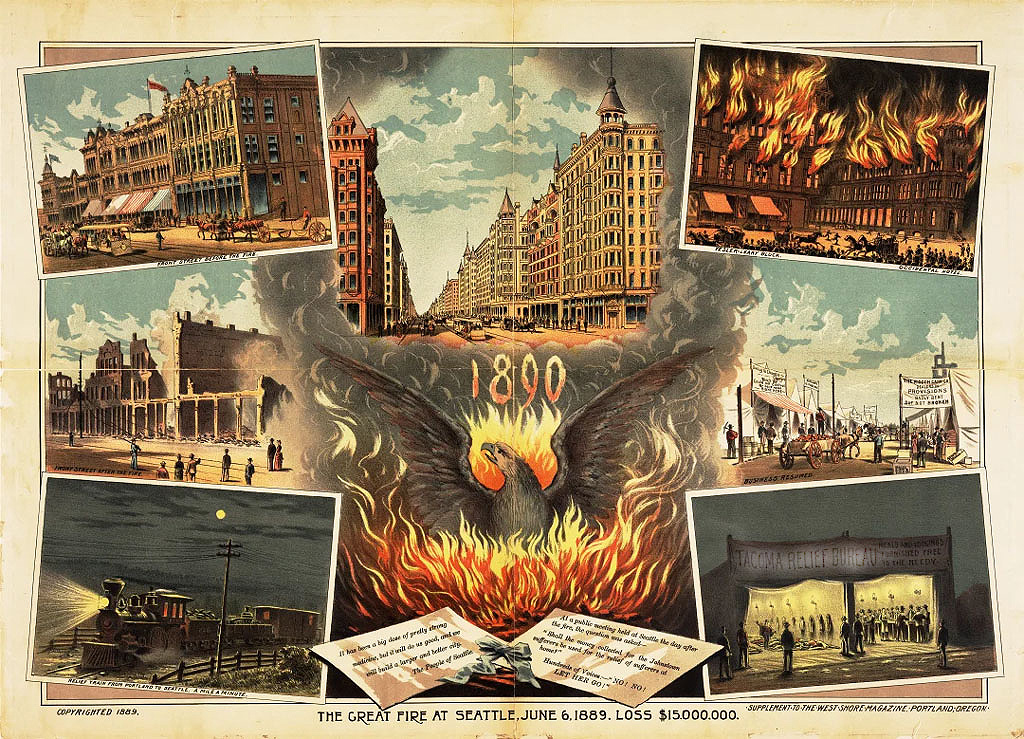
On June 6, 1889, glue ignited in a woodworking shop on Madison Street. The fire spread to the wooden buildings, and within hours 25 city blocks burned — almost the entire center of Seattle. But the fire was not the city's only problem. Seattle was built on marshy land by Elliott Bay, and at high tide the water rose so high that it flooded the first floors of buildings. Toilets worked in reverse — instead of flushing, they pushed everything back out. Locals joked that you had to be careful even in your own bathroom in Seattle.
After the fire the city had a chance to fix things properly: build a real sewer system, shore up the shoreline, drain the land. But that would have taken years and cost a fortune. Shop and hotel owners wanted to reopen as soon as possible — Seattle was in the middle of a gold rush, and thousands of people were coming here hoping to get rich in Alaska. So city authorities made an unusual decision: they allowed owners to quickly rebuild at the old street level, and then simply raised the streets 3–9 meters (10–30 feet) higher, filling the space between buildings with earth and debris.
The result was strange: shops opened on the ground floor, but after a few months that floor ended up as a basement, and the new street ran at the level of the second floor. Stairs were built between the old sidewalks and the new streets — sometimes 35 steps down to a single shop! Imagine living in an ordinary house and a year later your first-floor window is underground, and you now have to enter the house through what used to be a second-floor window.
A city on two levels: when children played where tourists walk now
For several years Seattle existed on two levels at once. Above, on the new streets, horse-drawn carriages passed and well-dressed ladies strolled. Below, in the dim corridors between the old buildings, shops, barbers and even banks continued to operate. Old wooden sidewalks turned into tunnels with purple glass tiles in the ceilings — light filtering down through them. You can still see those tiles today on some downtown sidewalks if you know where to look.
Children loved the lower level. It was their secret world — a maze of passages where they could cut across, hide from parents or play hide-and-seek. Mary McCarthy, who grew up in Seattle in the 1890s, recalled in her letters: "My brother and I knew all the ways beneath Yesler Street. It smelled of damp and kerosene lamps, but no grown-up could find us there." Shop owners below complained that the children scared customers by jumping out of the darkness.
But gradually the lower level became dangerous. There was no proper ventilation, water collected, and rats multiplied. In 1907 the city officially closed the underground sidewalks, declaring them unsanitary. Entrances were bricked up, and an entire city was buried beneath the ground. For almost 60 years it was forgotten — until 1965, when journalist Bill Speidel began leading the first tours there. Today "Underground Seattle" is one of the city's main attractions, with thousands of tourists descending each year to see the ghost streets.
Why a quick fix became a long-term problem
The very earth and debris used to fill the old streets in 1889–1890 continues to cause problems today, 135 years later. Engineers call it "uncontrolled fill" — nobody knows exactly what's inside it and how stable it is. When Seattle builds a new high-rise or digs a subway tunnel, millions of dollars must be spent to stabilize the ground. The Columbia Center, the city's tallest building, stands on 76 massive piles driven 37 meters (about 120 feet) down to get through the unreliable fill and reach solid bedrock.
Even more serious is the earthquake risk. Seattle lies in a seismically active zone, and scientists warn that a major quake will happen sooner or later. The fill in the downtown area can begin to behave like a liquid — this is called "liquefaction." Buildings on such ground can simply sink or tilt. In 2001, during a magnitude 6.8 earthquake, several older downtown buildings suffered significant damage precisely because of the unreliable foundation.
City authorities now spend huge sums to reinforce historic buildings and prepare for earthquakes. The seismic retrofit program will cost hundreds of millions of dollars. Seattle's chief city engineer said in a 2019 interview: "We are still paying for the decision our great-great-grandfathers made. They chose speed over reliability, and now it's our headache."
The lesson of a city that hid its problem under a rug
The story of Underground Seattle is not just an oddity for tourists. It's a reminder of how important it is to solve problems correctly, not merely quickly. In 1889 business owners wanted to make money immediately, and the city accommodated them. No one thought about what would happen in 50, 100 or 130 years. No one imagined that someday Seattle would be building skyscrapers and a subway.
Today, when Seattle debates new big projects — a new subway line, flood protections for climate change, the reconstruction of an old viaduct — there are always people who recall the lesson of 1889. "Let's not build a second floor over the problem again," one resident wrote to the city council in 2018 when a cheap but temporary waterfront repair was being discussed.
Underground Seattle teaches us that cities are more than buildings and streets. They are the decisions people made long ago, and those decisions continue to affect the lives of their great-grandchildren. Every time we choose a quick solution over the right one, we leave the problem for those who will live after us. And sometimes that problem literally lies beneath their feet — a whole buried city that reminds us: mistakes don't disappear just because you cover them with dirt.