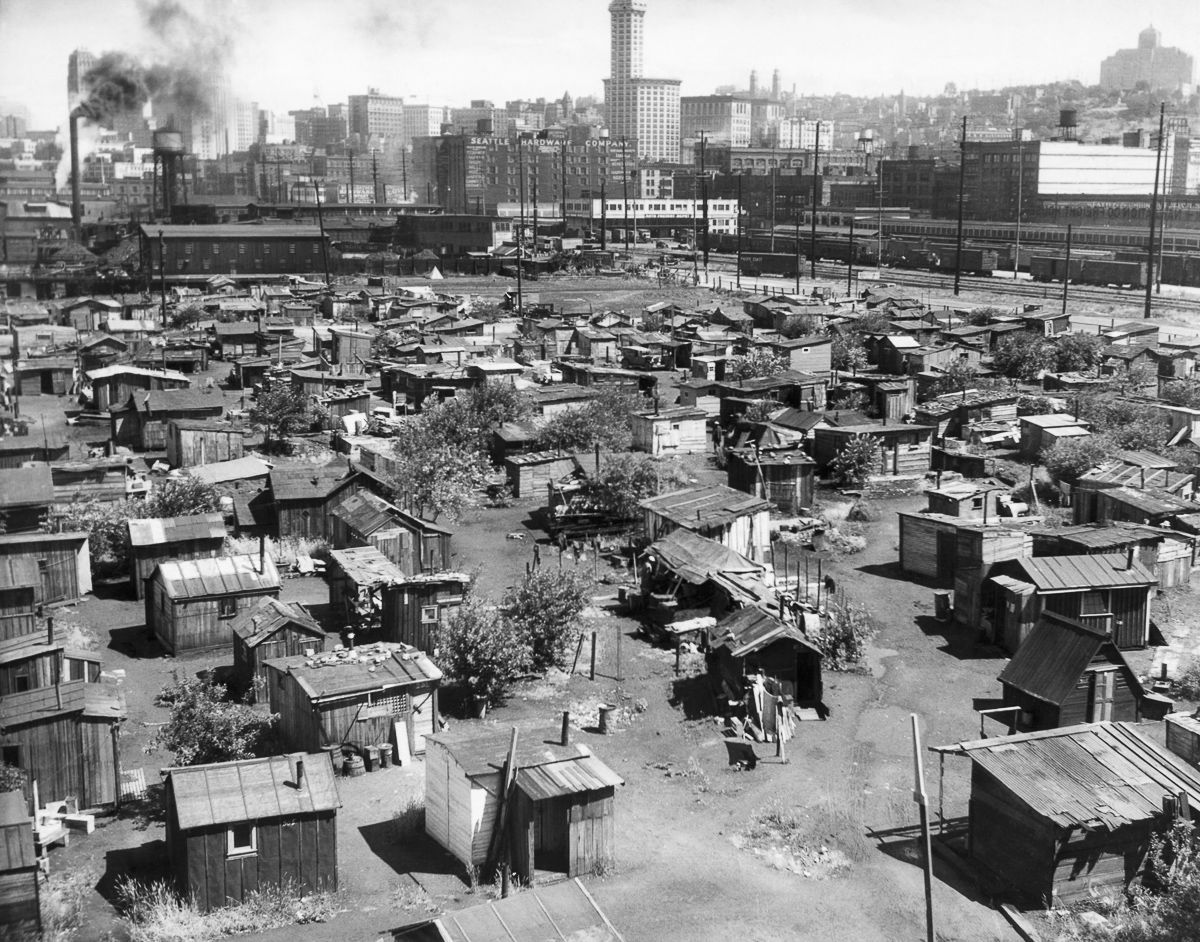
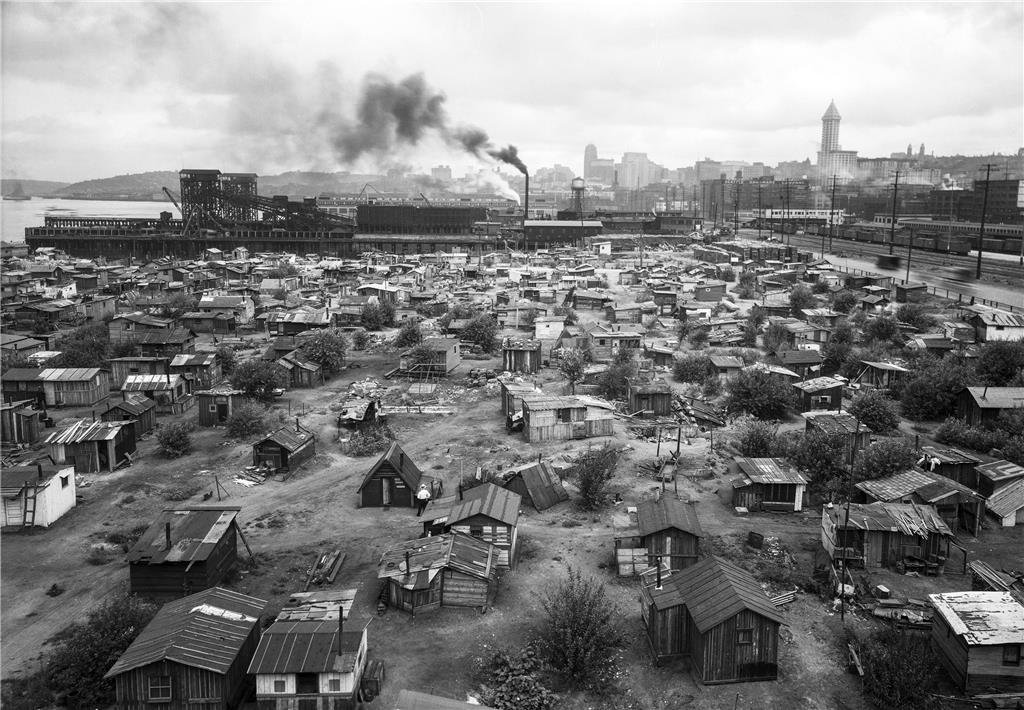
In 1931 a strange town appeared on the shore of Seattle's bay. Its homes were made of old crates, rusted metal and cardboard. There was no electricity. But the town had a mayor, it had rules, and people there cared for one another. That town lasted nine years — longer than any similar camp in America. And it taught the whole country an important lesson: even when people have nothing, they can create a real community if given the chance.
When houses were built from what was found in the dump
Imagine you lost everything: your home, your job, your money. That happened to thousands of people in America in the 1930s, during the Great Depression — the country's worst economic crisis. Factories closed, shops emptied, and millions of families found themselves on the street.
People across America began building camps from what they could find: old apple crates, sheets of tin, tarpaulin, cardboard. These camps were called "Hoovervilles" — after President Herbert Hoover, whom many blamed for the crisis. It was a derogatory name, a way to show their anger.
In most cities the police dispersed such camps after a few weeks or months. But something different happened in Seattle. The camp on the shore of Elliott Bay grew into a whole town with nine streets, where more than a thousand people lived. And that town existed from 1931 to 1941 — a full nine years!
The mayor who ran a town without houses
The most remarkable thing about Seattle's Hooverville was that residents decided to run it like a real town. They elected a mayor — a man named Jesse Jackson (not to be confused with the well-known civil rights figure; this was a different person). Jackson was an ordinary unemployed man, but he helped create rules that made life in the camp better.
Hooverville had its own laws. No stealing. No fighting. Everyone had to keep their plot clean. If someone broke the rules, they could be asked to leave — yes, even in a homeless camp there were standards!
Residents organized duty shifts. Someone kept the common areas clean, someone guarded the camp at night, someone helped newcomers build huts. When someone found work for a day or two, they shared the earnings with those who had nothing. When someone brought food, it was shared among neighbors.
A journalist who visited the camp in 1934 wrote in surprise: "This is not a chaotic jumble of shacks. It is an organized community where people have preserved their dignity."
Why Seattle did not disperse its Hooverville
In other cities the police quickly broke up homeless camps. Why did Seattle tolerate its Hooverville for so long? There were several reasons.
First, the camp was organized. Authorities saw that there was no disorder or crime. On the contrary, residents maintained order themselves better than the police might have.
Second, Seattle had a strong labor movement. Many ordinary townspeople were themselves poor or knew the poor. They understood that the people in the camp were not criminals but fellow workers who had simply been unlucky. Unions and churches defended Hooverville's right to exist.
Third — and most importantly — the authorities realized that if they dispersed the camp, people would have nowhere to go. They would simply scatter throughout the city, and the problem would grow. It was better to let them live in one place where they could help each other.
Of course, it was not an easy choice. Many Seattle residents complained that the camp spoiled the view of the bay. But the city decided that human dignity mattered more than a pretty landscape.
Lessons from the city of boxes
In 1941 Hooverville was finally closed — not because residents were driven out, but because World War II began. Factories started up again, making weapons and ships. People found work and could rent decent housing. The city of boxes was no longer needed.
But the story of Seattle's Hooverville remained an important lesson. It showed that even in the hardest circumstances people can create order and care for one another if given the chance. When authorities respect people — even the homeless — and allow them to organize themselves, the result can be better than simply driving them away and punishing them.
Today in Seattle, as in many other cities, homelessness is again a problem. Some people recall the Hooverville experience. They say: maybe instead of constantly moving the homeless from place to place, we should give them a safe place where they can organize their lives? Maybe we should work with them, not against them?
The story of the city of boxes reminds us: every person has dignity, even when they have no home. And sometimes the poorest people can show an example of how to care for neighbors and build a real community — even from old crates and cardboard.