Imagine living in a city where a toilet can suddenly turn into a fountain. Not a magical fountain from a story, but a very real one — dirty, smelly, and unpleasant. That’s how people in Seattle lived in the late 1800s. And this strange problem led to the city being rebuilt... twice. One on top of the other. Like a layered cake of streets, shops, and sidewalks.
This is the story of how an attempt to solve one problem created many others, and how sometimes adults make decisions without considering whether they are fair.
When the ocean shows up uninvited
In the 1850s Seattle was built on the shore of Puget Sound. It’s a beautiful place where sea meets land. But the city’s founders had one big problem: they didn’t think enough about the tides.
Twice a day the ocean rose and fell. That’s normal for a coast. But Seattle’s first streets were built so low that at high tide seawater flooded basements, shops and — worst of all — toilets. Sanitation then was very simple: pipes just emptied into the sound. When the tide came in, water flowed back up the pipes.
People told terrifying stories about having to be very careful in the toilet during high tide. Water could rise so much it would literally shoot upward! Some people were even injured. It sounds funny now, but at the time it was a real danger and a major health problem.
Also, the streets turned into muddy quagmires. The mud was so deep horses sometimes got stuck up to their bellies. It was said that once a cow completely sank in the mud on the main street and could not be pulled out.
The great fire and a big decision
In June 1889 disaster struck in a way that, oddly, gave the city a chance to fix things. A great fire destroyed downtown Seattle — 25 blocks burned to the ground. People lost homes, shops, everything they owned. It was a tragedy.
But city engineers saw an opportunity. They said: “Let’s not rebuild the city in the same place! Let’s raise it higher!” Their plan was ambitious: build new streets 2–3 meters (and in places even 6 meters) above the old ones. That way the water would never flood the city again.
Sounds like a good idea, right? And in many ways it was. The new sewer system worked much better. Streets no longer became swamps. Toilets stopped being dangerous.
But there was one huge downside: it took years.
A two-level city and unfair rules
While the new higher streets were being built, people still had to live and work. Shops reopened on the old, lower level. But the new streets were built higher, at the level of the old buildings’ second floors!
It turned out like this: you walk along the new street, enter a building... and find yourself on the second floor! The first floor sits below, on the old street, which had become a dark corridor between buildings.
To get from the upper level to the lower you had to go down stairways. And here the unfairness began.
City authorities decided men could use the lower passageways — the old sidewalks now in shadow between buildings. Women were forbidden! Why? Because those passages were dark, dirty, and it was thought a “proper woman” should not go there.
Instead, women had to climb up and down high staircases to cross the street. Imagine: you’re wearing a floor-length dress (women then only wore such dresses), a corset that makes breathing hard, perhaps carrying shopping bags or holding a small child’s hand. And you have to climb a steep wooden staircase up, then go down another staircase — just to cross to the other side!
Meanwhile, men in trousers walked easily along the lower level.
This continued for several years until all the new streets and sidewalks were completed.
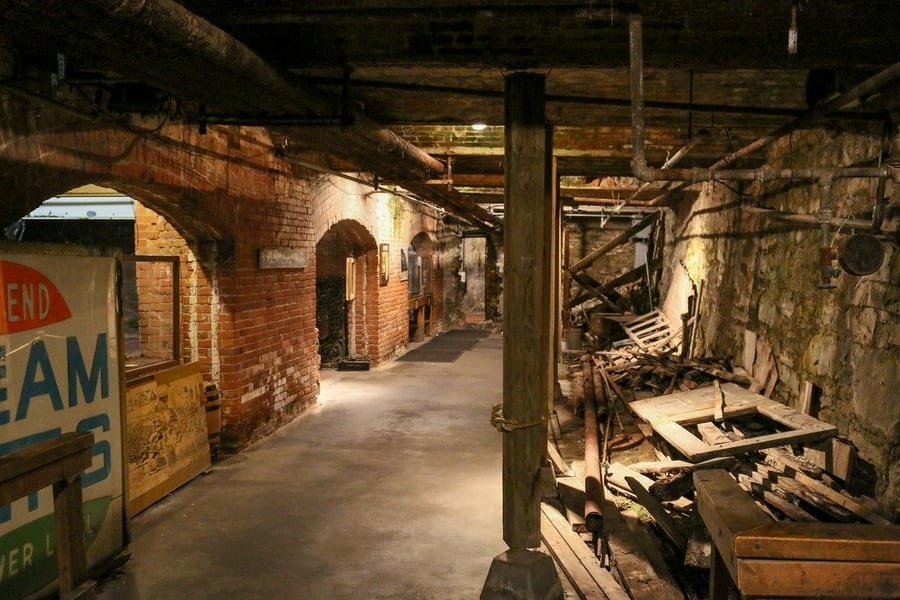
The underground city that was forgotten
By the early 1900s the new Seattle was ready. The upper level became dominant — with wide sidewalks, shops, and street lamps. It was pretty and modern.
What happened to the lower level — the old sidewalks and first floors? At first they were still used. There were shops, warehouses, even housing for the poor. But gradually those spaces became darker, dirtier, and more dangerous.
In 1907 the city officially closed the underground sidewalks. It was said to be a health hazard — there was no light, no fresh air, and the sewer system worked poorly. Many entrances were bricked over.
For decades Underground Seattle was abandoned. Rats moved in. During Prohibition (when selling alcohol was illegal) illegal bars hid there. People say there were secret gambling houses and other unlawful places.
The old city was simply forgotten. It lay beneath the feet of thousands who walked the upper streets every day, unaware that below them was an entire maze of old sidewalks, shopfronts, and stairways leading to nowhere.
What the underground city can tell us today
In the 1960s an enthusiast named Bill Speidel began leading tours of Underground Seattle. He realized these forgotten spaces are an important part of the city’s history. Today thousands of people descend each year to see old shop windows, wooden sidewalks, and the fountain-toilets (which no longer work, thankfully!).
But this story isn’t just about odd toilets and underground streets. It teaches us several important things:
About solving problems: Sometimes when we try to fix one problem (flooding) we create others (a two-level city). Good solutions take time and require thinking through all the consequences.
About fairness: The rule about stairs for women shows how adults sometimes make unfair decisions without thinking. They thought they were “protecting” women, but actually made life much harder for them. Today we understand fairness as equal opportunity for everyone, regardless of who they are or what they wear.
About the environment: Seattle’s early builders didn’t consider tides and how nature works in that location. They paid for that with years of trouble. Modern cities try to learn from such mistakes. They study a place’s natural conditions before building.
About memory: Preserving the underground sidewalks and now showing them to people is important. We only learn from past mistakes if we remember them.
Today, when you walk the streets of any city, you might wonder: what’s under my feet? What stories are hidden beneath the asphalt? Who made the decisions about how these streets were built, and did they think about whether they would be convenient for everyone?
Underground Seattle reminds us that cities are more than buildings and roads. They are stories about people, their mistakes, and their attempts to make life better. And sometimes — about exploding toilets that made a whole city get rebuilt.