Imagine your city decided to wash away an entire hill with water. Sounds insane? But that's exactly what happened in Seattle more than a century ago. Massive water cannons eroded the land, houses slipped and fell apart, and streets disappeared under flows of mud. The project was called the Denny Regrade, and its goal was to make the city flat to allow new construction. While adults thought about the future, a group of schoolchildren noticed something important: the hill's removal was erasing their city's history. So the children decided to act.
The hill that got in the way of big plans
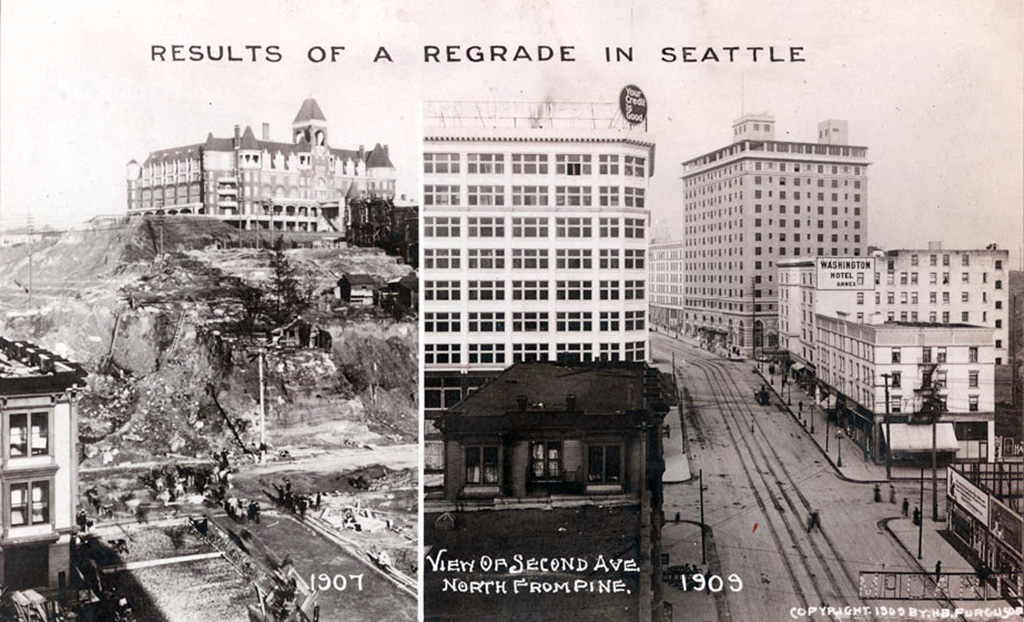
In the early 1900s, downtown Seattle looked very different from today. Where neat blocks stand now, the huge Denny Hill rose more than 30 meters. For residents this caused problems: horses struggled to pull carts up steep streets, building large structures was nearly impossible, and slopes became dangerous in winter.
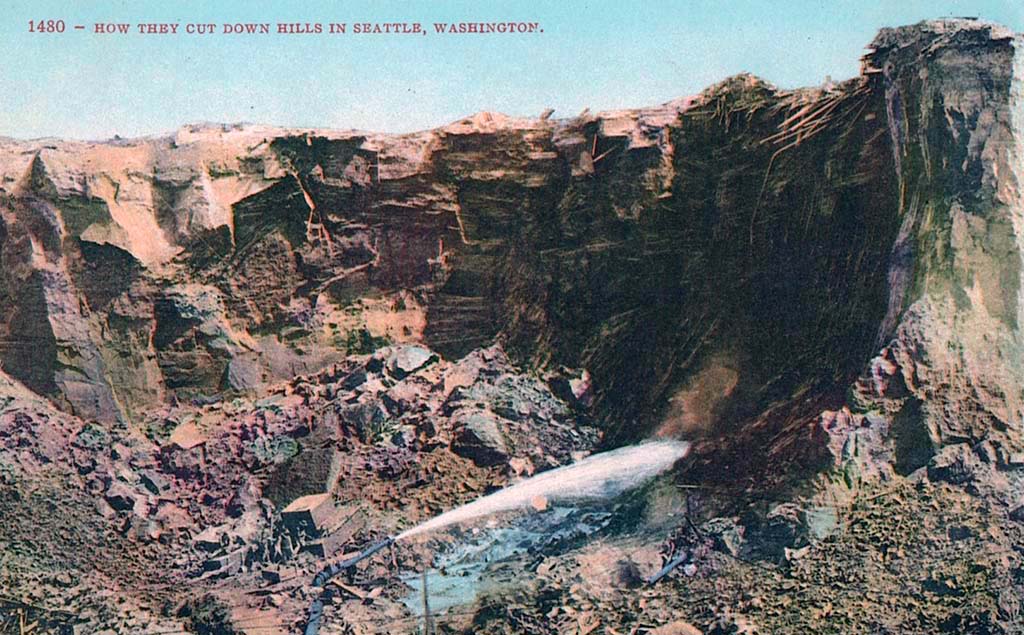
City authorities made a radical decision: to remove the hill entirely. They used technology that resembled gold mining — powerful high-pressure water cannons washed away the earth, turning it into liquid slurry. That slurry was flushed into Elliott Bay, gradually extending the shoreline. Work began in 1898 and continued, with interruptions, until 1930.
The spectacle was both impressive and frightening. Whole houses hung on the edges of cliffs; some had to be moved on rollers, others were simply demolished. Residents left their homes, shops closed, and with them went family stories that had lived there for decades. Adults argued over compensation and new development plans. No one thought to preserve memories for the future.
The teacher who taught the children to look back
Miss Elizabeth Graham taught history at an elementary school on Denny Hill. Every day she watched from the classroom window as her neighborhood disappeared. One morning in 1910 she took her students — children aged 9 to 11 — to the edge of the demolition zone. There, among piles of construction debris, lay carved wooden window surrounds, antique doorknobs, shop signs, and framed photographs.
“What’s going to happen to these things?” asked one pupil, Mary Anderson. “They’re either being thrown away or burned,” Miss Graham answered. Then ten-year-old Mary said a line that changed everything: “But that’s like burning the books of our city’s history!”
The teacher realized the girl was right. These objects told stories: a sign showed what shops were in the neighborhood; a family photo on a porch showed how people dressed and lived; a carved trim showed what craftsmen worked in the city. If all of this vanished, future generations would never know what old Seattle had been like.
Miss Graham proposed an unusual project to the children: create a “rescue museum” right in the school basement. The children would collect artifacts from demolition sites, record stories from residents leaving their homes, and photograph buildings before demolition. What began as a history lesson turned into a real salvage operation.
Little rescuers of a big history
Every day after school a group of about twenty children set out on a “treasure hunt.” They wore homemade badges that read “Denny Hill History Keepers.” At first the construction workers laughed at them. “Why do you want that old junk?” they asked. But the kids persisted.
Eleven-year-old Thomas Chen, the son of a Chinese restaurant owner, explained to the workers: “My grandfather came here from China forty years ago. He built his first house on this hill. The house is gone now, but I want to save at least the nameplate from his door so my children know he lived here.”
Gradually adults began to help. Workers set aside interesting finds instead of discarding them. the local newspaper photographer began coming with the children to take before-demolition photos — free of charge. Shop owners brought their old signs and photographs to the school.
The school basement became a real museum. The children made a catalog recording where each item came from and the story it told. There were: - A carved wooden angel from the roof of the neighborhood's first church - A collection of doorknobs showing how styles changed over 50 years - A sign reading “Mrs. Olson’s Bakery” in three languages — English, Norwegian, and Swedish - More than 200 photographs of houses, streets, and people - Diaries from residents who agreed to donate them to the museum
When the adults finally listened
In 1912 an event captured the whole city's attention. The city council planned to demolish the first bank building on Denny Hill — a handsome brick structure with stone lions at the entrance. The children from the “rescue museum” wrote a letter to the Seattle Times. In it they asked that at least the stone lions and the cornerstone with the building's date be saved.
All twenty participants signed the letter. Mary Anderson, by then the group's leader, added at the end: “When we grow up, we will be ashamed to live in a city that does not remember its past. Please help us save at least pieces of history.”
The letter was published on the front page. The response was surprising: hundreds of Seattle residents wrote in support of the children. Some offered money to preserve the lions, others offered storage space for artifacts. The city council held a special meeting and invited Miss Graham and three children — Mary, Thomas, and nine-year-old Sophia Larsen.
The children spoke before the council. They brought photographs from their museum and told the stories behind the items. Sophia showed a diary of an old teacher who had taught on the hill in the 1870s. “In this diary she writes how she taught Native and settler children together,” Sophia said. “This is an important story about how our city learned to live together.”
The council decided: the stone lions would be preserved and placed in a new park. Moreover, the city was advised to create an official program to preserve historical artifacts during future large projects. It was the first time in Seattle history that the authorities formally recognized the importance of preserving the city's history.
What remained after the water cannons
The Denny Regrade project concluded in 1930. The hill was gone; in its place stood level blocks with new buildings. The city became more convenient for living and business, as planned. But thanks to the children and their teacher, not everything was lost.
The school basement collection formed the basis of the first historical exhibition at the Seattle public library. The stone lions were indeed installed in a park, where they still stand. Most importantly, the children's idea influenced how the city treats its history.
When plans emerged in the 1960s to build new highways that threatened the historic Pike Place Market, activists remembered the “rescue museum.” They used the same methods: collecting residents' stories, photographing buildings, and explaining to people what would be lost. Thanks to that campaign, the market was saved and today is one of Seattle’s main attractions.
Mary Anderson grew up and became one of the founders of Historic Seattle, an organization that still works to preserve the city's historic buildings. In a 1970s interview she said: “When I was ten, I thought we were just collecting old things. Now I understand — we were learning to value memory and to protect what matters to the community.”
Lessons that matter today
The story of the Denny Hill children teaches several important lessons. First, progress does not have to mean complete forgetting of the past. You can build new things while preserving the memory of the old. Second, important ideas can come from anyone — even ten-year-old children — if adults are willing to listen.
Today Seattle has strict rules for preserving historic buildings and artifacts. Any major construction project is preceded by a historic assessment. That became possible in part because of that small school-basement museum, which showed that a city's history is not just dates in textbooks but living stories of real people.
The stone lions from that bank still stand in Regrade Park. A plaque near them tells of the children who saved them from destruction. It is a reminder that even when everything around changes rapidly, there are people — sometimes very young — who remember how important it is to safeguard history for future generations.