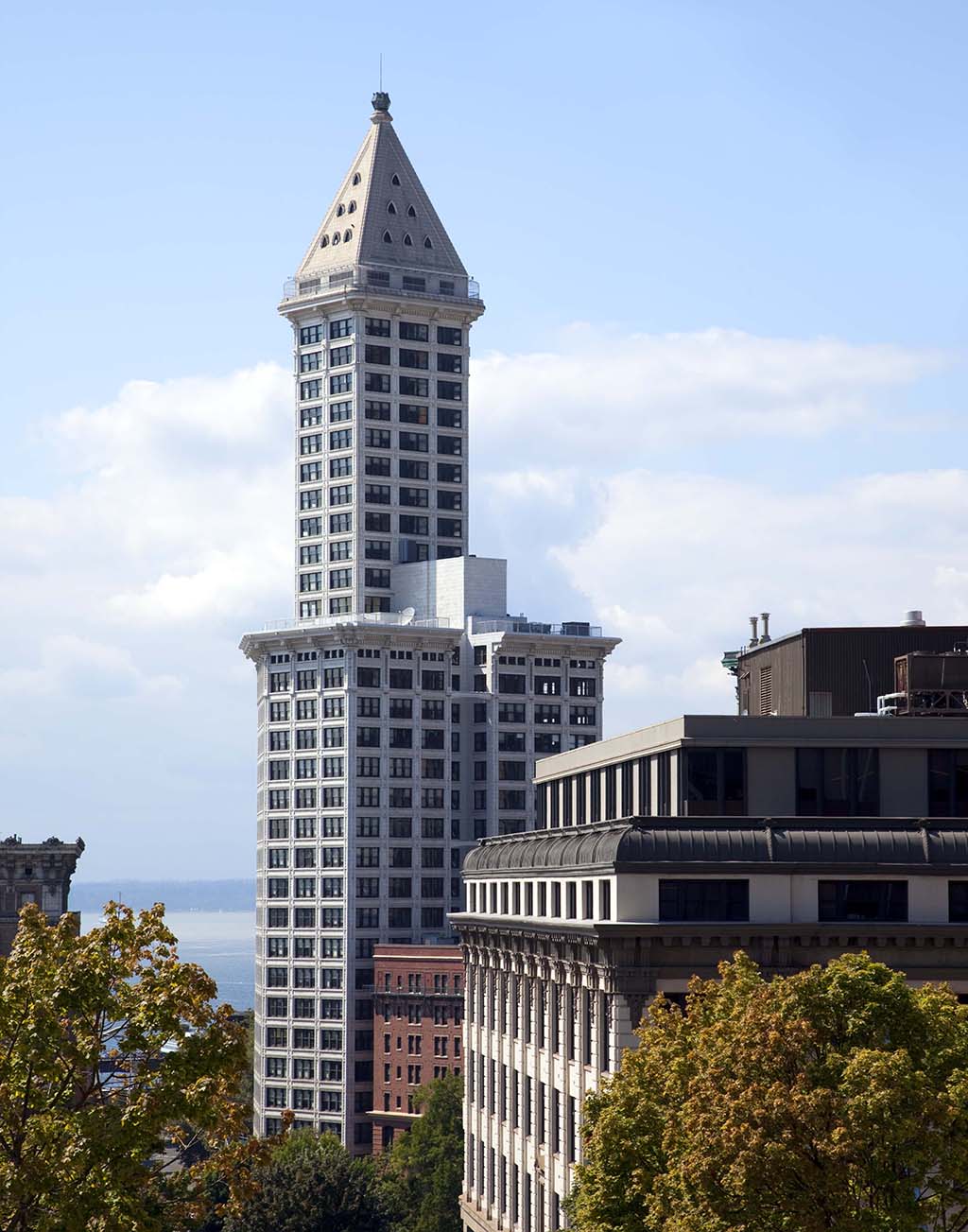
Imagine you’re riding an old elevator—wooden, creaky, with an iron grille instead of a door. The lift crawls upward, floor by floor, and you count them out loud. Five, ten, twenty, thirty-five... The doors open—and you step into a room that looks like a dream: a carved ceiling, little lanterns, an antique table, and just one chair by the window. And outside the window is all of Seattle, small and shining, like a toy city. This is the Smith Tower. And it has a secret.
The Man Who Wanted to Touch the Sky
Long ago—in 1914—one man named Lyman Cornelius Smith decided to build in Seattle the tallest building west of the Mississippi River. That’s a huge river that divides America almost in half. Everything west of it is mountains, forests, the ocean, and young cities that are only just learning how to grow upward.
Lyman Smith was a wealthy man: he made typewriters—the very ones that people used to print all letters and books before computers came along. But he wanted something more than typewriters. He wanted his name written right up in the sky.
The tower was built over two years. It rose by 38 floors—nearly 150 meters. For 1914, that was astonishing. People came to see it as a miracle. Newspapers wrote that it “pierces the clouds.” When the tower opened, offices moved in right away—lawyers, doctors, everyone who wanted to work in the highest building in the Wild West.
The Jazz Age and Dreams of Steel
The Smith Tower arrived at a special time historians call the “Jazz Age.” Jazz is music that was born in America: fast, cheerful, a little cheeky. People danced to it in big halls, wore shiny dresses, and believed that anything was possible. Cities seemed to grow upward as if they were competing—who could be higher, prettier, braver.
That’s when architects—people who figure out what buildings will look like—began to dream about skyscrapers. They said, “Why build outward when you can build upward?” The Smith Tower was one of the first such dreams on the West Coast. It was made of white terra cotta—special facing tiles—and looked dressed up, almost like a cake with a complex pattern. From below it seemed light, though inside it hid a heavy steel framework—like a person’s skeleton.
In those years Seattle was a young, noisy city: a port, sawmills, gold prospectors returning from Alaska. The Smith Tower seemed to tell everyone, “We’re not a small town anymore. We’re a real city.”
The Chinese Room and the Magical Chair
But the most interesting thing is tucked away on the 35th floor. There is a so-called Chinese Room—a room with a carved wooden ceiling, lanterns, and antique furniture. According to legend, all of this was given to the tower by the Empress of China herself. Whether that’s true or just a beautiful story—no one knows for sure, but the room really does look like something out of a fairy tale.
And in a corner sits a chair. Plain-looking, wooden. It’s called the “Widow’s Chair.” And this is where the magic begins: they say that if an unmarried woman sits in this chair, she will be married within a year. Of course, it’s only a legend—there’s no real magic in the chair. But for many decades, women have made a point of going up to the 35th floor just to sit in it. Some came laughing, others quite seriously. And many later said the legend came true.
Today, there’s a small bar on this floor, and tourists from around the world come here—not just for the city view, but for that chair too. Sometimes a line forms right at the window overlooking Puget Sound Bay.
The Tower That Outlasted Its Rivals
For 11 years, the Smith Tower remained the tallest building west of the Mississippi River—until 1931, when Los Angeles built something higher. Then other skyscrapers appeared, and in Seattle itself the famous Space Needle grew. The Smith Tower stopped being the record holder.
But it didn’t become just an old building. In 2016, new owners bought it and carefully restored it—fixed the elevators, updated the halls, but kept everything old and original. Today you can once again go up to the observation deck, have lemonade on an open terrace, and, of course, sit in that very chair.
I think that’s where the special magic of the Smith Tower lies—not in records or architectural details, but in the way it preserves stories. Every building is a little treasure box: from the outside you see only walls and windows, but inside are someone’s dreams, someone’s secrets, and maybe even that one wooden chair that is still changing someone’s life.