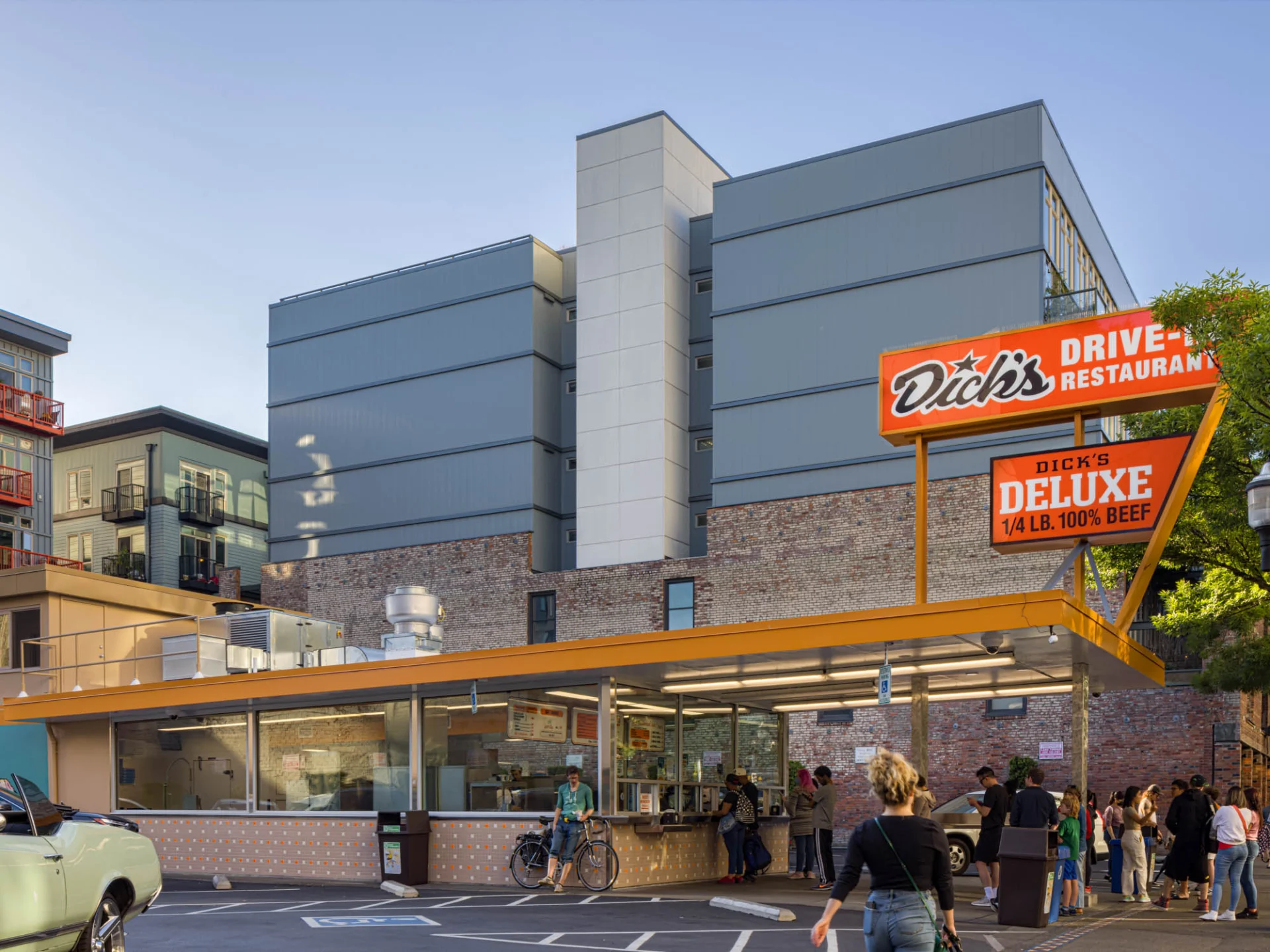
There’s a small chain of diners in Seattle with red roofs where something unusual happens: employees love their job so much they bring their own children to work there. Then those children grow up and bring their children. Three generations of one family stand behind the same counter frying french fries. Sounds like a fairy tale? But this is the real story of Dick's Drive-In — a restaurant that accidentally changed the rules of the game for an entire city.
The secret everyone saw but no one understood
Imagine a typical diner. The owner wants burgers to be cheap, so pays workers minimum wage. Employees are unhappy, often quit, and new hires must be trained constantly. Food quality fluctuates. Sounds logical, right?
Dick's Drive-In did the opposite. In 1954, when the restaurant first opened, its founder Dick Spady decided: we will pay people much more than others. Not just a little more — one-and-a-half to two times more! Plus health insurance (which fast-food workers in America usually don’t get). Plus money for college — up to $28,000 for anyone who works six months.
Everyone said, “You’ll go bankrupt! Burgers will have to be sold at steak prices!” But the opposite happened. A burger at Dick’s costs $2.70 — cheaper than at most other places. How is that possible?
The math of kindness
It turns out when people are happy at work, magic happens (though really it’s just economics). Dick’s employees stay for years. Some for decades. That means:
- No constant need to find new people. Do you know how much it costs to recruit and train a new restaurant worker? About $3,500! When people don’t leave, that money stays in your pocket.
- Experienced workers work faster. Someone who’s been flipping burgers for five years does it twice as fast as a newbie. That means you can serve more customers in the same time.
- Happy people make fewer mistakes. Less wasted food, fewer wrong orders, fewer unhappy customers.
The founder’s son, Jim Spady, once told reporters: “We could have opened 50 restaurants and become millionaires. But then we would have to treat people like cogs in a machine. We chose to stay small and treat employees like family.”
The city that copied the secret
For many years Dick’s was just a beloved diner. Students came after school, families on weekends. But in the 2010s something changed. People in Seattle began debating: should the minimum wage be higher? Many business owners shouted: “No! It will ruin small business! Prices will skyrocket!”
Then someone pointed to Dick’s Drive-In. “Look,” they said, “here’s a restaurant that has been paying $15–$16 an hour for years. It didn’t go bankrupt. Its burgers aren’t priced like gold. On the contrary — it’s thriving!”
Dick’s became living proof. Not a textbook theory, but a real place where you can buy an inexpensive burger and talk to someone who’s worked there for 12 years and sent three kids to college with money from that job.
In 2014 Seattle became the first major American city to raise the minimum wage to $15 an hour. It was a revolution. And Dick’s Drive-In — a small restaurant with five locations — played a huge role in that revolution. It showed that it works.
Ripples from a small stone
Today Dick’s model is studied in business schools. Not just as an example of kindness (though that too), but as smart business. Economists have calculated: every dollar invested in a worker’s wage returns three dollars in profit — through loyalty, quality, and speed.
Other restaurants in Seattle began to copy the model. Then — companies in other sectors. Amazon, headquartered in Seattle, raised its minimum wage to $15 for all U.S. employees in 2018 — about 350,000 people!
And at Dick’s there’s a woman named Maria. Her mother worked there in the 1980s and saved for college. Maria came in 2005 — also saving for school. In 2023 her daughter, 17-year-old Sofia, applied for a job at the same Dick’s. Three generations, one counter, one philosophy: treat people well, and they will treat you well.
The lesson from the red roof
The story of Dick’s Drive-In teaches us something important: sometimes what seems expensive actually saves money. Kindness is not a luxury or a foolishness. It’s an investment that pays off.
The small restaurant didn’t set out to change the world. It simply wanted people who fry fries and assemble burgers to live decently and send their kids to school. But that simple choice set off a chain reaction that changed a whole city, and then influenced the whole country.
Today, when you see debates about fair pay in the news, remember: somewhere in Seattle there’s a diner with a red roof that has been proving for 70 years that being kind to people is not only right, but profitable. And that one small business that believes in people can change the rules for everyone.