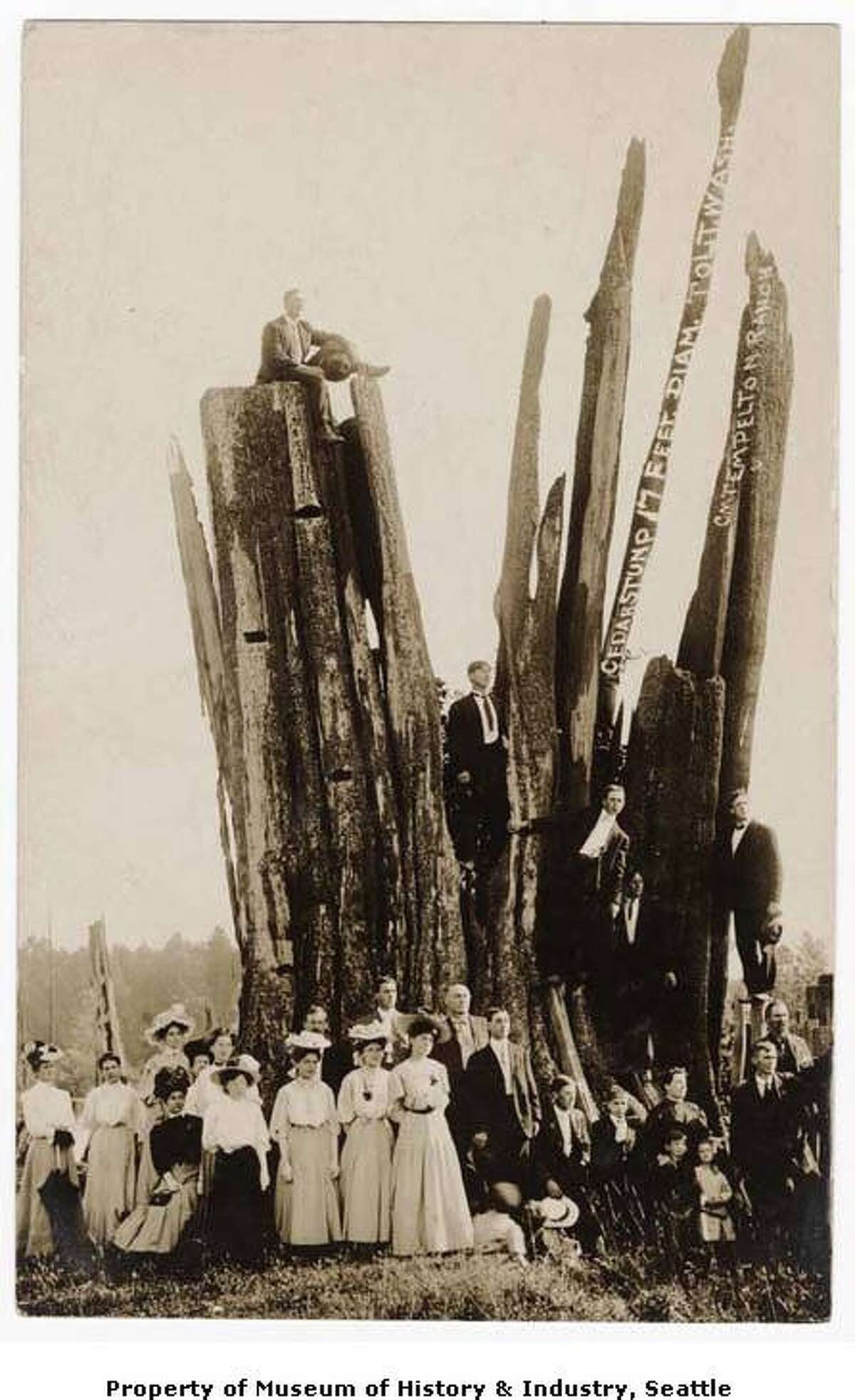
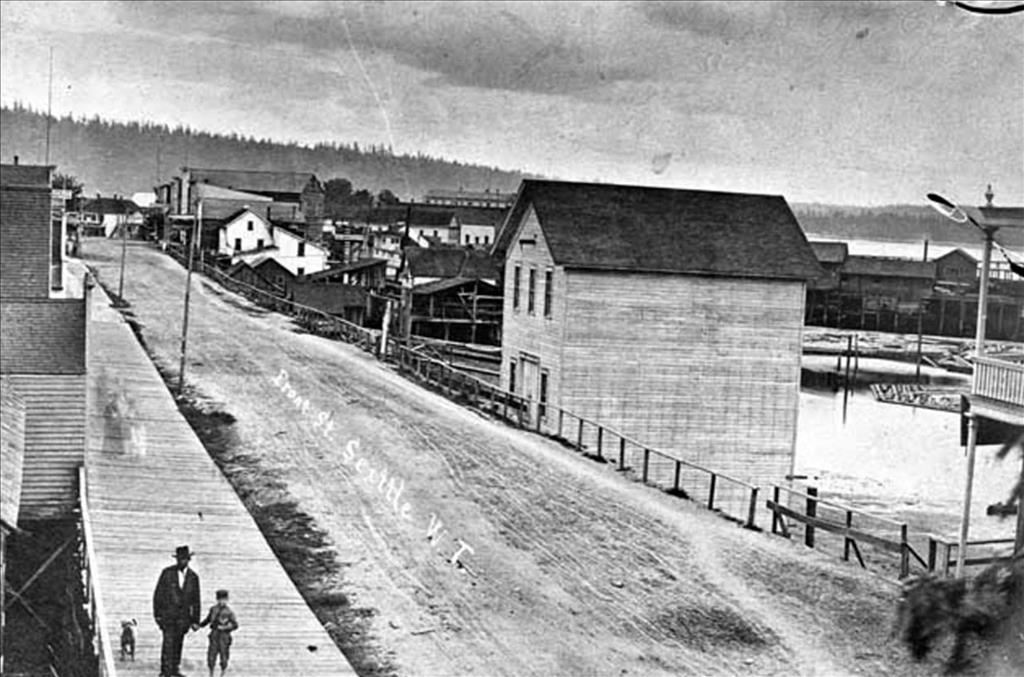
Imagine a city where, instead of benches and swings, the streets were full of huge stumps of old trees — so large that five children could sit on one. These stumps couldn't be removed because they were too hard for the tools of the time. Thus, in mid-1800s Seattle a dead forest became part of a living city, and children turned the remains of giant trees into their secret play spots.
This story didn't begin in a park or on a playground. It began with a road that was killing the forest.
The road that killed trees and created a city
In 1852 a man named Henry Yesler built Seattle’s first sawmill — a massive machine that turned trees into boards for building houses. But there was a problem: how to get the giant trees down the hill to his mill? The trees were so enormous — some cedars and firs reached 3–4 meters in diameter — that they couldn't be hauled on wagons.
Yesler came up with a clever solution. He built a special log road greased with fish oil, down which felled trees would slide under their own weight to the bay. Loggers called it the "skid road." It was the first real street in Seattle, and it was covered in fish oil slime and wood shavings.
But when the trees were cut and turned into boards, stumps remained. Hundreds of stumps. And here’s the most interesting part: these stumps proved practically indestructible. Centuries-old cedars had grown for hundreds of years, and their wood had become so dense and hard that axes just bounced off. Dynamite hadn't been invented yet. Saws broke. So Seattle residents simply... left the stumps in the streets and began building the city around them.
When the dead forest became urban furniture
Picture your city’s main street, but instead of ordinary benches and posts there are tree stumps waist-high to an adult, some even chest-high. That’s what early Seattle looked like. Photographs from the 1860s show a striking scene: wooden houses, muddy streets, and everywhere — like mushrooms after rain — giant stumps jutting up.
But residents didn’t see them as a problem. On the contrary! The stumps quickly became the most useful pieces of urban furniture one could imagine. Merchants tied horses to them. Adults used them as tables for street vending — laying out wares right on the flat cut surface. Some enterprising shop owners even carved hollows into stumps to make them more comfortable seats for customers.
For children, though, these stumps were far more important. They were islands in a sea of mud (Seattle’s streets were incredibly muddy then), forts for games, secret meeting places. Kids jumped from stump to stump to avoid dirtying their boots. They carved their initials and drawings into the wood. One longtime Seattle resident recalled in the 1920s how, as a child, he and his friends "owned" certain stumps — their personal territories where they left toys and met after school.
Ghosts of the forest that slowly disappeared
The most remarkable thing about these stumps was how long they remained in the city. Some stood for 30, 40, even 50 years! Cedar wood decomposes very slowly, especially the portion near the ground — the densest, most resinous heartwood.
Gradually the stumps began to vanish. Not because people finally learned how to uproot them, but because they slowly rotted from within. First cracks appeared. Then insects moved in. Rain washed away the core. And one fine day a stump simply fell apart into pieces, leaving behind a round patch of darker soil — the trace of roots that had reached deep beneath the pavement.
By the 1890s most stumps were gone. But they left behind something unexpected: a "ghost map" of the ancient forest. If you look at old city plans, you can notice odd bends in some buildings, unexplained gaps between houses, sidewalks that take strange turns for no visible reason. All of these are traces of stumps around which the city had been built. Architects simply worked around them because removal was impossible.
A lesson from trees that refused to go
The story of the Skid Road stumps is more than a curious fact about old Seattle. It's a story of how nature can resist even after death, and how that resistance shapes what people build.
Modern urban designers call this "ecological memory" — when traces of nature remain in the city and influence how we use it. In a sense, those ancient trees still shape Seattle. Yesler Way (formerly Skid Road) still runs at the same angle that logs slid down 170 years ago. Some buildings in the old core have odd shapes because they were constructed around stumps.
But most importantly, the stumps changed how children related to the city. While those stumps stood in the streets, children learned to play with nature right in the city center. They didn’t go "into nature" somewhere far away — nature was part of their street, part of everyday life. Perhaps that’s partly why Seattle today is known as one of America’s greenest cities, where people care about preserving trees and parks.
Sometimes the best way to build a good city is to let nature argue with your plans a little. Those stubborn stumps that refused to leave taught Seattle’s first residents an important lesson: a city and nature don't have to be enemies. They can be strange, inconvenient, but very interesting neighbors.