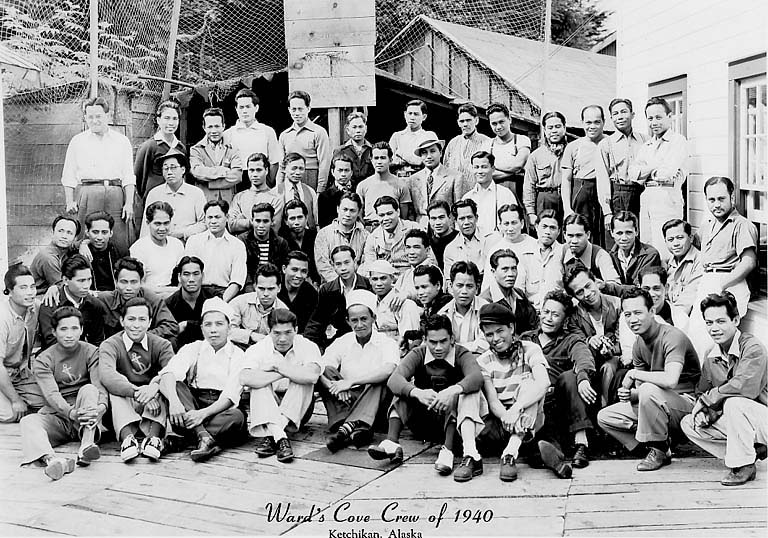
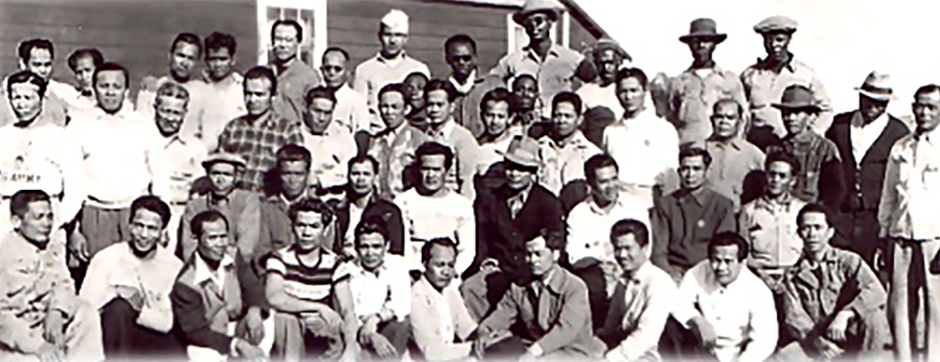
Imagine: 1933, a small Alaskan town smelling of fish and sea. Hundreds of men are sitting in tents, refusing to work at the cannery. But instead of simply waiting, they do something unusual — they take out worn textbooks and begin teaching the children of their settlement to read and write. Right in the middle of the strike, between demands for fair pay and negotiations with plant owners, a real school was born. This is the story of how education became the most powerful weapon in the struggle for justice.
Workers who crossed an ocean for a dream
Filipino workers began arriving at Alaska’s canneries and those on the West Coast of America in the 1920s. They crossed the Pacific on large ships, leaving behind their families, rice fields, and warm sun to earn money to send home. Many were only 18–25 years old — almost teenagers dreaming of a better life.
Work in the canneries was brutal. Workers stood 12–16 hours a day in cold processing rooms, their hands reddening from icy water and their fingers aching from endless cleaning and packing of salmon. They lived in cramped barracks, with 10–15 people per room. But the most insulting thing was pay: they were paid two, sometimes three times less than white workers for the exact same work.
Plant owners explained it simply: “Filipinos will work for any wage.” But that was not true. The workers had no choice — they were far from home, their English was poor, and many could not read the contracts they signed. They were cheated, and they had no way to prove it.
The strike that turned into a school
In the summer of 1933, when the salmon season began, the Filipino workers said “enough.” They demanded a wage increase from 20 cents to 40 cents an hour and better living conditions. The plant owners refused, assuming hungry workers would quickly give up. But something remarkable happened.
Older workers who could read and write organized daily classes in the strike camp. In the morning, after a breakfast of rice and fish, they gathered everyone — adults and children of the workers, even wives — and began lessons. They taught the English alphabet, explained how to read newspapers, how to understand the numbers on pay stubs, and how to write letters.
One striker, Carlos Bulosan, who later became a well-known writer, recalled: “We sat on wooden fish crates, and our teacher Domingo drew letters with coal on a large plywood board. The children repeated after him, then explained to their parents what the words in the newspapers about our strike meant.”
These lessons had a very important purpose. The workers understood that to win they had to be able to read labor laws, understand what newspapers were saying about them, and explain their case to others. Education turned them from “illiterate immigrants,” as the plant owners called them, into people who knew their rights.
Lunch lessons that taught them to count money
The cleverest invention of the strikers was the “lessons at lunch.” Every day, when the workers gathered to eat, one of them would stand up and explain the cannery’s economics. He showed with examples:
“Look, a can of salmon sells in the store for 25 cents. We clean and pack 100 cans an hour. That’s $25. And we are paid only 20 cents for that hour. Where does the rest of the money go?”
They drew diagrams on the ground with sticks, showing how profit from their labor was distributed. Children sitting nearby learned to count from these examples better than in any school. They understood that math was not just numbers in a textbook but a way to see injustice and prove it existed.
The women, the workers’ wives, also took part in these lessons. They learned to keep records of the strike fund’s expenses so everyone could see how shared money was spent. Transparency and honesty became the camp’s main rules. This mattered because plant owners tried to spread rumors that strike leaders were stealing funds.
Why education proved stronger than hunger
The strike lasted nearly three months — a very long time for people who had no wages. But the strike camp did not collapse, and here’s why: the educational programs created a real community. Children attended lessons, adults learned and taught others, and everyone felt they were part of something important rather than merely starving while waiting.
Moreover, these schools drew the attention of local residents. American families from neighboring towns began visiting the strike camp and saw not “dangerous foreigners,” as some newspapers had written, but people teaching their children and fighting for justice. Many started bringing food, books, and notebooks. Teachers from local schools came to help with English lessons.
A local priest wrote in the paper: “I saw the camp of Filipino workers. There is more order and desire for knowledge there than in many of our schools. These people deserve fair wages.”
Public opinion began to change. Plant owners realized they could not simply wait for hungry workers to give up. Too many people were now watching the situation and supporting the strikers.
A victory that changed the rules
Eventually, plant owners agreed to raise wages to 35 cents an hour — not the full 40 cents the workers demanded, but still a 75% increase over the previous pay. That was a real victory. But even more important was this: the workers won the right to written contracts in a language they could understand and to a representative who could check payroll calculations.
Many of the children who learned in the strike camp later said these lessons changed their lives. They learned the value of education not from boring moralizing but from seeing how knowledge helped their parents fight for justice. Some became the first in their families to graduate from university.
The idea of “strike schools” spread to other labor movements. Union archives from the 1930s–40s often mention educational programs during protests. Workers realized that owners fear not hungry people but educated people who know their rights and can defend them.
A lesson that continues today
The 1933 strike of Filipino cannery workers teaches us an important lesson: education is not just the ability to read and write. It is the capacity to understand the world around you, see injustice, and find ways to correct it. When people learn together, especially in hard times, they grow stronger not only through knowledge but through friendship, mutual aid, and a shared purpose.
Those workers who crossed the ocean in search of a better life faced injustice. But instead of just complaining or enduring, they took chalk, coal, and textbooks into their hands. They turned their protest camp into a place where children learned to read, adults learned to count their earned money, and everyone learned to defend their rights together.
Today, when we go to school, we rarely think that education is both a privilege and a power. But somewhere in history there are people who risked everything to learn and to teach others. The Filipino cannery workers showed that even when you have no money, no roof over your head, or no support from authorities, you still have the chance to learn. And that knowledge no one can take from you.