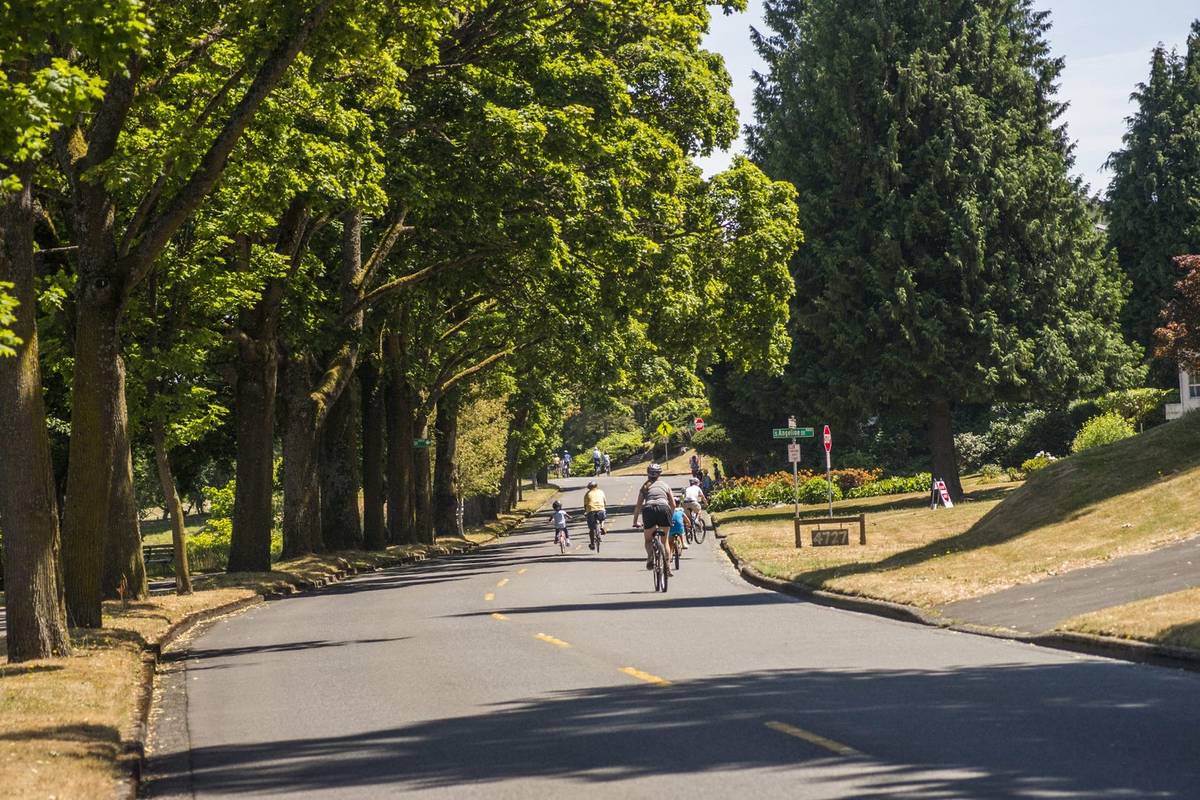
Imagine you live so close to school you could bike there in ten minutes. But your parents drive you every day because the route is too dangerous: big trucks, fast cars, and not a single bike lane. That’s how children in one Seattle neighborhood lived in the 1990s. But they didn’t accept it — and they changed the whole city.
This is the story of how ordinary families who just wanted to get to school safely accidentally invented a new kind of street. Cities across America copy these streets today. And it all started when kids picked up colored pencils and began counting cars.
Detectives with Notebooks and Stopwatches
In 1995, elementary school students in the Fremont neighborhood noticed something strange. Their quiet residential street suddenly became very noisy. Drivers had learned to use maps and discovered that cutting through the neighborhood was faster than the main road. Every morning hundreds of cars sped past houses, and children couldn’t even cross the street to play with friends.
Their teacher, Mrs. Johnson, suggested an unusual project: “Let’s become researchers and prove the problem is real.” The kids split into teams. Some stood with stopwatches and counted how many cars passed in an hour (it turned out to be more than 1,000!). Others drew maps marking all the dangerous spots. A third group surveyed neighbors and learned that three accidents had occurred near the school in the past year.
But the smartest thing they did was draw a “dream map.” On it they showed what their street could look like if it were safe for bicycles. They invented special signs, small circular plazas at intersections (to slow cars), and even drew bicycles directly on the pavement.
When the City Said “No” (and What Happened Next)
The children and their parents went to a city council meeting. They brought their maps, charts, and drawings. They explained they wanted to bike to school but were afraid. They asked the city to help make their street safe.
City officials looked at their work and said, “This is interesting, but too expensive. We don’t have money for dedicated bike lanes. Maybe in a few years.” Many families were upset. But not everyone.
A group of parents decided, “If the city can’t do this quickly, we will.” They organized what they called a “makeover Saturday.” One spring morning dozens of families took to the street with paints, brushes, and bicycle-shaped stencils. In one day they painted special symbols on the pavement to show it was a “bike street.” They put up homemade signs. Parent-engineers designed and built wooden planters at intersections so cars couldn’t speed through.
It was a little illegal — you can’t just alter a city street. But it worked. Drivers saw all the signs and symbols and began to slow down. They realized this was a special street where people, not cars, came first.
Engineering Magic That Works Without Electricity
The city could have been angry and removed everything. Instead something surprising happened: city engineers came to see what had been done and said, “This really works!” They saw traffic decrease and the remaining cars go slower. And no accidents.
Engineers explained why it worked. Drivers make decisions in fractions of a second based on what they see. If a street looks like a “fast road” (wide, straight, empty), they drive fast. But if there are lots of signs, planters, painted bikes, and circular plazas at intersections, a driver’s brain automatically thinks, “I need to be careful here.”
The city decided not only to keep what residents had done, but to improve it. They added official “Bicycle Boulevard” signs. They built proper speed humps — small raised sections in the road that cars must cross slowly, while bikes can pass through a curbside bypass. They installed traffic signals that respond to bicycles (special sensors are hidden under the pavement that detect the metal in a bike).
But the smartest invention was the “diagonal crosswalks.” At major intersections they limited cars to right turns only, while bicycles could travel straight across the intersection diagonally. That means a cyclist doesn’t have to wait through two lights as before, and cars don’t meet bikes in the same conflict zone.
How One Street Changed a Whole City
The success of that first “bicycle street” was so obvious that nearby neighborhoods wanted the same. Two years later Seattle had ten such streets. Five years later — fifty. Today the city has more than a hundred bicycle boulevards forming a network of safe roads that allow you to cross the city by bike.
But the most important change was how the city makes decisions. Now, when planning a new road or repairing an old one, city engineers always ask residents: “How do you want this to look? What do you need?” Often children come to those meetings with their drawings and ideas.
The story of that first bicycle street teaches an important lesson: you don’t have to be an adult, an engineer, or the mayor to change your surroundings. Sometimes it’s enough to notice a problem, come up with a solution, and show it to others. The kids of Fremont didn’t know they were inventing a new type of street. They just wanted to bike safely to school. But their courage and creativity showed the whole city that streets can be different — safer, friendlier, more humane.
Today many of those children have grown up. Some became engineers and urban planners. They continue to make Seattle better, remembering the day they and their parents took to the street with paints and brushes and redesigned their neighborhood. And every time a child in Seattle safely bikes to school on a dedicated street, it’s a small victory for those early activists who proved change starts with people who care.