Imagine abandoned railway tracks. Trains no longer run on them, the metal is covered in rust, and grass pushes up between the ties. Most people would say, “Tear it down and forget it.” But in Seattle in the 1970s, there were people who saw something completely different in those old tracks—and their idea changed an entire city. Not only how people got around in it, but also how much money the shops, cafés, and workshops along the route made. This is the story of how the bicycle beat the train—and why it turned out to be real magic.
When the trains left and no one knew what to do
In the late 19th century, a railway line called the Seattle, Lake Shore and Eastern Railway ran through Seattle. It carried freight and passengers along the shores of Lake Washington, through quiet residential neighborhoods and student areas. But by the middle of the 20th century, trucks and cars became more convenient than trains, and the railway gradually fell into decline. By the 1970s, the rails were simply lying there and rusting—unneeded, abandoned, a little sad.
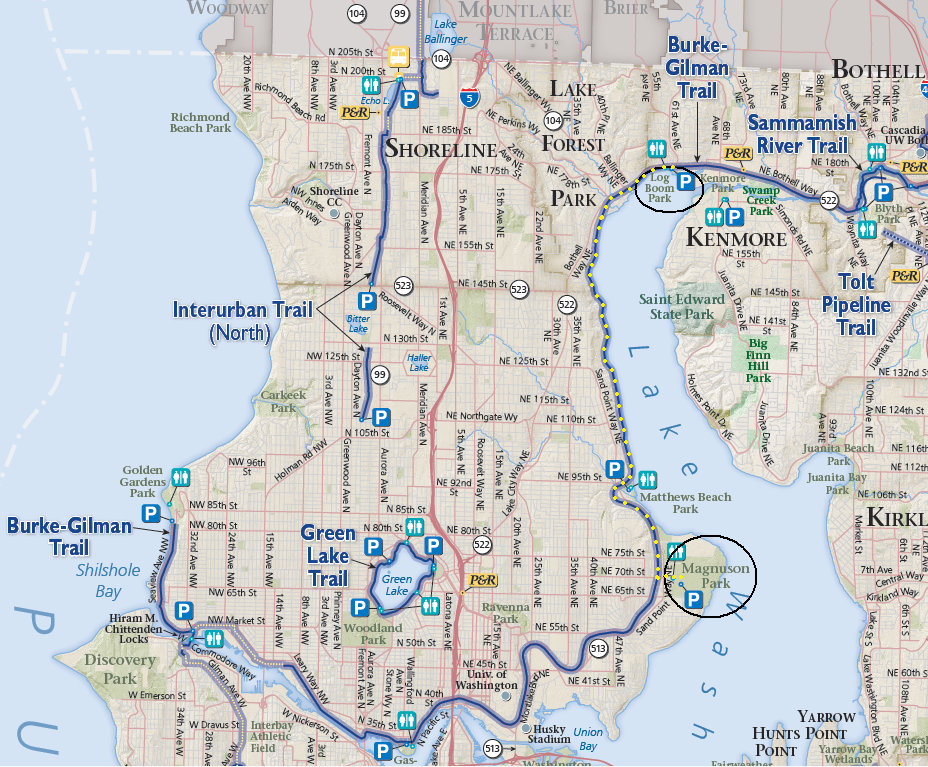
Then a group of Seattle residents proposed something unheard of: what if the old railway right-of-way were turned into a bike path? Not just drawing a line on an ordinary street, but creating a separate route—long, continuous, safe, with no cars. In 1978, the city agreed, and the Burke-Gilman Trail was born. It was one of the first projects of its kind anywhere in the United States—an experiment, and many people didn’t believe it would succeed.
Skeptics said, “Who needs a bike path? People drive cars.” But the people behind the idea thought differently. They believed that if you create a convenient and beautiful route, people would want to switch to bicycles on their own. And they were right—though the evidence didn’t appear right away, but rather years and even decades later.
How the old rails became a living street
The architects and engineers working on the Burke-Gilman Trail faced a smart challenge: how do you take an industrial corridor—straight, narrow, squeezed between buildings—and make it pleasant for people? The rails were removed, the roadway was paved with asphalt, and trees were planted along the edges. The path began to wind through the neighborhoods of Fremont, Wallingford, and the University District—past coffee shops, bookstores, and small parks.
One important detail: the trail intersects busy roads almost nowhere. It’s not just convenient—it’s fundamentally a different way of thinking about the city. Usually streets are built for cars, and people somehow fit alongside them. Here everything is the other way around: space is created for people and bicycles, while cars stay out of the picture.
One of the route’s most beloved features is the Fremont Bridge. In 2012, an electronic bicycle counter was installed on it: a large display that shows in real time how many people have ridden across the bridge each day, each month, each year. Seattle residents loved it so much that it became a real attraction. People even stop just to look at the numbers. By the mid-2010s, the counter had recorded millions of bicycle trips. This isn’t just a device anymore—it’s a monument to how many people chose to ride.
Does a bicycle bring in money? Seriously?
This is where the most surprising part begins. When other cities proposed building bike lanes, shop owners often objected: “If you remove parking for cars, nobody will come to us, and we’ll go out of business!” That seemed logical: after all, by car you can bring more purchases than a cyclist with a backpack can.
But research showed something unexpected. Cyclists and pedestrians visit shops more often than drivers. A person in a car goes straight to a big supermarket and buys everything at once. A cyclist passes by a small bakery and goes in. Then they see a flower shop—and go in again. Over the course of a week, they will spend more money at local stores than the person who drives in once a month with a huge trunk.
Along the Burke-Gilman Trail, this became noticeable very quickly. Fremont—once a quiet, somewhat dull area—turned into one of Seattle’s most vibrant and unusual corners. Cafés opened, as did art galleries, bike repair workshops, and small restaurants. Housing prices near the trail rose, because people wanted to live where it was convenient to walk and ride a bicycle. Fremont even gave itself a playful nickname—“Center of the Universe”—and put up a sign at an intersection to match. Of course, that’s a joke. But there’s truth in the joke: the neighborhood really became a special place, and the bike path played a significant role in that.
Seattle goes further: the bike revolution doesn’t stop
The success of the Burke-Gilman Trail convinced Seattle’s city planners to try something bolder. If a bike path on the edge of the city works, why not build protected bike lanes right in the center?
In 2014, the first “protected” bike lane appeared on Second Avenue in the heart of downtown Seattle. It was separated from traffic not just by a painted line, but by physical barriers—curbs, posts, and special fencing. Cyclists found themselves in their own “corridor” among the skyscrapers. It looked unusual and modern—almost like an architectural feature built into the city fabric.
Again, skeptics showed up. Again, people said it would be bad for business. And again, the data proved the opposite: the number of cyclists on that route increased several times after the protected lane opened. People who had previously been afraid to ride a bicycle through the city started to feel safe—and switched from cars and buses to bikes. Shops along the avenue didn’t go under—they gained new customers.
A small bicycle with a big heart
The story of the Burke-Gilman Trail and Seattle’s bicycle infrastructure is a story of how a small idea can change a big city. No one in 1978 could say for sure what would happen. It was a risk, an experiment, a leap into the unknown. But people tried—and the city became different.
If you think about it, there’s something very important in this: sometimes the smartest solutions look strange and unfamiliar. Turning rusty rails into a bike path sounds like a fairy tale. But those “fairy-tale” ideas sometimes change whole neighborhoods, make people happier, and make cities richer and kinder. Seattle proved that. And maybe the next city to try something similar will be yours.