Imagine you built a pretty dollhouse but accidentally closed the fridge door where your hamster’s food was kept. Something similar happened with grown-ups in Seattle: they built comfortable homes and roads, and orcas near the city began to starve. It took many years before people understood what was happening.
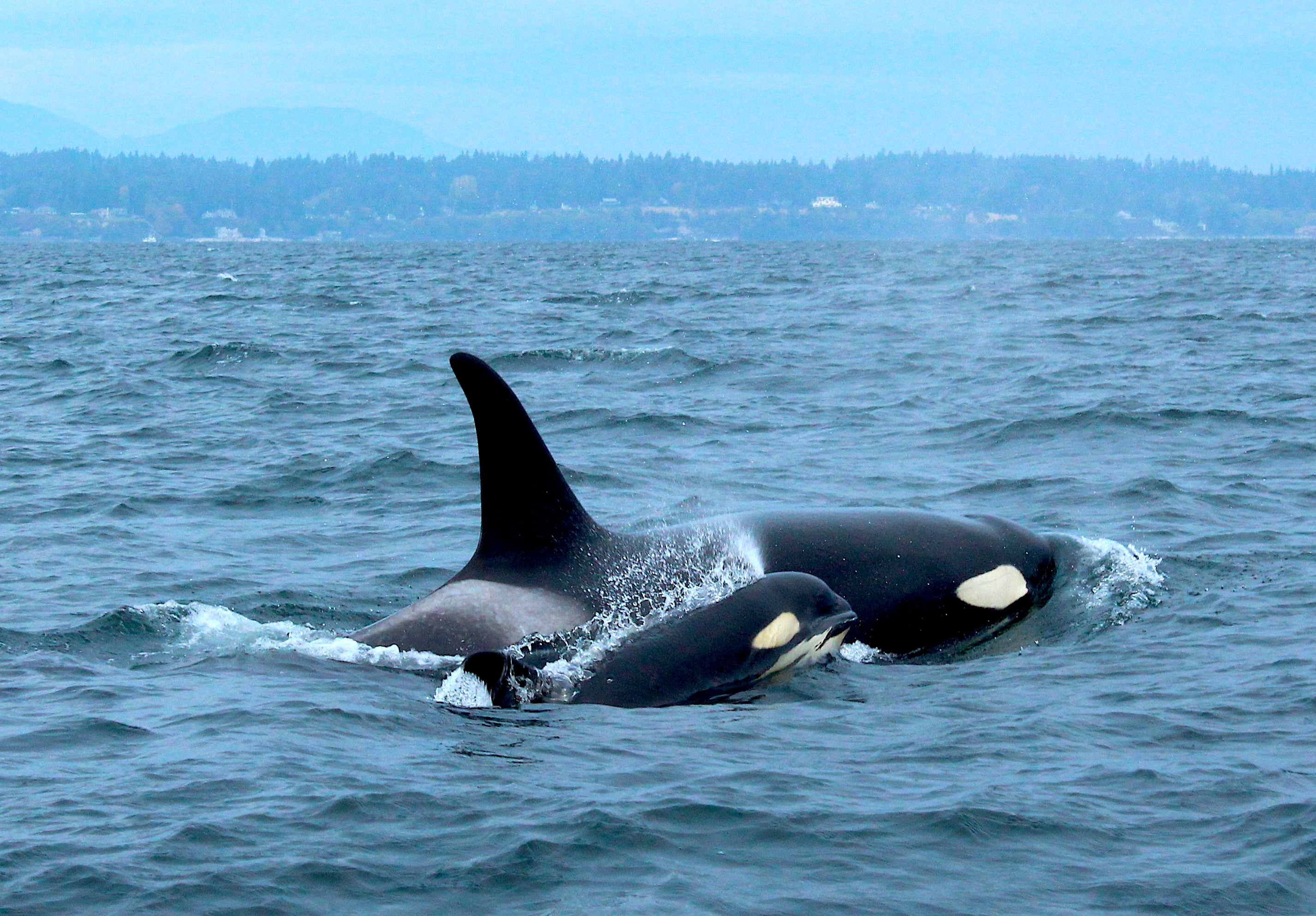
A distinct family of orcas lives in the waters around Seattle; scientists call them the Southern Resident killer whales. Now there are only about 75 individuals left — roughly the size of three school classes. By contrast, in the 1960s there were nearly 140. Orcas are disappearing, and one of the main reasons is that they’re starving. They’re starving because their favorite food has declined: the big, fatty salmon that once filled the rivers around Seattle. And here begins a surprising detective story about how roofs and parking lots are connected to hungry whales.
Rain That Became Poison
In the 1970s and 1980s Seattle grew quickly. Builders put up new neighborhoods with nice houses, shopping centers with huge parking lots, and office buildings with shiny roofs. Architects and engineers were proud of their work: they used the latest techniques. When it rained (and it rains a lot in Seattle!), water didn’t pool on the streets — it ran quickly into special pipes and flowed straight into Puget Sound, the inlet beside the city.
That seemed like a great solution: clean streets, puddles gone quickly, people stay dry. But nobody thought about what happened to that water on the way. What happened was this: rainwater washed paint residues and chemicals off roofs, oil and rubber particles off roads, and gasoline and antifreeze off parking lots. All of that turned ordinary rain into a poisonous cocktail that flowed through pipes straight into rivers and the sea.
Scientists calculated that one square meter of asphalt or concrete can send into the water as much pollution as is contained in several bottles of motor oil per year. And in Seattle and its surroundings there’s more paved area than all the city parks put together! Imagine a huge blanket of concrete and asphalt covering the land — with every rainstorm that blanket “squeezes” dirt into the water.
Detectives in Rubber Boots
For a long time no one understood the link between new buildings and disappearing salmon. Fishermen said the fish were fewer. Biologists noticed orcas losing weight and giving birth to fewer calves. But why? In the 1990s scientists launched an investigation worthy of real detectives.
They put on rubber boots and walked along the creeks that flow into the big rivers. They took water samples after every rain. What they found: in creeks running through areas with lots of buildings and roads, young salmon died within hours after rain. Simply put, mass die-offs as if someone had poisoned the water. In creeks running through forests, the fish were fine.
One experiment particularly shocked researchers. In 2011 biologist Nathaniel Scholz took clean tap water and added a bit of stormwater runoff from a busy highway near Seattle. The young salmon in that water began behaving strangely: they lost orientation, swam in circles, and then died. The culprit turned out to be a chemical called 6PPD, added to car tires to make them last longer. As tires wear on asphalt, 6PPD transforms into a compound that is deadly to salmon.
Architecture That Learns from the Forest
When the link between buildings and hungry orcas became clear, Seattle residents started devising solutions. Architects looked to the forest: there, rainwater doesn’t rush straight to the river but slowly soaks through soil, getting cleaned along the way. Plants and earth act like a massive filter.
Now Seattle has “green roofs” — roofs planted with real vegetation and grass. Such a roof soaks up rain like a sponge, so water doesn’t run off as filthy runoff. For example, the roof of a convention center downtown has a whole garden nearly the size of a soccer field! It retains millions of liters of stormwater each year.
Another invention is the “rain garden.” These are planted depressions in the ground located near parking lots and roads. When it rains, dirty water flows into these gardens, and the plants and soil clean it before it reaches the creek. In the Ballard neighborhood of Seattle they built more than a hundred such gardens, and the water quality in the local creek has noticeably improved.
Some new buildings collect rainwater in special tanks and then use it for irrigation or toilet flushing. That way the water never reaches rivers dirty. One school in Seattle installed such a system and now saves 3 million liters of clean drinking water a year!
Hope the Size of an Orca Calf
Work by marine biologist Jessica Lundin shows that the changes are working, but slowly. She says, “Every time I see an orca with a calf, my heart stops. It means the mother had enough food to carry and give birth to a baby. It’s a small victory.” But such victories are still too few.
The problem is that Seattle was built over decades, and there’s a lot of paved area. To truly help salmon and orcas, dozens of buildings and parking lots need to be remade. That’s expensive and time-consuming. Some residents propose radical ideas: for example, tearing up old parking lots and planting trees in their place. Others say we should build fewer new roads and rely more on public transit.
Interestingly, children in Seattle schools are now learning this story and creating small rain gardens at their schools. A girl named Emma told a local newspaper in an interview: “I’m sad that adults didn’t think about the orcas in the past. But I think about them now. When I grow up and become an architect, I will design buildings that help animals, not harm them.”
A Lesson for Future Builders
Seattle’s orca story teaches an important lesson: when we build something new — a house, a road, a whole city — we must think not only about people but also about the surrounding nature. Architects and engineers of the 1970s weren’t bad people. They simply didn’t know that their shiny roofs and convenient parking lots would create a problem 30–40 years later. They didn’t ask: “Where will all that rainwater go? What will it carry with it?”
Now every new building project in Seattle is reviewed by environmental specialists. They ask: “How will this building affect the nearby creek? Will stormwater be cleaned before it reaches the river? Could this harm the salmon?” This is called “environmental design,” and it’s becoming more popular.
Orcas in Puget Sound are still in danger. But because people recognized the connection between architecture and nature, there is hope. Every green roof, every rain garden, every redesigned parking lot is a small step toward bringing salmon back to the waters near Seattle and stopping the orcas from starving. And it’s a reminder to all of us: our homes and cities are not a separate world. They are part of a larger nature where everything is connected: roofs to rain, rain to creeks, creeks to salmon, and salmon to the majestic black-and-white orcas who deserve to live and thrive.