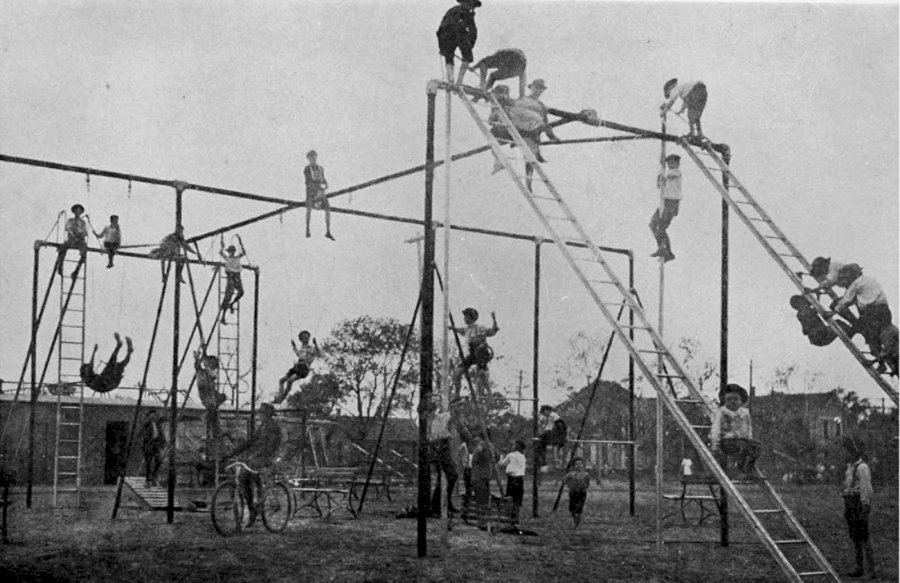
Imagine a city with not a single patch of green. No parks, no backyards, no trees—only cobblestone streets, smoke from factory chimneys, and the clatter of horse-drawn carriages. That was the world millions of children lived in in American cities in the late 19th century. And it was these children—more precisely, the adults who took up their cause—who launched a movement that ultimately gave Seattle one of the most beautiful park systems in the world.
A City That Forgot About Children
In the 1880s and 1890s, American cities grew at an astonishing pace. Factories, railroads, apartment buildings—everything was built quickly and without regard for the people who would live there. Poor neighborhoods were packed so tightly that a single family might have just one room. No yard, no garden—only the street.
And the street was dangerous. Horses, wagons, streetcars. Children played right between the wheels, and accidents were all too common. Social reformer Jane Addams, who founded the famous “Hull-House” in Chicago—a place that helped impoverished immigrants—put it this way: in working-class districts, children didn’t know what grass was. Literally. Some had never seen a living tree up close in their lives.
It seemed unfair. And gradually, people began to say so out loud.
The Movement for the Right to Play
In 1885, Boston created the first public playground for children in America—just a pile of sand in the yard of one of the schools. It sounds modest, but it was a real breakthrough. Children from poor families finally had a place where they could simply… play. Not work, not hide from horses—just play.
The idea spread quickly. All across the country, organizations sprang up demanding that city authorities build playgrounds and parks. Women’s clubs—specifically, women who often led these movements at a time when many of them still didn’t have the right to vote—gathered signatures, wrote letters, and held public meetings. They argued that if children couldn’t play, they would grow up sick and unhappy. Therefore, parks weren’t a luxury, but a necessity.
At the same time, the “City Beautiful Movement” gained momentum. Its supporters believed that if a city was beautiful, people would become better in it. Green boulevards, fountains, well-kept parks—everything should remind people of the beauty of nature they had lost when they moved to a noisy industrial city. It may sound a bit naive, but behind the idea was something important: the belief that beauty and nature belong to everyone, not just the wealthy, who had country homes and private gardens.
The Olmsted Brothers and the “Emerald Necklace”
And it was at this moment that the Olmsted brothers stepped onto the scene—John Charles and Frederick Law Olmsted, Jr. Their father, Frederick Law Olmsted, Sr., was perhaps the best-known landscape architect in America: he designed New York’s Central Park. Their father believed that nature heals the soul—that a walk among trees and green meadows could help a person cope with the stress, illness, and fatigue of city life. The sons inherited that idea and turned it into a profession