If you go for a walk in Seattle’s old downtown today, you might notice something strange underfoot. Thick glass cubes of a purple hue are set into the sidewalks in places. They look like gems embedded right into the pavement. Passersby usually don’t pay them much attention. But these little pieces of glass hold a story about how ordinary people — many of them women entrepreneurs — solved an impossible problem and accidentally created something beautiful.
This is a story about how necessity drove invention, and how invention became art.
The city that rose, and the people who stayed below
In 1889 Seattle suffered a huge fire. The entire downtown burned — wooden buildings, shops, homes. When city authorities began rebuilding Seattle, they decided to raise the streets a full story higher. The reason was simple: the old city was constantly flooded at high tide, the sewer system worked poorly, and everyone was fed up.
But here was the problem: building the new, elevated city took almost ten years. And people needed to earn money right away. Shop owners — tailors, bakers, cloth and hardware sellers — couldn’t wait ten years. Many of those proprietors were women. In those days women had a hard time finding other work, and their small shops were the family’s sole source of income.
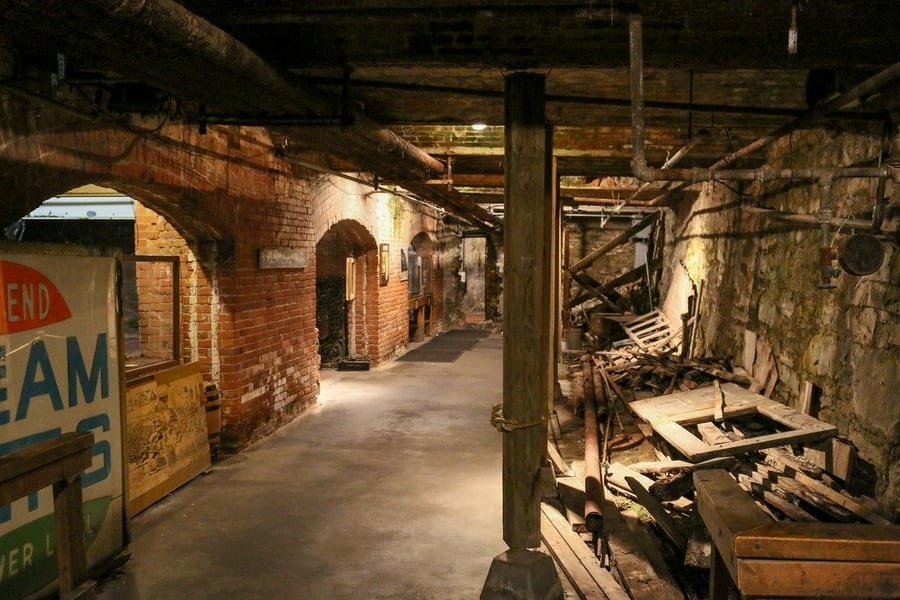
So they made a bold decision: to keep working at the old street level, which now lay underground. While new sidewalks and streets were being built overhead, they opened their shop doors, laid out goods, and served customers in the dim light. The city lived on two levels at once: above, builders erected the future; below, merchants clung to the present.
The problem of light and the purple solution
Imagine your shop ended up in a basement. Windows that once faced the street now looked into the earth. Electricity in the 1890s was scarce — light bulbs were rare and expensive. Kerosene lamps blackened with soot and could start another fire. How could you work in such darkness? How could customers see your wares?
Engineers came up with a brilliant solution: glass prisms. These were thick pieces of durable glass shaped in a special way, inserted directly into the new sidewalks above. Sunlight hit these prisms, refracted inside the glass, and was diffused downward, lighting the underground shops with natural light. They were like little windows in the floor, only much stronger — people could walk on them, and horse-drawn carts could pass over them.
The most surprising thing happened later. The glass used to make these prisms was clear. But over time — twenty, thirty, forty years — it began to change color. Sunlight, or more precisely its invisible part (ultraviolet), slowly turned clear glass purple! This happened because of manganese — a substance added to the glass to make it clearer. No one planned this effect. It was a gift of time and chemistry.
Life in a two-story city
For people of the time, shopping became an adventure. You’d descend the stairs from the new, higher street down into the dim world of the old city. Light pierced downward through the glass prisms overhead — it was strange, diffused, and cast unusual shadows. You could hear the footsteps of people above — they echoed in the underground corridors. Sometimes you could make out silhouettes through the thick pavement glass.
Shopkeepers quickly learned to use this special light. They arranged goods so that beams from the prisms fell on the prettiest items — spools of colorful thread, polished copper pots, fresh loaves of bread. A hat shop owner would specifically place her best hats under the prisms — folks said they looked especially elegant in that mysterious light.
Gradually the city moved upstairs. New buildings were completed, new shops opened at the upper level. The old underground city emptied. But the prisms remained. They were part of the sidewalk; removing them would have meant tearing up the whole street. And they continued to do their job — letting light down, even though there was no one left below.
When a practical fix becomes art
Today there aren’t many of these purple prisms left in Seattle. Many have broken over more than a hundred years. Others were replaced during road repairs. But those that remain have become more than just old pieces of glass.
They remind us that ordinary people — not heroes, not celebrities, just small shop owners — found a beautiful solution to a hard problem. They didn’t give up when their city rose a full story and left them below. They didn’t close up shop and leave. They figured out how to let light into the darkness.
And these prisms show how time can turn something ordinary into a work of art. No one intended the glass to become purple. It happened on its own, thanks to the sun, chemistry, and patience. Engineers wanted to solve a practical problem — to bring light to shops. What resulted was something beautiful — purple gems in the sidewalks that catch the sun and hold stories.
Now in Seattle these prisms are protected as historic artifacts. When old streets are repaired, workers carefully remove each prism, number it, and put it back in the same place. Artists and photographers come specifically to shoot them. Tourists look them up on maps. Children (like you!) stop and peer through the thick purple glass, trying to imagine what a shop below looked like a hundred years ago.
The light that keeps shining
The story of these prisms teaches an important lesson: sometimes the most beautiful solutions come from the hardest problems. The women and men who ran underground shops just wanted to keep working. They weren’t thinking about beauty or history. They were thinking about feeding their families, keeping their businesses alive.
But their practicality turned into poetry. Their prisms still catch sunlight on Seattle’s streets. Only now that light doesn’t illuminate shops — it illuminates memory. It reminds us that ordinary people are capable of extraordinary things. That resourcefulness can be beautiful. That sometimes, when life puts you a level down, you simply need to find a way to let light in.
And the story speaks to patience. The prisms didn’t turn purple overnight. They took decades to change from clear to colored. Some things can’t happen fast. Some kinds of beauty take time.
The next time you face a hard situation — when things don’t go as planned, when life changes unexpectedly — remember Seattle’s purple prisms. Remember the shopkeepers who didn’t give up when their city rose and left them in the dark. They found a way to let light in. And that light still shines, more than a hundred years later, more beautiful than anyone could have imagined.