Imagine walking down an ordinary street, looking down—and seeing thick glass under your feet, through which rooms with goods, lamps, and people a floor below are visible. That’s exactly how sidewalks in downtown Seattle looked more than a century ago. Engineers came up with the idea of embedding glass blocks in pavements so sunlight could reach the shops and storerooms beneath. But the most surprising thing happened later: many of these panes gradually turned purple, even though they were originally clear. This accidental magic turned a practical invention into one of the city’s most beautiful mysteries.
A city built twice: why Seattle needed glass streets
In 1889 a massive fire devastated more than 25 blocks of downtown Seattle. As residents began to rebuild, they faced a serious problem: the old city had been built too low, almost at the level of Puget Sound. During high tides the streets flooded, the sewer system performed poorly, and this created unsanitary conditions.
City authorities made a bold decision: raise the street level by a whole floor—about 3–5 meters higher than before. Merchants and shop owners couldn’t wait for the entire reconstruction to finish, so they continued to trade on the old, lower level while new streets were being built above. That’s how Seattle’s true underground city emerged: the first floors of old buildings ended up below the new sidewalks, becoming basements.
But these “basements” had a major problem—they received almost no daylight. Electricity in the 1890s was rare and expensive. Gas lamps gave little light and were hazardous. Traders needed a solution that would allow customers to see goods without spending a fortune on lighting.
Prisms that caught the sun: how glass sidewalks worked
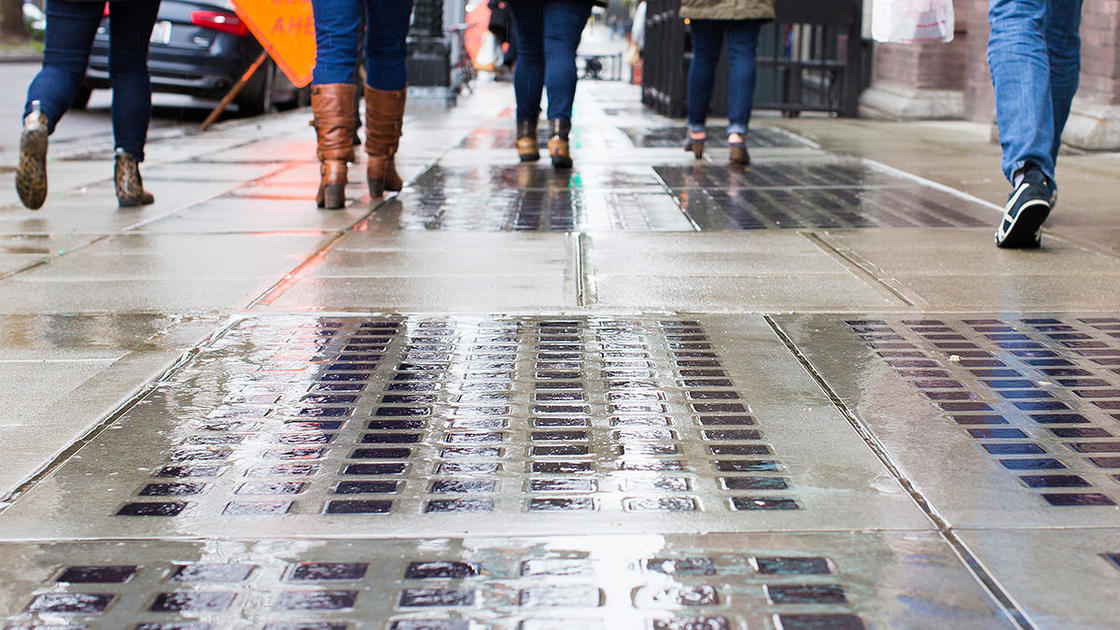
Engineers invented a brilliant solution called “vault lights.” These were thick glass blocks roughly the size of a brick, embedded directly into sidewalks and even parts of the roadway. But they were not ordinary flat glass—each block had a special shape with prismatic protrusions on the underside.
The prisms acted like tiny mirrors and lenses at once. When sunlight hit a glass block from above, the prisms refracted it and directed it downward at different angles, scattering light throughout the underground space. It worked like a chandelier with crystal pendants—one beam of light turned into many small rays that illuminated the whole room.
The glass for these blocks was made very thick—up to 10 centimeters—so it could bear the weight of people, horses, and wagons. Each block was handmade by pouring molten glass into special molds. You could walk over Seattle’s sidewalks without suspecting you were walking on glass rather than stone—the constructions were that sturdy.
The purple mystery: why the glass changed color
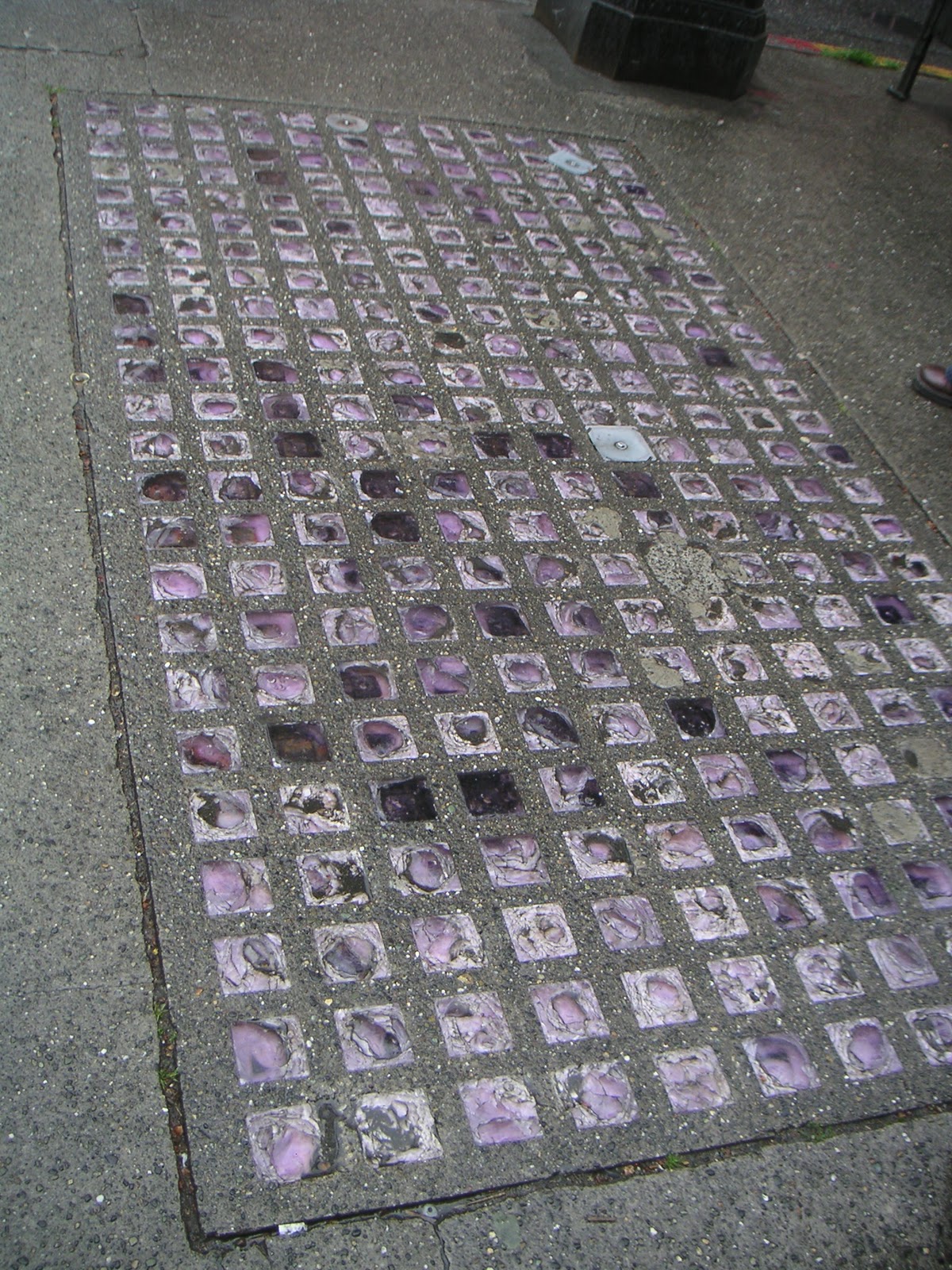
When engineers installed the glass blocks in the 1890s–1910s, all of them were clear or slightly greenish. No one intended them to be colored. But after a few decades Seattleites began to notice something strange: some sidewalk panes took on a beautiful amethyst, purple hue. Others remained clear. Why did this happen?
The answer lay in the chemical composition of the glass. In the late 19th and early 20th centuries manufacturers added a small amount of manganese to glass. This substance made glass clearer by counteracting the greenish tint imparted by iron. Manganese served as a decolorizer—similar to how bleach makes a white shirt whiter.
But no one knew what would happen if such glass remained exposed to sunlight for many years. Ultraviolet rays slowly, year after year, altered the chemical state of the manganese in the glass. This process is called “solarization.” The manganese oxidized and formed compounds that gave the glass a purple color—the very shade seen in amethysts.
Interestingly, not all blocks turned purple. Those in the shade of buildings or installed later (when manufacturers stopped using manganese) stayed clear. The result was an accidental mosaic: clear and purple panes lying side by side on the same sidewalk, telling the story of different production batches and varying amounts of sunlight.
People walking through history: what happened to Seattle’s underground
By 1907 most of the underground spaces were officially closed. New buildings were constructed with the raised street level in mind, and the need for basement commerce disappeared. Many glass blocks were filled with concrete or covered with ordinary asphalt—they were no longer needed to light empty basements.
But in the 1960s journalist and historian Bill Speidel began leading tours of the remaining sections of the Seattle Underground—the network of subterranean sidewalks and rooms of the old city. People were amazed to discover an entire layer of history beneath modern Seattle: old shopfronts, staircases that now led nowhere, and, of course, glass ceilings—the very sidewalks above which pedestrians once walked.
Today those tours attract about 100,000 visitors a year. Standing in a dim underground space and looking up, visitors see purple squares of light—glass blocks that still work, letting sunlight into the basement. It’s a strange and magical feeling: realizing that above your head is not just a ceiling but a real street with cars and people.
Preserved glass sidewalks have become so valuable they’re part of historic preservation programs. When blocks crack or break, city authorities try to find antique replacements or commission new ones made to historical specifications. Some building owners deliberately restore glass sections of sidewalks to show what the city looked like more than a century ago.
A lesson from the purple windows: when a mistake becomes a treasure
The story of Seattle’s glass sidewalks teaches an important lesson: sometimes the most interesting solutions are born of necessity, and the greatest beauty comes from accident. Engineers did not set out to create a work of art. They simply solved a practical problem: how to give light to people working underground. Glassmakers did not know their manganese additive would, in 30–40 years, turn clear blocks into purple gems.
But it was exactly this combination—thoughtful engineering and an unpredictable chemical reaction—that created what we cherish today. The purple panes in the sidewalks remind Seattle residents of a time when their city was built twice, raising entire streets one floor higher. They show how ingenuity helps solve difficult problems and how time can turn ordinary things into something special.
The next time you see something old—a weathered house, a rusty railing, cracked tile—try to imagine the story that object might tell. Maybe it, too, was someone’s brilliant solution to a problem. Maybe it, too, changed over time in a way no one could have predicted. And maybe, a hundred years from now, someone will look at objects from our era with the same wonder with which we now look at purple windows underfoot in old Seattle.