Imagine this: you’re seeing something important right in front of your eyes, but no one around you believes you—because television shows something completely different. That’s exactly what a group of ordinary people in Seattle faced back in 1999—and their answer changed the entire internet.
A Big Argument on the City Streets
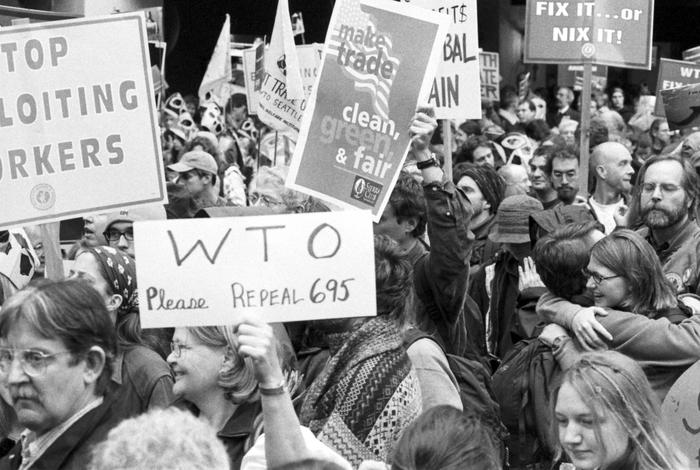
In late November 1999, very important people came to Seattle—leaders from trade organizations across the globe. They were heading to a meeting called the “WTO negotiations”—an acronym for the World Trade Organization. Put simply, these people decided how countries would trade with each other: who would sell what, at what prices, and who would benefit.
But many residents didn’t agree. They felt these decisions were being made secretly, without the involvement of ordinary people—workers, farmers, teachers. Dozens of thousands took to the streets: some marched with signs and sang songs, while others were more openly angry. Police used tear gas and rubber bullets. Several blocks in the city center were sealed off. Journalists dubbed what was happening “The Battle of Seattle.”
It was loud, frightening, and incredibly important. But here’s the problem: what was on TV and what people were seeing on the streets were very different.
A Garage That Changed the Internet
While police and protesters faced off outside, something completely different was unfolding nearby, in a rented space. A small group of people—programmers, journalists, activists—put together a few computers, connected them to the internet through a regular telephone line, and… started running a live report from the streets.
They called their project Independent Media Center—“Независимый медиацентр,” or simply Indymedia. The idea was simple and revolutionary at the same time: let anyone upload their own photo, write their own report, share their own video. No chief editor deciding what’s important and what isn’t. No big TV network choosing what you get to see.
Sounds familiar? Of course! That’s exactly how Instagram, TikTok, and YouTube work today. But in 1999, nothing like that existed. The Indymedia team effectively invented it—in a rented room, using old computers, just days before the protests began.
“We just wanted people to be able to tell the truth in their own words,” one of the founders later recalled.
How It Worked—and Why It Was So Hard
Today, uploading a video to the internet takes a few seconds. In 1999, it was like a feat of engineering. The internet was slow—so slow that loading a single photo could take several minutes. Real-time video was something no one even dreamed of.
But the Indymedia team found a solution. They wrote a special program—open publishing code—that allowed many people to add materials to a single site at the same time. They compressed video into tiny files so it could still be transmitted over slow lines. They also came up with a system where each reporter on the street could call the center and dictate their text, and an operator would publish it online right away.
In the first week, the Indymedia site was visited by more than a million people—an astonishing number for 1999, when far from everyone was using the internet. People around the world followed the events in Seattle through the eyes of the participants themselves, not through the television screen.
The software code written by the Indymedia team was released as open access—meaning any programmer anywhere in the world could take it and use it for free. And that’s what happened: over the next few years, similar independent media centers appeared in dozens of cities around the world—from London to Buenos Aires, from Nairobi to Moscow.
The Seed from Which a Forest Grew
The Indymedia story is about how injustice gives birth to invention. People were angry—not just about the trade talks. They were angry that their voices weren’t being heard. And instead of simply shouting louder, they built a new microphone—from code, wires, and stubbornness.
Of course, the Indymedia site itself eventually faded away: Facebook and Twitter did the same thing later, but more conveniently. Yet the idea—that every person can be a journalist, that news doesn’t have to flow only from top to bottom—lives on to this day in every video you record on your phone, in every post you publish, in every comment you leave.
The next time you watch a video filmed by an ordinary person on an ordinary street, remember this: somewhere in Seattle in 1999, a group of people with used computers decided the world should hear ordinary voices. And they were right.