Imagine you really want to ride your bike to school, but the road is too dangerous — cars speed by very close, and there’s no dedicated bike lane. You ask the adults to paint one, but they say “no.” What would you do? That’s exactly the problem Seattle residents faced in the 1970s, and they came up with a solution that changed the whole city.
At that time Seattle was a city built only for cars. Bicycles were considered children’s toys, not real transportation. But a group of ordinary people — teachers, artists, parents — thought differently. They wanted to bike to work to avoid polluting the air and to be healthier. The problem was that city officials refused to build dedicated bike lanes for them. So these people decided: if no one will paint bike lanes, we will paint them ourselves.
A Secret Operation with Buckets of Paint
On a cold autumn night in 1977 a few members of the Cascade Bicycle Club gathered late in the evening. They took buckets of white paint, brushes, and stencils of a bicycle. When the streets emptied out, they went onto the road and began painting.
They applied white lines along the edge of the street and painted bicycle symbols — just like real road signs, only handmade. By morning there were “bike lanes” on several streets that hadn’t been there the night before. Drivers were puzzled: did the city do this or someone else? The police didn’t know what to do — technically it was graffiti, but people just wanted safety.
The most interesting thing was that these homemade lanes worked! Drivers began to avoid the painted lines, giving cyclists more space. It was like children drawing chalk lines on a playground for hopscotch when the adults won’t draw them.
Living Barricades of People
But painting lines was only the beginning. Activists came up with an even bolder idea: they created “human bike lanes.” Here’s how it worked: on Saturday mornings a large group of cyclists would gather — sometimes 50, sometimes 100 people. They would line up in two rows on a wide street. The inner row were the regular cyclists who just rode. The outer row were “defenders,” who rode between the cyclists and the cars like a living barrier.
One participant in those actions, a teacher named Margaret, later recalled: “I was in the outer row, and my heart pounded with fear. But I understood: if I ride here, between my daughter on a bike and the cars, drivers will be more careful. I was not just a cyclist — I was a living road sign.”
These “bike parades” took place every week on different streets. People were showing the city: this is how many of us want to ride bikes safely. It was like birds flying in a large flock — safer and more noticeable.
Engineers Made of Ordinary People
But the activists didn’t just protest — they became real engineer-inventors. They studied how bike lanes worked in other countries, especially the Netherlands and Denmark. They made drawings, designed schemes, and brought them to city meetings.
One activist, an architect named Peter, created a whole collection of solutions for different types of streets. For narrow streets he proposed “sharrows” — special arrows on the road indicating that cyclists can ride in the center of the lane. For wide streets — separate lanes with physical barriers. For intersections — special “bike boxes” where cyclists could wait ahead of cars for a green light.
City engineers laughed at these ideas at first. But the activists were persistent. They brought photos, accident statistics, petitions with thousands of signatures. They brought children to city meetings, and the children told how scary it was to bike to school.
How Paint Beat Indifference
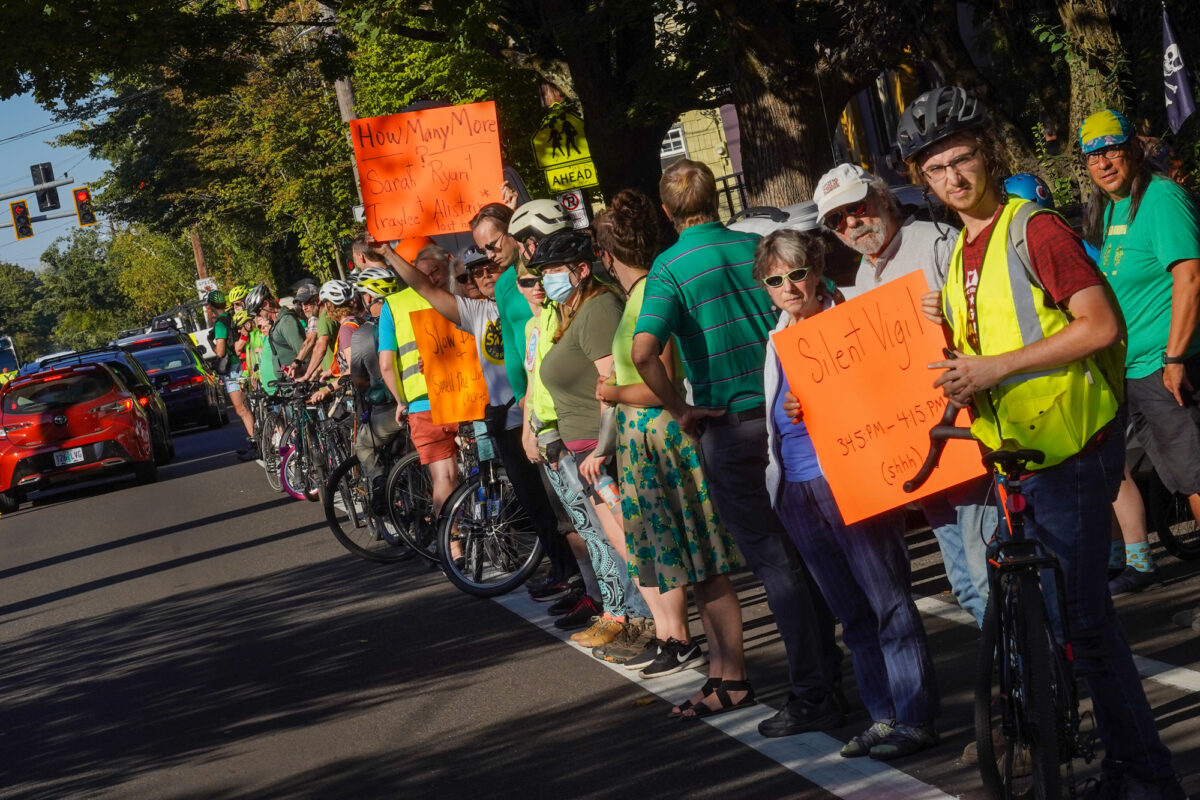
The turning point came in 1978 after a tragic incident. A young woman cyclist was killed under the wheels of a truck on a street where activists had repeatedly asked for a bike lane. The next day hundreds of people came to that street with bicycles, flowers, and candles. They stood silently, forming a human chain along the entire street.
This quiet demonstration was shown on television, and many Seattle residents for the first time wondered: why don’t we have safe roads for bikes? After that the city council finally allocated funds for the first official bike lanes.
But the activists didn’t stop. They created a “bike patrol” — a group of volunteers who rode around the city and marked dangerous spots. They compiled a map showing all hazardous intersections and streets in red. That map became the city’s work plan for the next ten years.
One of the most touching stories involves an elderly woman named Dorothy. She was 68, couldn’t drive a car, but wanted to bike to the store. She came to a city meeting and said: “I have lived in this city my whole life. I paid taxes for 50 years. Do I not deserve a safe road for my bicycle?” After her speech there was silence in the hall, then everyone began to applaud. Her words were quoted in the newspaper and became a symbol of the movement.
A City That Learned to Listen
Today, nearly 50 years later, Seattle is one of the most bike-friendly cities in America. It has more than 300 kilometers of bike lanes — about the distance from Moscow to Tver! There are dedicated bike bridges, underground bike parking, even bicycle traffic lights.
But the most important thing is not the kilometers of lanes. The most important thing is that ordinary people proved: if you see a problem and know a solution, you can change an entire city. You don’t need to be the mayor or an engineer. You need to be stubborn, creative, and ready to act.
Those nighttime artists with buckets of paint, those “living barricades” of cyclists, those people who drew maps and brought plans to boring meetings — they were ordinary people. Among them were kids your age who just wanted to get to school safely. And they won because they didn’t give up.
Today in Seattle there is a commemorative plaque on one of the first bike lanes. It reads: “Built with stubbornness and hope. 1978.” It’s a reminder that big changes start with small actions by brave people. And who knows — maybe someday you will change your city for the better too, starting with something simple: a bucket of paint, a map of dangerous spots, or simply asking “why?”.