When you hear the words “Battle for Seattle,” you immediately imagine something out of a movie: cannons, ships, heroic soldiers. And yes—some of that really happened. But the real story—one that is almost never told—is completely different. It’s the story of how a tiny town survived not because of an army, but because of friendship and trust among people who, it seemed, had no reason to be friends at all.
A Town the Size of a School
Picture January 1856. Seattle isn’t a vast modern city with skyscrapers and coffee shops on every corner. It’s a tiny settlement on the shore of a bay: several dozen wooden houses, muddy paths instead of streets, constant rain, and a dense forest right beyond the doorstep. The number of residents is about the same as the students in a big school—maybe a little more.
These people had arrived only recently, from different places, with different histories. They built sawmills, traded, and raised children. Life was hard, but it was theirs.
And just nearby, on the same lands, lived Native peoples—Duwamish, Suquamish, and others—whose ancestors had lived here for thousands of years before the first European ship ever appeared.
At the time, conflicts were unfolding across the region. Many tribes were outraged by treaties that effectively took land from them. Tensions were rising. And little Seattle found itself right in the middle of this storm.
A Warning That Saved Everyone
This is where the part of the story that’s hardly ever mentioned begins.
Among the Native people was a man that the settlers simply called—Chief Seattle. His real name sounded like Si’ahl, and he was a leader of the Duwamish and Suquamish. Many years earlier, he decided that he wanted to live in peace with the new neighbors. It wasn’t an easy decision—many of his own people saw the settlers as a threat, and in their own way they weren’t wrong. But Chief Seattle believed in something else: that negotiating was better than fighting.
And so in January 1856, when hostile warriors from other tribes began gathering around the settlement, it was the people of Chief Seattle who warned the residents about the danger. They came with a warning—quietly, without any unnecessary noise—and told them to get ready: an attack was coming soon.
Think how brave that was. At the time, many settlers viewed all Native people with suspicion, without distinguishing who was a friend and who wasn’t. And still—the Duwamish came and warned them. Because they were neighbors. Because that’s what you do when the friendship is real.
How the Whole Settlement Built a Shelter
But a warning is only half the story. The second half is what the residents did with that warning.
They didn’t panic and scatter. They started acting together.
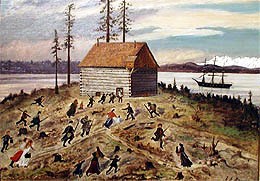
Even before the attack, the residents of Seattle built blockhouses—sturdy wooden shelters with thick walls where people could hide if danger came. They built them as one town, the way neighbors build a shared fence or paint a school before a holiday—together, helping one another. Men cut timbers; women organized food and helped take care of the children. Nobody waited for someone else to handle it.
Local residents also organized a volunteer unit—the “Seattle Rangers.” These weren’t professional soldiers, but ordinary people: carpenters, traders, farmers. They agreed to stand watch at night, monitor the forest, and pass along alarm signals. This was true neighborhood self-defense—like neighbors in the same block agreeing to look out for one another.
In the bay, the warship Decatur was anchored. Its crew was also part of this shared protection. But a single ship couldn’t do anything if the residents weren’t ready and didn’t know about the threat in advance.
The Day Everything Happened
On January 26, 1856, early in the morning, the attack began.
Residents were already in the blockhouses. Children and women were safe. Volunteers were in their positions. The ship in the bay opened fire with cannons to stop the attackers. The fighting lasted almost the entire day.
It was a terrible day. Two residents were killed—Milton Holgate and Robert Wilson. Their names should be remembered. Many were terrified. But the settlement held.
And then—this is also an important part of the story—the residents came together again. They buried the dead, cared for the wounded, and supported those who had lost loved ones. No one left a neighbor alone in grief.
After the battle, Chief Seattle and his people continued to live alongside the settlers. Their friendship proved stronger than fear.
Why This Story Matters Today
The Battle for Seattle is usually told as a military story: a ship, cannons, victory. But if you look closer, you see something entirely different.
The settlement survived because different people—settlers and Native peoples, men and women, soldiers and carpenters—chose to trust one another and act together. Chief Seattle could have stayed silent. The residents could have chosen not to build blockhouses. The volunteers could have decided it wasn’t their responsibility. But none of them did.
There’s a word—“activism.” It means when people don’t wait for someone else to solve the problem, but step in themselves. The residents of little Seattle in 1856 were exactly that kind of activists—long before the word ever became fashionable.
The city that today bears Chief Seattle’s name grew out of this tiny settlement. And perhaps most importantly, it inherited not cannons or ships, but the habit of standing together when things get difficult.