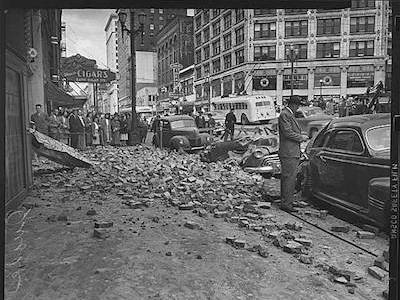
Imagine you are sitting at your school desk and suddenly everything around you starts to sway. Books fall from shelves, the chandelier rocks like a swing, and the teacher shouts, "Under the desks, quickly!" That's exactly how children in Seattle felt in the spring of 1949 when a strong earthquake struck. Many buildings cracked, some collapsed, and the city's residents realized something had to change. But who could have guessed that a few years later ordinary mothers, teachers and even schoolchildren would become true heroes who would transform the whole city and save thousands of lives?
When the ground beneath your feet turned into waves
In 1949, an earthquake of magnitude 7.1 shook Seattle. It was as if a giant grabbed the city and gave it a good shake. Eight people died, hundreds were injured, and the damage amounted to millions of dollars. But the scariest realization was that Seattle sits in a hazardous zone where the ground could "wake up" again at any moment.
Under Seattle and the entire U.S. West Coast runs a special zone where huge pieces of the Earth's crust—like giant puzzle plates—slowly move and collide with each other. Imagine placing two sheets of paper on a table and pushing them toward each other. At some point one sheet begins to slide under the other and the paper crumples. The same thing happens with the Earth's crust, only instead of paper it's rock tens of kilometers thick, and instead of crumpling you get earthquakes.
After 1949 conversations began about building houses differently. But more than a decade passed with no change. Builders said new rules would make houses too expensive. Building owners didn't want to spend money. City officials feared business would leave Seattle for other cities. Then a second earthquake hit in 1965, magnitude 6.7. This time seven people died, and schools were among the damaged buildings.
An army of moms with notebooks and children's drawings
After the 1965 earthquake something remarkable began in Seattle. A group of mothers whose children attended the damaged schools decided: enough waiting! They organized a movement they called "Safe Schools for Our Children." These women were not engineers or politicians—among them were teachers, nurses, homemakers, sales clerks. But they knew how to do the most important thing: not give up and explain important matters in simple terms.
They went door to door collecting signatures for a petition. They attended city council meetings—sometimes bringing children holding posters with drawings of cracked houses. One activist, Margaret Thomson, an elementary school teacher, had a brilliant idea: she organized "Earthquake Weeks" in schools where children learned how to behave during tremors, then took special leaflets home for their parents.
"When my seven-year-old son explained to his father why our house might fall on our heads, my husband finally agreed to come with me to the city hall meeting," Margaret recalled many years later.
The activists used a smart tactic: they invited engineers and scientists to meetings to explain how to build houses that could "dance" during an earthquake instead of breaking. Picture a tall tree in a strong wind: it bends and sways but does not break because it is flexible. Buildings should behave the same way during an earthquake.
Buildings that learned to bend, not break
By the late 1960s the movement for safer buildings had grown too powerful for city officials to ignore. In 1971 Seattle adopted new building codes—some of the strictest in the country. These rules required:
- Using special steel frames that can bend
- Strengthening the connections between walls and roofs
- Creating foundations that "float" on special pads
- Inspecting and retrofitting older buildings
Then the most interesting part began: economic disputes. Builders calculated that the new rules increased construction costs by 15–20%. Business owners protested: "We'll go bankrupt! No one will build in Seattle!" Newspapers wrote about "crazy expenditures" and "earthquake panic over events that might not happen for another hundred years."
But the activists did not back down. They created a simple table they showed everyone:
| Year | Average cost of a new building | Additional safety costs | Potential damage without protection |
|---|---|---|---|
| 1971 | $500,000 | $75,000–100,000 (15–20%) | $300,000–500,000 in an earthquake |
| 1980 | $2M | $300,000–400,000 | $1.5–2M in an earthquake |
| 1990 | $5M | $750,000–1M | $4–5M in an earthquake |
They explained: "Yes, building is more expensive. But if a building collapses, you lose everything. And if people are inside—this is no longer about money, it's about lives."
When the city chose between money and children
Debates continued for years. Some construction companies even threatened to leave Seattle. But something important happened: a new generation grew up understanding the danger of earthquakes. The children who in the 1960s participated in drills and held posters at meetings were adults by the 1980s. Many went to work for the city, became engineers, architects, teachers.
The city gradually changed. Old brick buildings were reinforced with steel beams. New skyscrapers were built using technologies that allowed them to sway during tremors like reeds in the wind. Schools became the most protected buildings in the city—after all, those very mothers had fought for their safety.
The economic effect turned out to be unexpected. Initially construction did become more expensive, and some projects were delayed. But by the mid-1980s Seattle had a reputation as one of the safest cities on the seismically active coast. When large tech companies (including Microsoft and Amazon) began arriving, they paid attention to reliable infrastructure. Servers and data centers cannot be housed in buildings that might collapse.
The earthquake that proved the moms right
In 2001, thirty years after the new codes were adopted, the Nisqually earthquake struck with magnitude 6.8. It was powerful and lasted nearly a minute—a lifetime when the earth is bucking beneath your feet. It caused several billion dollars in damage, but—crucially—in Seattle only one person died, and that was from a heart attack, not from building collapse.
Scientists calculated that had Seattle not changed its building codes in the 1970s, the damage would have been 5–7 times greater and fatalities would have been in the dozens or even hundreds. Buildings built to the new standards withstood the shakes. Some swayed so much people inside could not stand, but the structures remained intact.
Older buildings that had not been retrofitted suffered the most. Several historic brick structures sustained serious damage. That became the final proof: the city adopted a mandatory program to strengthen all old buildings. Yes, it cost money. But after the 2001 quake no one argued about the need for these expenses.
A legacy measured in lives saved
Today, walking the streets of Seattle you cannot tell at a glance which building is seismically reinforced. But if you know where to look you can spot special metal ties on old brick walls, the distinctive construction of skyscrapers, and strengthened school buildings. All of this is the result of ordinary people who were not afraid to challenge big business and city officials.
The economic impact of that movement was enormous. Seattle's construction industry became a leader in developing seismic technology. Engineers from the city consult builders worldwide. Insurance companies offer discounts on Seattle buildings because they know they are built right. And most importantly—the city avoided catastrophic losses that could have halted its development.
There is one story Seattleites like to tell. In 2015, on the 50th anniversary of the 1965 earthquake, a group of elderly women came to city hall. These were the activists from the 1960s, now in their 80s. They brought their grandchildren and great-grandchildren—schoolchildren who study in safe buildings. "We didn't fight for ourselves," one of them said. "We fought for them. And we won."
This story teaches an important lesson: sometimes the most ordinary people—mothers, teachers, neighbors—can change an entire city. You only need not to be afraid to speak up about what matters, even if it seems no one is listening. Those women were not rich or famous, but they were persistent. Thanks to them, thousands of children in Seattle today attend schools that won't fall on their heads, even if the ground begins to dance again.