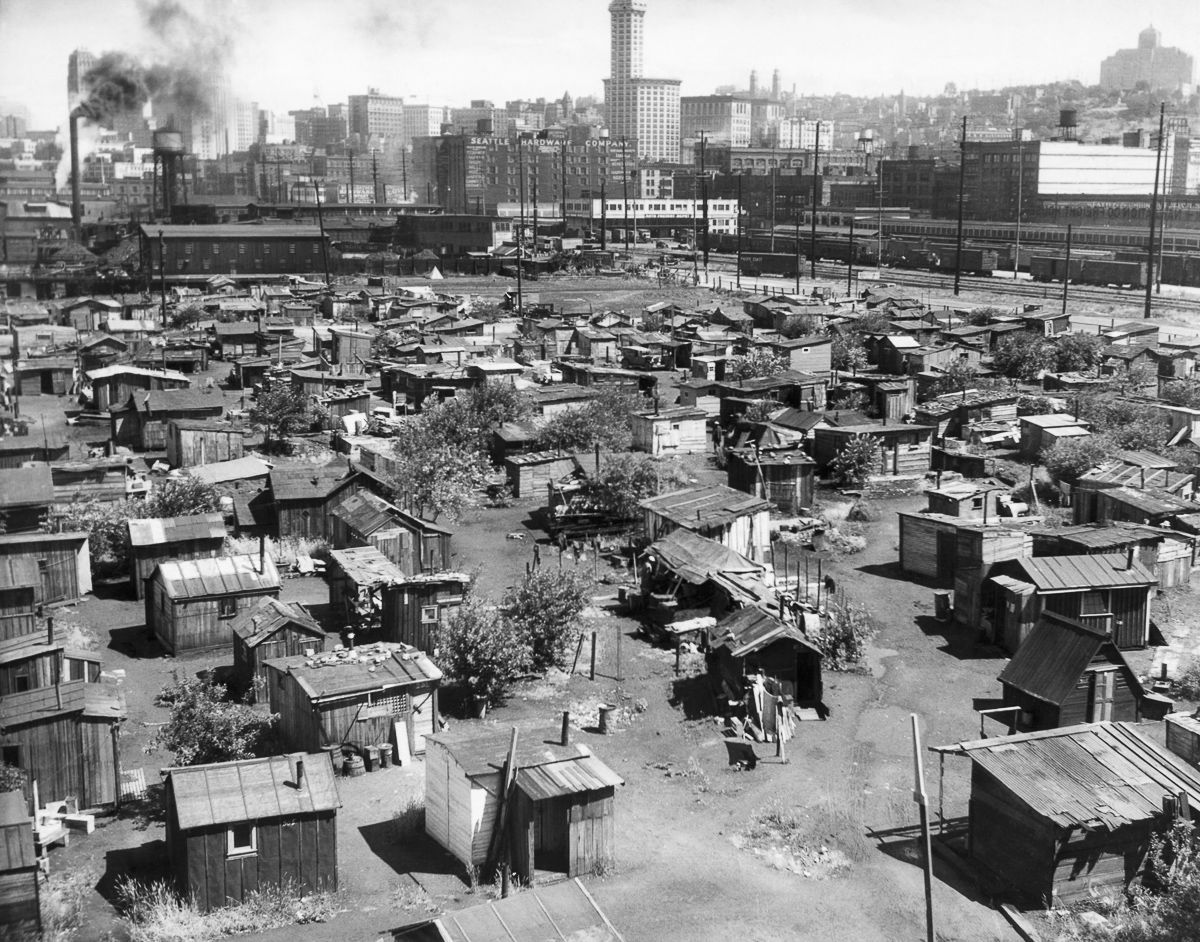
Imagine that one morning your family lost everything: your home, your money, your job. And it wasn’t just one family—it happened to thousands of people in the same city at once. What do you do? You can give up. Or you can take old planks, rusty sheets of metal, and scraps of tarpaulin and build an entire new city. That’s exactly what Seattle residents did in the 1930s. And what they came up with changed the city forever.
When Money Disappeared for Everyone at Once
In 1929, the United States suffered the Great Depression—a massive economic crisis. It sounds complicated, but it’s easy to explain: banks, shops, and factories suddenly stopped working, like a broken machine. People lost their jobs, couldn’t pay for housing, and ended up on the streets. Not because they were bad or lazy—simply because the whole system broke all at once.
In Seattle, as across America, thousands of people found themselves without a roof over their heads. City officials didn’t know what to do. There weren’t enough shelters. So people began settling on empty, dirty riverbanks south of the city center—where the giant Lumen Field stadium stands today, home to the Seattle Seahawks football team. The place was called Hooverville, in mockery of President Herbert Hoover, whom many blamed for the crisis.
By 1931, about 1,200 people lived there. They built little homes out of whatever they could find: old boards, pieces of sheet metal, cardboard, and tarpaulin. The homes were small, crooked, and cold in winter. But they were their homes. And soon it became clear that the Hooverville residents could do something surprising.
A City That Invented Itself
This is where it gets really interesting. Most people think that if someone doesn’t have a home and money, they can’t organize anything. The residents of Seattle’s Hooverville proved the opposite.
They held elections. Real ones—like in a real city. Residents voted and chose a mayor and a council. The council set rules: no fighting, no stealing, disputes handled together—not with fists. If someone broke the rules, they could be asked to leave. That was serious: there was nowhere else to go.
When city authorities tried several times to tear down Hooverville, residents didn’t just run away—they went to officials and talked. They explained, argued, and got their way. They weren’t helpless. They were a community.
Sociologists from the University of Washington—scientists who study how people live together—came to Hooverville specifically to document everything. One of them, a student named Donald Roy, even lived there for a time to understand how this little makeshift country worked. What he saw amazed him: people who had lost everything were able to create a functioning society—with rules, leaders, and mutual help.
A City Where Everyone Was Different—and That Was Normal
Another thing that surprises historians: Hooverville was unusually diverse for its time. In the 1930s, America was deeply divided: white and Black people often lived separately, and newcomers from other countries were frequently viewed with suspicion. But in Hooverville, white Americans, Black residents, Filipinos, Mexicans, people from different countries and cultures lived side by side.
Why? Probably because when everyone shares the same kind of hardship, differences start to feel less important. When you have to put out a fire together or share food, it doesn’t matter much where you’re from. That doesn’t mean everything in Hooverville was perfect—conflicts did happen. But the very fact of such neighboring in those years was something rare and significant.
Historians say that this experience—living next to people unlike yourself and solving problems together—left a mark on Seattle’s character. The city is still known for its openness and willingness to protect the rights of different kinds of people.
What Remained of the City of Boards
In 1941, city authorities finally demolished Hooverville—officially due to sanitation requirements. The residents dispersed, each going their own way. The wooden homes were burned. It seemed like the story was over.
But it wasn’t.
Today, a huge stadium stands on that very site. Tens of thousands of people go there to cheer for their favorite team. Few of them know that beneath the stands—literally—lies the ground where small, crooked homes once stood and where people lived who invented their own rules.
And the spirit of Hooverville—the idea that ordinary people can organize themselves and solve their problems without waiting for someone big and important to come along and fix everything—hasn’t gone away. Seattle is known as one of the most active cities in America: people here often come together to fight for justice, defend their neighborhoods, and help their neighbors. Historians and residents alike often say that this tradition traces its roots back to exactly that—back to the city of boards on a dirty riverbank.
A Lesson That Didn’t Burn Along With the Homes
There’s something very important in this story. People who had almost nothing managed to do something that turned out stronger than any wealth: they believed they could decide for themselves how they would live. They didn’t wait for permission. They just started.
Hooverville has long disappeared from the map. But every time Seattle residents gather to change something in their city—without even realizing it—they continue what the people in those homes made of old boards began nearly a hundred years ago. Sometimes the most important things are built not from stone and glass, but from determination and mutual trust.