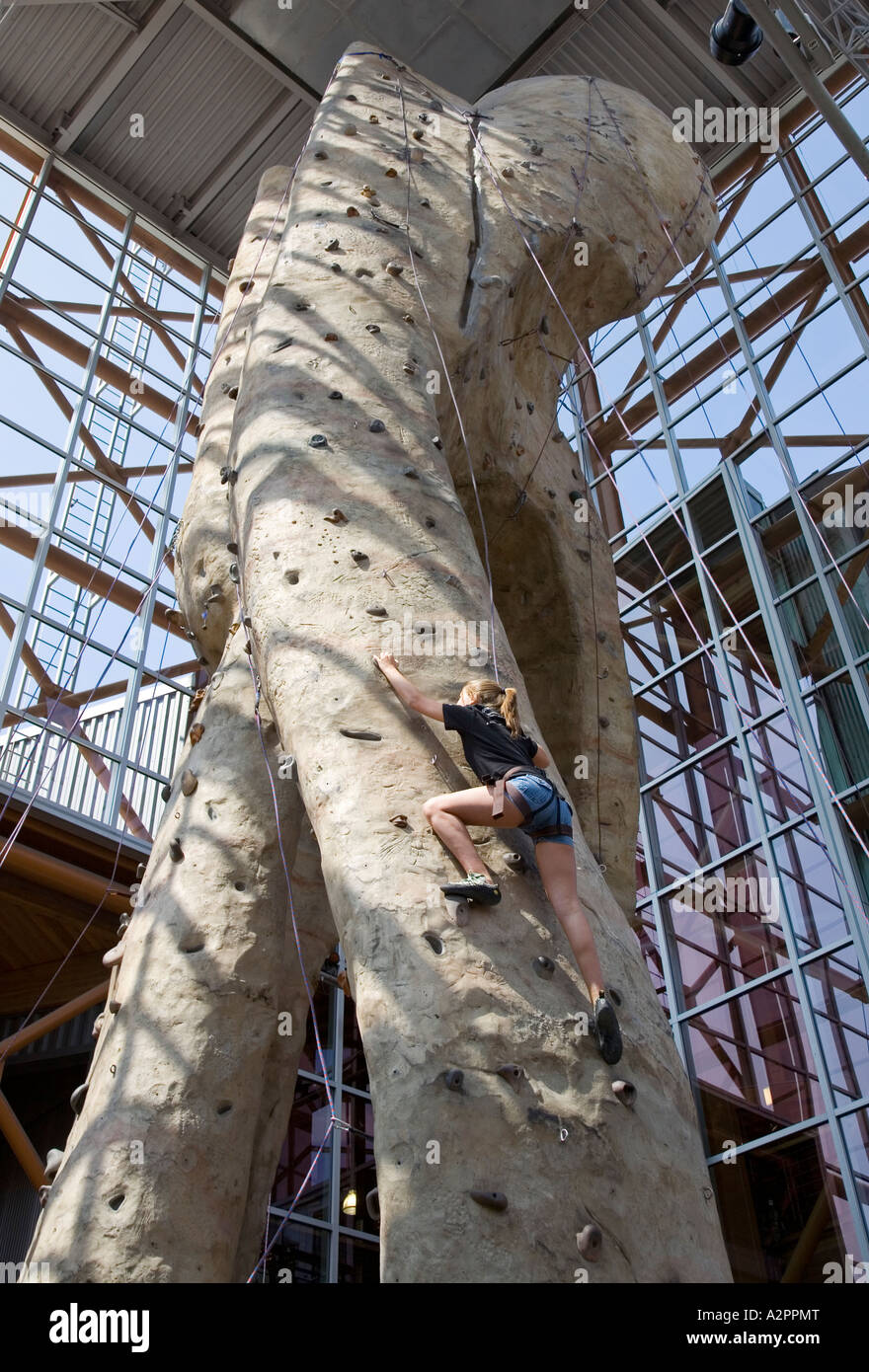
Imagine this: you walk into a store to buy a backpack — and suddenly you see, right in front of you, a real cliff. Not a picture, not some toy little hill, but a huge stone wall as tall as a six-story building, which people are climbing right now. Next to it there’s a cycling path with bumps and turns, where you can ride a bicycle even before you’ve bought it. This isn’t an amusement park. It’s a store in Seattle called REI. And it’s set up in such an unusual way for one very important reason: it’s owned by its customers.
What a cooperative is — and why it matters
Imagine your class decides to buy one big telescope to watch the stars. Everyone chips in a little money, and now the telescope belongs to everyone at once. No one can secretly sell it without the others. No one takes all the profits for themselves. Together, they decide how to use it. That’s what a cooperative is — a word that comes from the Latin for “working together.”
REI works exactly like that. When you buy something there for the first time, you pay a small membership fee and become a co-owner of the store — just like more than twenty million other people across America. At the end of the year, if the store has done well, each cooperative member gets back part of the money they spent. This is called a “dividend” — a kind of little gift from yourself to yourself, because you are the owner.
REI was founded in 1938 by two Seattle climbers, Lloyd and Mary Anderson. They wanted to buy good gear for the mountains, but in regular stores there was hardly any of it, and what there was cost a fortune. So they brought in friends, pooled their money, and began buying equipment directly from Europe. That’s how a small circle of outdoor enthusiasts grew into one of the most unusual stores in the world.
A building that says: “Try it yourself”
In 1996, REI built a new large store right in the center of Seattle. It was designed by the local architecture firm Mithun, and from the very beginning the architects asked themselves a strange question: “What should a store owned by customers look like?”
In a typical store, the owner wants you to buy as quickly as possible and leave — because then the next customer comes in, and the owner earns even more. That’s why ordinary stores are arranged so you don’t linger: everything is neatly laid out, the checkout is close, and the exit is nearby.
But in a cooperative, it’s the opposite. The owners are the customers themselves. What matters to them isn’t just selling fast, but selling the right way. After all, if you buy the wrong hiking boots and end up rubbing your feet, you’ll be upset. And an upset co-owner is bad for the whole cooperative.
That’s why the architects came up with a building where you don’t have to rush and you can test everything. A climbing wall isn’t decoration. It’s a tool: you put on new climbing shoes and immediately understand whether they fit well. A cycling path in the courtyard isn’t an attraction either. It’s a way to feel how a bike handles real bumps, not just a smooth store floor. Inside, there’s even simulated rain — so you can check how truly waterproof the jacket is.
Such a building costs a lot to build and maintain. A typical store owner would never agree to it — it’s simply not profitable enough. But the cooperative agreed. Because its “owners” are people who go into the mountains and want to be sure of their gear.
Architecture as honesty
There’s an expression: “Buildings don’t lie.” It means that if you look at a place closely enough, you can understand a lot about the people who built it and why.
The REI store in Seattle is one of the most honest examples of this kind of architecture. Outside, it looks a bit like a mountain cabin: wooden beams, lots of glass, greenery all around. Inside, there are high ceilings, because a real rock fits there. All of it says: “We’re about nature, about real adventures, not about pretty display windows.”
Mithun’s architects said they studied how climbers and hikers move in the mountains — how they stop, look around, check their equipment. And they tried to bring that same kind of movement into the building. The result is a store you walk through not like a supermarket — fast, straight ahead — but like a trail: slowly, with stops, and with surprise around every bend.
The important idea is this: architecture can communicate values. A huge glass skyscraper says, “We’re rich and strong.” A small wooden library says, “We’re cozy and open to everyone.” And a store with a rock inside says: “We trust you — and you can trust us.”
Why it matters today
Today, many people — especially young people — feel like ordinary large stores and companies care only about money, not about people. They’re looking for something else: places where they’re treated not like a wallet, but like a human being.
And it turns out that REI came up with an answer to that question as far back as 1938 — just using a different ownership model. Then in 1996, it brought that answer to life in stone, wood, and glass.
Today, cooperatives are appearing all over the world in increasing numbers: cooperative cafés, cooperative farms, cooperative internet providers. And many of them also think about what their buildings should look like. Because if you want to tell people “you’re the owners,” it needs to be visible not only in paperwork, but also in how the door, ceiling, and wall are set up — including the wall you can climb right inside the store.
The rock inside REI isn’t just an attraction. It’s a promise built out of concrete. And that promise still holds today.