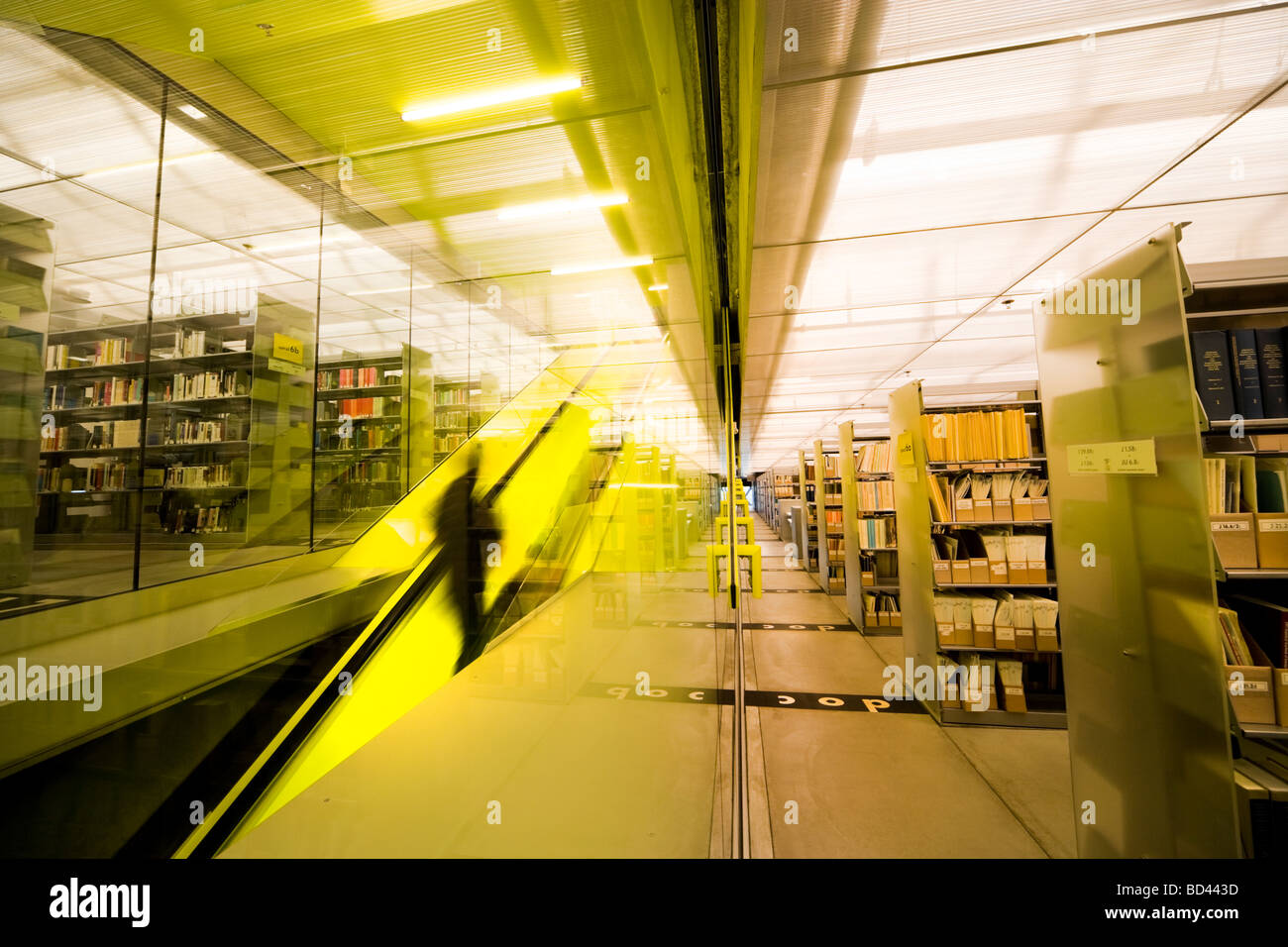
Imagine: you walk into a library and, instead of a quiet hall with wooden shelves, you see a huge glass ship. The walls tilt in different directions, as if the building were squeezed and twisted by someone. Inside are bright yellow escalators, floors that “hang” in midair, and a staircase that never ends. That’s what the Seattle Central Library looks like. And the most interesting part is that it’s strange for a reason. It’s strange because the architect first looked honestly at how people actually behave.
One question that changed everything
In the late 1990s, the city of Seattle decided to build a new main library. The old building was cramped and boring. For the project, they brought in a famous Dutch architect—Rem Koolhaas. He’s known for asking uncomfortable questions.
And the first one he asked was this: “So what do people even do in a library?”
Surely they read books—what else? But when his team observed visitors, something unexpected came to light. People in the library don’t just read. They whisper to friends. They doze in an armchair. They draw in a notebook. They simply sit and look out the window. Kids play. Someone searches for a job on a computer. Someone just warms up because it’s raining outside—and in Seattle, it rains a lot.
Koolhaas decided: if a library is a place for all of that, then the building should show it honestly. Not pretend to be a strict quiet temple where you can’t make noise and can’t move. Instead, it should become a truly living home—for people and for books at the same time.
The staircase that never ends
The most unusual part of the library is what people inside call the “books spiral,” in English—Books Spiral. It’s a long, long slanted walkway—like a gentle slide—except it goes both ways, and it runs through multiple floors. And along the entire stretch of this walkway are shelves with books about the real world: nature, science, history, animals, countries.
You just walk along this route—and without even noticing, you pass thousands of books. You don’t have to climb a staircase. You don’t have to hunt for the right floor. You simply walk and look around. And then—bam!—you see a book about octopuses. Or about volcanoes. Or a girl who lived in the jungle. You didn’t go looking for it, but it found you.
It’s a very smart idea. Architects call it “serendipitous discovery.” When you’re not searching for something specific, you end up finding something unexpected. And that unexpected thing often turns out to be the most interesting.
A secret IKEA knows
If you’ve ever been to an IKEA store—the big Swedish store with furniture and meatballs—you already know this secret. You just didn’t realize you did.
In IKEA, there are no straight routes. You enter and then follow one big winding path through the entire store. You can’t cut corners. You pass everything. And along the way you notice things you didn’t plan to buy, but they’re so cute…
Rem Koolhaas did the same—only not for purchases, but for knowledge. The books spiral is a route that leads you past everything most interesting. Only instead of going home with an extra throw pillow, you leave with a book about dinosaurs that you didn’t even think to want.
This is called “path design”—when the very arrangement of space helps you discover something new. And today, the same principle is used everywhere: in schools where classrooms are laid out so that kids accidentally meet and talk; on websites where they show you “similar articles”; even in zoos, where the route is designed to wind past the most surprising animals.
A building that tells the truth
The library opened in 2004 and immediately became famous around the world. Not everyone loved it right away—some Seattle residents said it was too strange, too cold, too much like a factory. But then people started going there. And it turned out that inside it’s very cozy. That the glass walls let in plenty of light, even on a cloudy day. That on the upper floor you can see the entire city and the bay. That the library has room both for quiet reading and for loud conversation—and just for sitting down and thinking.
Architectural critic Nikolai Urusov once wrote that a good building is one that doesn’t lie. The Seattle library doesn’t lie. It says: “People are different. They need different things. And that’s normal.”
Maybe that’s the main lesson of this story. Sometimes, to make something truly smart and beautiful, you just have to stop and look honestly—at how people actually live. At what they need. And then even a library can become a spaceship you’d want to stay in forever.