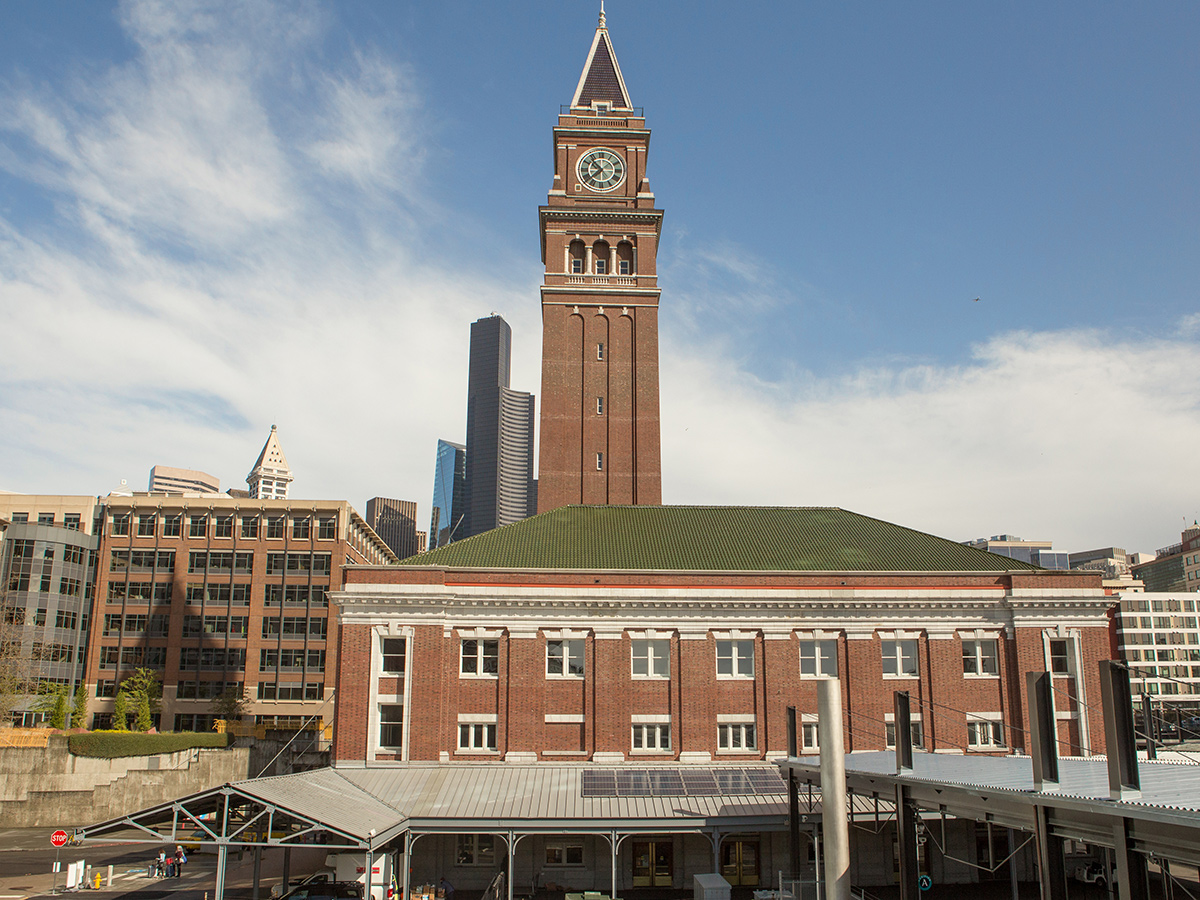
In downtown Seattle stands an old train station with a tall clock tower. More than a hundred years ago, trains arrived there every day, and people in neat uniforms and caps were always waiting nearby—the porters. Many of them were African American. They helped passengers, carried suitcases, and made up beds in the train cars. They also did something few people think about: they helped build an entire neighborhood that still preserves their history.
A Tower Like an Italian Bell Tower
King Street Station opened in 1906. Its clock tower is very tall, and it seems as though it might touch the clouds. The builders modeled it on the famous bell tower in Venice—the one in St. Mark’s Square. So if you look at the tower and squint, you can imagine yourself in Italy, even though rainy Seattle surrounds you.
For people arriving in the city, the station was like the front door of a large home. It was where their first introduction to the city began. And the porters were there to greet visitors at that “door.”
Many years later, the station looked old and tired: some of its beautiful details had been covered, and the ceiling was hidden behind new panels. But then it was carefully restored, and in 2013 its old beauty returned. The high decorative ceiling and patterns that remember those people in uniform caps can once again be seen.
Who the Porters Were and Why Their Work Mattered
The company that made sleeping cars was called Pullman. Its cars were like small hotels on wheels: passengers could eat, relax, and sleep while the train raced through the night. Sleeping-car porters kept these “hotels” in order. They carried luggage, prepared beds, polished shoes, brought water, and helped everyone on board.
The work was difficult, and the pay was not especially generous. But at the time, it was considered reliable and respectable: workers had a steady salary, a smart uniform, and the opportunity to travel across the country. For many Black families, it was a real step upward, because they were often denied other good jobs.
Most importantly, the porters became a close-knit team. In 1925, together with a leader named A. Philip Randolph, they created their own organization—the Brotherhood of Sleeping Car Porters. It was a labor union: an organization in which people join together to ask for fair working conditions. The company resisted for a very long time. But in 1937, it finally signed an agreement with them. This is considered the first major victory of a Black labor union in the United States.
Imagine several children in a class asking their teacher for something fair. One child might not be heard. But if the whole class asks together, the teacher has to listen. That is roughly how it worked.
A Home They Couldn’t Choose
The porters earned good money and dreamed of owning their own homes. But they were not allowed to live wherever they wanted. At the time, American cities had discriminatory rules: “red lines” were drawn on maps, and Black families were barred from buying homes in certain neighborhoods. Sometimes such restrictions were even written into housing contracts.
As a result, many Black residents of Seattle settled in one place—the neighborhood known as the Central District. There they bought homes, built churches, and opened stores, clubs, and barbershops. It was their own community—a large, lively, and friendly one. Neighbors knew one another by name, helped each other when someone was sick, and celebrated holidays together.
Of course, they did not choose this place freely: they simply had few other options. But they turned this forced choice into something beautiful—a neighborhood with its own music, flavor, and pride. They were not architects in the usual sense. But a city is not only its buildings; it is also the life that takes place inside them. And the people who created life in this neighborhood were the very people who built it.
How Old Decisions Affect the Present
Decades passed. Redlining was outlawed long ago, but its effects remain. The neighborhood where the porters’ descendants once built their community was conveniently located near downtown. Over time, many people wanted to live there. Housing prices began to rise, and it became difficult for many longtime residents—the children and grandchildren of those who built the neighborhood—to stay. Some had to move far from their families and roots.
Adults call this process “gentrification”—when a neighborhood becomes more expensive and fashionable newcomers gradually push out longtime residents. It is a complicated issue, and there is no simple answer. But it clearly shows how decisions made long ago can “catch up” with us many years later.
Many people in Seattle are now working to preserve the memory of what happened. They collect stories, share them in museums and schools, install plaques, and support local churches and small businesses. This helps the neighborhood remain more than just a collection of houses. It remains a place with a soul and a history.
What to Remember
It seems to me that the most important lesson in this story is this: cities are built not only by people who draw plans and lay bricks. They are also built by those who greet visitors every day, help one another, create homes filled with the smell of a delicious meal, and organize celebrations in the neighborhood. The porters in their uniform caps were people like that—modest in appearance, but remarkably strong in their determination.
If you ever find yourself at King Street Station, pause for a moment and look at the tall tower and the beautiful ceiling. Imagine the people who once stood there with suitcases, smiling at visitors, then returned in the evening to their neighborhood, where family, neighbors, and warm light shining through windows awaited them. Their story is also part of the city—and it is worth remembering.