Imagine you live in a huge city with skyscrapers and asphalt everywhere. And then you learn that right under your feet, in small streams hidden in pipes, real salmon are supposed to live — the same fish that make incredible journeys from the ocean to the mountains. But the salmon were disappearing, and nobody knew why. That's how one of Seattle's most remarkable detective stories began, with ordinary children and their neighbors as the main characters.
The Mystery of the Vanishing Fish
In the early 1990s, Seattle residents noticed something strange: city creeks that used to teeming with salmon were seeing fewer and fewer fish. Scientists puzzled over the mystery. Pacific salmon are true survival champions. They are born in the freshwater of mountain streams, then swim to the ocean where they live for several years, and later return to precisely the same place where they were born to lay their eggs. It's like you moving to another country and, five years later, finding exactly the house where you were born — without a map or GPS!
But something was interfering with these amazing fish. In Longfellow Creek, which flows through residential neighborhoods in south Seattle, salmon fry (tiny fish the size of your pinky) were dying right in the water. Biologists found strange chemicals in the city streams: motor oil, detergents, paint, even traces of gasoline. How did all this get into a natural creek?
The answer was right underfoot. Every time it rained in Seattle (and it rains a lot there!), water ran off streets, roofs, and parking lots straight into storm drains — those round grates in the road where leaves fall in autumn. People assumed that water from storm drains went to treatment facilities, like water from a toilet or sink. But it didn't. Storm drains in Seattle discharged directly into creeks and rivers, with no treatment. That meant every drop of motor oil, every cigarette butt, every paint drip from someone's brush went straight to the salmon fry.
An Army of Little Protectors
When scientists understood the problem, they realized the whole city needed to help. And then the most unexpected heroes stepped up — schoolchildren. In 1993 Seattle launched the "Salmon in the Classroom" program. Children in schools received real aquariums with salmon eggs. They watched tiny orange eggs hatch into fry with big eyes and translucent tails. They fed them, changed the water, measured the temperature. Then in spring they ceremonially released the grown fish into a nearby creek.
But that was only the beginning. Kids who had raised salmon with their own hands couldn't watch their pets swim into dirty water. Schoolchildren became real detectives. Armed with notebooks, rubber boots, and nets, they started investigating their neighborhoods. Groups of kids walked streets looking for storm drains. At each drain they took water samples, recorded what they saw nearby (an auto repair shop? a car wash? a parking lot?), and tried to figure out where the pollution was coming from.
One group of students from the Green Lake area found that the drain beside an auto shop was covered in rainbow sheen — motor oil. They photographed it, showed their teacher, who helped contact the shop owner. The mechanics simply didn't know the drain flowed to a lake where fish lived; they thought it went to treatment. After that, the shop installed oil catchers.
Fish on the Pavement
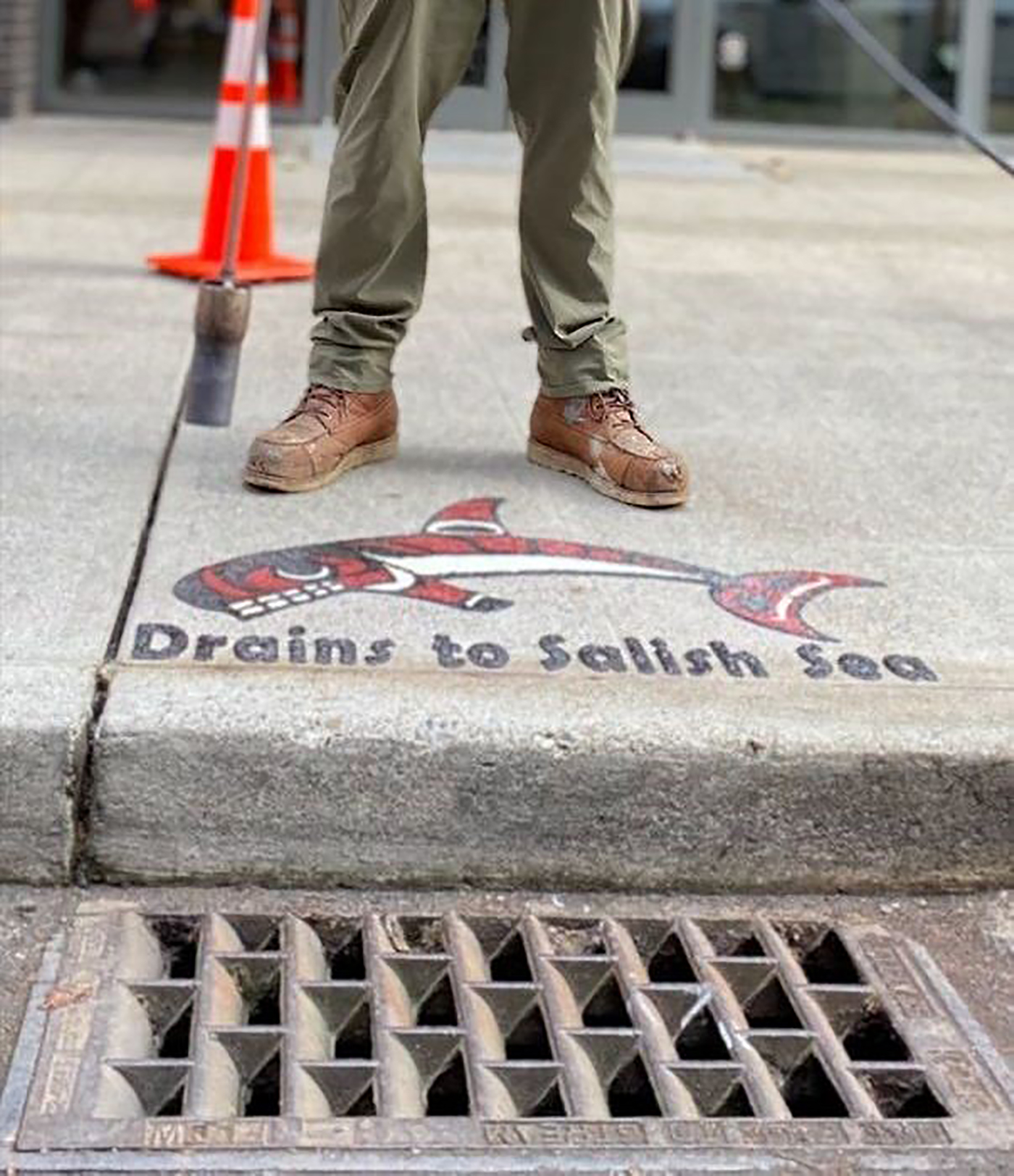
But the most famous project was the program of painting fish on storm drains. The idea was simple and brilliant: if people don't understand that water from a drain goes straight to a river, remind them. Children and adult volunteers used special paint (which doesn't wash away but is safe for the environment) and began painting a bright fish — the silhouette of a salmon — next to each storm drain. Nearby they wrote: "Dump No Waste - Drains to Stream" or "Only Rain Down the Drain."
Imagine how it looked: an ordinary gray street in rainy Seattle suddenly blooming with bright blue, green, and orange fish. Each painted fish was a little cry: "Hey, stop! Real salmon live here!" People who had been washing cars on their driveways or pouring leftover paint into drains without thinking suddenly hesitated. The fish made them stop and think.
The program spread throughout the city. By the 2000s more than 20,000 such fish had been painted across Seattle and the surrounding area. Schools organized "drain-fish painting days" like festivals. Families came: children painted, parents helped, grandparents told stories about how their local creek used to be full of fish in their childhood. It became not just an environmental project but a way to bring neighbors together.
Streams Returning Home
But the real magic began when the city decided not just to protect streams, but to bring them back to life. Many of Seattle's urban creeks had been buried in pipes early in the 20th century. People had thought open water in the city was dirty and inconvenient. Creeks were paved over with concrete and asphalt, turned into underground sewer pipes. Salmon trying to return to their natal spots found only dark concrete tunnels with no plants, no cool shade, no insects for the fry to eat.
In the late 1990s, something remarkable started to happen in Seattle. Residents of neighborhoods where creeks once flowed began demanding: "Give us our creeks back!" It was unusual. People typically want a new park or playground. Here, they wanted asphalt torn up and a creek released.
The first major project was the restoration of Thornton Creek. Engineers and ecologists worked with residents. They removed concrete walls that had narrowed the creek into a narrow channel. Instead, they gave the water room to flow freely, forming meanders and pools — the very places salmon like to lay eggs. Willows, alders, and cedars were planted along the banks — their roots stabilize the soil and their branches provide shade so the water doesn't warm too much in summer. Cold water is critical for salmon: warm water holds less oxygen, making it hard for fish to breathe.
Local residents didn't sit on the sidelines. They formed "Stream Stewards" groups. Every Saturday volunteers came to "their" stretch of creek: picking up trash, pulling invasive weeds that displace native plants, counting returning salmon. For many this became a family tradition. Parents brought children and taught them how to tell a male salmon from a female (males have a hooked jaw), how to find eggs in the gravel, and how not to scare the fish.
When the Salmon Came Back
Then came the moment everyone had waited for. In fall 1999, after several years of work, the first salmon returned to Longfellow Creek. Not one or two, as in past years, but a whole group — more than a hundred fish! News spread through the neighborhood instantly. People ran out of their houses with cameras; children skipped cartoons to rush to the creek. The students who had once released fry now stood on the bank and cried with joy: their fish had come home!
Salmon in an urban creek is more than a pretty sight. It's an indicator of the entire ecosystem's health. If salmon can live in a creek, the water is clean enough, cold enough, and rich enough in oxygen. It means there are insects for the fry to eat. It means there are plants providing shade and shelter. It means the whole system is functioning.
By the 2010s, Seattle had restored more than 30 kilometers of urban streams. Neighborhoods once considered "concrete jungles" now showed real wildlife: herons fishing, raccoons coming to drink, even otters. One Mount Baker resident said he once saw an eagle perched in a tree over a creek from his kitchen window. "I've lived in this house 40 years," he said, "and I never thought I'd see an eagle in the middle of the city."
Lessons That Changed the City
The movement to save salmon changed not only the creeks but how Seattleites view their city. Before, many thought of nature as something distant, up in national parks. The city was for people, cars, and buildings. Salmon taught Seattle residents that the city can also be part of nature. That the creek in your neighborhood is as important as a large river in the forest. That every person is connected to nature, even if they live in an apartment building.
This changed many things. When new buildings were planned in Seattle, architects began asking: "How will this affect the nearest creek?" Green roofs planted with vegetation to absorb rainwater became common, instead of routing runoff to storm drains. Rain gardens — planted basins that filter water before it reaches creeks — were built. Parking lots used permeable paving so water soaks into the ground rather than rushing to drains.
Seattle schools made "Salmon in the Classroom" a required program. Now nearly every child in the city grows a salmon fry at least once and releases it into a creek. That created a generation that understands the link between their actions and the health of nature. Children know not to pour paint down a drain because it will kill their fish.
The movement spread beyond Seattle. Cities along the Pacific coast — from Vancouver, Canada, to San Francisco, California — started their own urban stream restoration programs. Painting fish on storm drains became an international movement. The idea was so simple and clear that it was adopted even in places that never had salmon, simply as a way to remind people that drain water flows into nature.
Why This Matters to All of Us
The story of saving salmon in Seattle shows several important things. First, children can change the world. Not when they grow up, but right now. The students who painted fish on pavement and raised fry weren't scientists or politicians. They were ordinary kids who couldn't stand by. Their actions triggered a chain reaction that changed a whole city.
Second, nature is remarkably resilient if given a chance. Salmon didn't return to urban streams by themselves — people helped them. But once barriers were removed, water cleaned, and banks restored, the fish came back. Nature is ready to recover if we stop getting in its way.
Third, small actions matter. One painted fish may seem trivial. But 20,000 fish changed a city's mindset. One person who stopped washing their car on the driveway won't save a creek. But thousands of people changing habits can.
Today, if you visit Seattle in the fall you can see an amazing sight: huge salmon swimming through a creek that runs between ordinary houses, past playgrounds and bus stops. Their backs break the water as they stubbornly swim upstream to the place they were born. And on the bank stand people — children and adults — quietly watching this ancient miracle. Each of them knows: these fish are here because someone once decided it mattered. That salmon are worth fighting for. That a city can be home to both people and wildlife.
And who knows — maybe your city has a creek waiting for its defenders? Maybe you'll be the girl who paints the first fish and starts the change? Seattle's story shows: to change the world you don't need to be an adult or famous. You just need to begin.