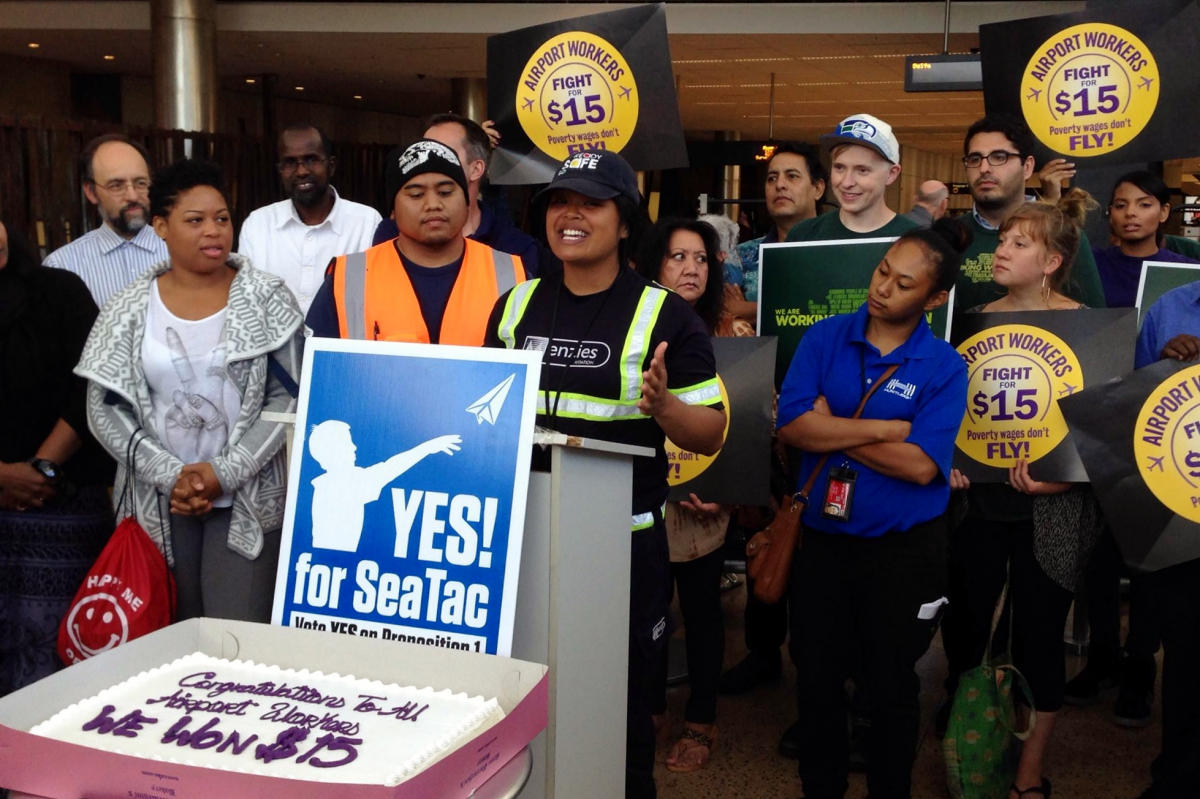
Imagine that you spent an hour helping in a store: stocking shelves, smiling at customers, and cleaning up after yourself. How much do you think you should be paid for that? Adults ask themselves this question every day too, but for them it is a very serious matter. In 2014, the American city of Seattle answered it in a new way: it decided that an hour of work should pay at least $15. And here is the most interesting part: the idea was not invented by powerful people in fancy offices, but by ordinary people who took to the streets carrying signs.
What Is the “Minimum Wage,” and Why Do People Argue About It?
Many countries have a rule in their laws called the “minimum wage.” It is the smallest amount an employer is required to pay someone for one hour of work. Paying less is not allowed, even if the employer really wants to save money.
Now imagine a school birthday cake. If you cut it into pieces that are too thin, everyone gets only a crumb. But if you make the pieces enormous, there will not be enough cake for everyone. Wages work in a similar way: some people say workers should be paid more because life in a big city is expensive—apartments, food, transportation, and everything else costs money. Others worry that small cafés and stores will not be able to afford the expense and will have to reduce their staffs. It became a major debate, and there were no simply “good” and “bad” sides: each had its own concerns.
How It Started: Signs at the Airport and in Cafés
The most interesting thing is that the first victory did not happen in Seattle itself, but in a tiny nearby city. It is called SeaTac because it lies between Seattle and Tacoma, and it is home to a major airport. In 2013, the city’s residents held a vote on whether airport and hotel workers should be paid at least $15 an hour. The result was so close that the winning margin was only about 77 votes. Imagine: if around seventy people had changed their minds, everything might have turned out differently!
Around the same time, fast-food workers in cities across the United States began going on strike. They walked out of cafés in their uniforms, held signs, and demanded $15 an hour. At first, many people laughed and said it was unrealistic. But the workers stood their ground, and talk of “fifteen dollars” began to be heard everywhere—including in Seattle.
How Everyone in Seattle Sat Down at One Table
This is what seems wisest to me about the story. Seattle Mayor Ed Murray did not simply announce a new rule. He assembled a special group called the “Income Inequality Advisory Committee.” It included business representatives, workers, unions, and community organizations. They met, argued, and sometimes disagreed, but they searched for a solution that at least most people could accept.
The result was a phased plan. Large companies had to raise wages more quickly, while small businesses were given more time. That way, no one had to jump over ten steps at once: they moved upward gradually, one step at a time. In 2014, the city council voted for the law, and, especially remarkably, all nine council members voted yes. For such a complicated issue, that was almost a miracle.
What Happened Next: The Honest Answer Is “People Still Argue About It”
Now for the most honest question: did it work well? Adult researchers are still debating that. Researchers at the University of Washington studied what happened after the increase. They found that many people’s hourly wages went up. But in some cases, employers began offering fewer working hours, so the total amount some workers earned at the end of the month did not change as much. Other studies found more encouraging results. There is no single answer, and that is normal: a city is complicated, and countless other factors affect what happens.
One thing is clear, however: Seattle’s idea spread far and wide. Other cities began discussing similar rules, and the conversation about how much an hour of work is worth grew louder.
What This Story Teaches Us
It seems to me that the main lesson is not the number “$15.” What matters most is how it happened. First, a few people said out loud what many others were thinking. Then more people joined them. After that, the decision-makers sat down and began listening—to both businesses and workers. That is how ordinary people with signs managed to change the rules for an entire city.
You know how it can be in a classroom? If one person asks for something to change, they may be turned down. But when many people support the request and the teacher is willing to listen, an interesting conversation can begin. That is exactly what Seattle did, even though it was dealing with a very grown-up issue. Scientists are still discussing how well it worked—and perhaps when you grow up, you will be able to add your own voice to the debate.