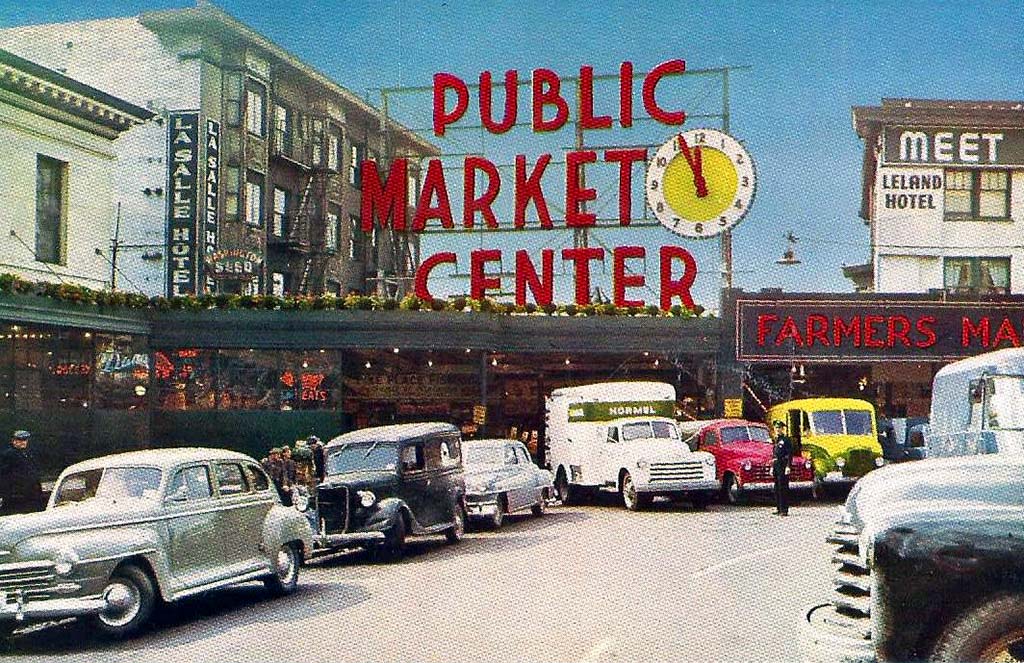
Imagine your favorite place in the city — a park where you play, a library where you read, or a market that sells delicious doughnuts — suddenly slated to be demolished by bulldozers. Wiped off the map and replaced with a boring parking lot. Sounds like a nightmare, right? That almost happened to Pike Place Market in Seattle in the 1960s. But a group of ordinary people — not superheroes, not millionaires, just fellow residents — decided it wouldn't happen. And they won. This story shows that even when it seems decisions are made by "grown-ups and important people," ordinary citizens can change the future of their city.
A frightening plan: when the "new" wanted to destroy the "old"
In the early 1960s Pike Place Market did not look like it does today. The buildings were old, paint was peeling, wooden floors creaked. Many city officials considered the market an "eyesore" in downtown Seattle. They dreamed of a modern city with tall glass buildings, wide roads, and huge parking lots.
In 1963 the city council officially voted for a plan to "renew" the area. Sounds fine, right? Who's against renewal? But in reality "renewal" meant total demolition. The plan called for: - Demolishing all the market's historic buildings - Removing all small vendors and farmers - Building hotels, office buildings, and multi-story parking garages on the site - Turning a lively, noisy market into an ordinary business district
Officials said this was "progress" and that the old market had "no place in a modern city." They had already begun buying buildings and evicting shop owners. It seemed the market's fate was sealed. Bulldozers were expected within a few years.
Heroes without capes: an architect and an army of ordinary people
But one man said, "No!" His name was Victor Steinbrueck, and he was an architect — someone who designs buildings. Interestingly, architects usually like building new things rather than defending old ones. But Victor understood that Pike Place Market was more than old buildings. It was the living heart of the city, a place where people of different backgrounds met, where farmers sold fresh produce straight from the fields, where street musicians played songs, and fishmongers tossed giant salmon back and forth with laughter.
Victor began drawing pictures of the market and writing newspaper articles. He explained to people what they would lose if the market disappeared. Others joined him: artists, writers, shop owners, ordinary shoppers. Among the activists were many women and even young people — students who were just beginning to realize their voices mattered.
They formed an organization called "Friends of the Market." It sounds simple, but behind that name was a real battle. They devised a plan: collect residents' signatures and put the question of saving the market to a public vote. If a majority of citizens voted "yes," the market could not be demolished.
A race against time: 53,000 signatures against the bulldozers
A real race began. The Friends of the Market stood on street corners with signature pads. They went door to door, talked with neighbors, handed out leaflets. They needed to collect tens of thousands of signatures to get the issue onto the ballot.
Imagine: no internet, no social media, no one-click online petitions. Every signature had to be collected in person, face to face. It was hard, slow work, and many doubted it could be done.
But people responded. Thousands of Seattle residents loved the market and didn't want to lose it. Some remembered buying fresh strawberries there as children. Some met their spouses at the flower stall. Others simply loved the atmosphere — the smell of fresh bread, the cries of seagulls, the laughter of children.
In the end, the Friends of the Market collected 53,000 signatures — more than required. The issue went to a vote in November 1971. And you know what? People voted to save the market. Moreover, they established the Pike Place Market Historical District — a historic district protected by law. That meant no one could just tear down those buildings. The market had been saved forever.
Why this story matters today
This might seem like just a story about an old market. But it's actually about something much bigger. It was one of the first major victories by ordinary citizens in defending the history and culture of their city against plans by government and big business.
Before this in America (and many other countries), officials often demolished old neighborhoods without much question. It was assumed "they know best." The Pike Place Market story showed that citizens also have a voice. Their opinion matters. And if they unite, they can change the decisions of even the most powerful people.
Today we see similar stories around the world. Children and teenagers march demanding action on climate change. Neighborhood residents fight to save parks from development. Students create petitions to change unfair school rules. These are echoes of the same idea: ordinary people, even children, can influence what happens around them.
By the way, Pike Place Market now attracts more than 10 million visitors a year. It is one of Seattle's most popular attractions. Hundreds of small businesses, artists, and craftsmen work there. Imagine — none of this might have existed; instead, there could have been a dull parking lot or an office building.
Victor Steinbrueck, the architect who started the movement, died in 1985. In his honor a small park near the market was named Victor Steinbrueck Park. From there you get a wonderful view of the bay and the market he saved. It's a reminder that one person with a good idea and the support of others can change an entire city.
Now think: if something important to you in your city were going to be demolished, what would you do? Maybe you'd gather friends, write letters, start a petition? The Pike Place Market story teaches that age and title matter less than the willingness to act and the belief that change is possible. Sometimes the most ordinary people do the most extraordinary things — simply because they care.