Imagine you have an old wooden railway for a toy train. The train has long since disappeared, and no one needs the tracks anymore—but instead of throwing them away, you suddenly think: What if you could ride a bicycle along those very tracks? That is exactly what happened in the American city of Seattle—only for real, not as a game. And this story began during genuinely difficult times that affected the entire city.
The City That Lost Its Smile
Many years ago, Seattle was a city of airplanes. The huge Boeing company operated there, building aircraft for the entire country. Thousands of people—fathers, mothers, grandparents—worked at the factory. But in the early 1970s, disaster struck: demand for airplanes fell sharply, and the company had to lay off a great many workers. Imagine if, on nearly every street in your neighborhood, someone lost their job at the same time—that is how bleak things were in Seattle then.
Someone even put up a huge sign at the entrance to the city with a joke—though a slightly sad one: “Will the last person leaving Seattle—please turn out the lights!” People left to look for work elsewhere, while the city tried to figure out how to move forward.
Tracks No Trains Used Anymore
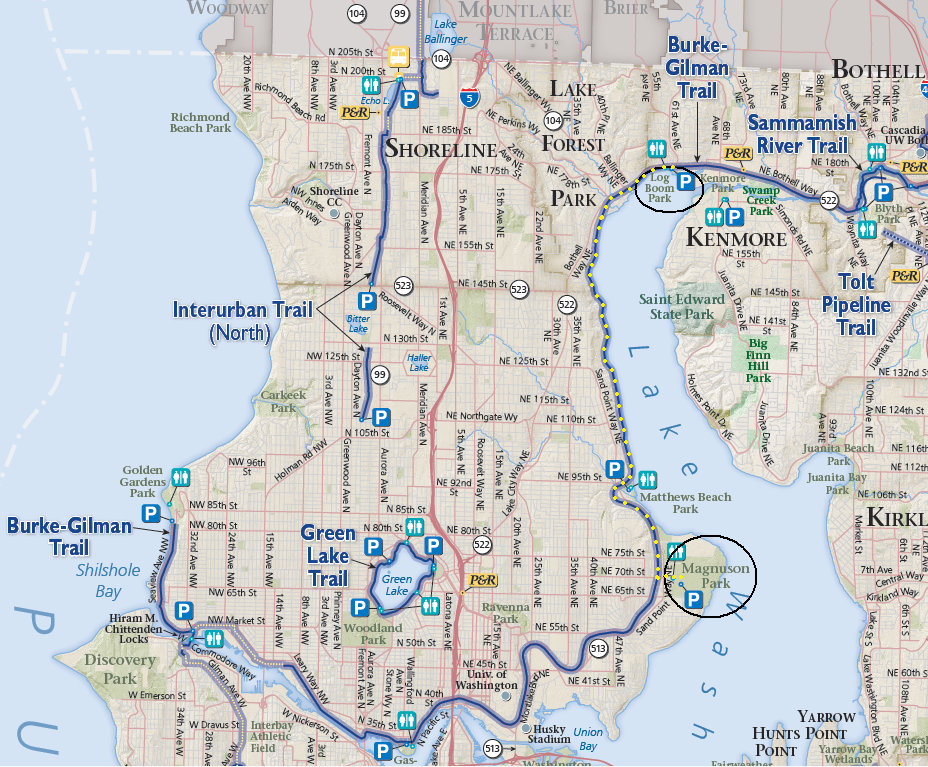
At the same time, the city had an old railroad that had once carried logs from the forests and coal to the ships. It was called Burke-Gilman, after two men who had proposed building it back in the nineteenth century. But gradually, trains ran less and less often, and eventually the railroad company went bankrupt—that is, it ran out of money and stopped operating.
The tracks simply remained in the ground, rusting and serving no purpose. The city had to decide: should it spend a great deal of money removing the tracks, or... come up with something more interesting?
A Trail Instead of a Train
That was when ordinary Seattle residents entered the story—neighbors who loved walking and cycling. They approached city officials with an idea: instead of simply removing the tracks, why not turn the strip of land into a trail—not for cars, but for cyclists and pedestrians?
The idea turned out to be excellent for several reasons:
| Why the idea was smart | What it gave the city |
|---|---|
| There was no need to build a new road from scratch | Money was saved during a difficult period |
| The strip of land was already straight and level | Cyclists could ride easily and safely |
| The trail connected different parts of the city | People could get to work without a car |
| The surrounding trees and natural areas were preserved | It became a pleasant place to walk and breathe fresh air |
In 1978, the first section of the Burke-Gilman Trail opened. It became one of the country’s first trails of its kind, built directly on the site of an old railroad. One of the city engineers who worked on the project later said they were not thinking about creating something historic—they simply wanted to help the city survive a difficult time and give people a beautiful place to walk.
The Trail That Changed an Entire City
Today, thousands of people use the Burke-Gilman Trail—which stretches for more than 30 kilometers—every day. Some ride to work, some go to school, and others simply walk their dogs or cycle with their grandparents on weekends. The trail passes lakes, parks, cafés, and even a university.
Most importantly, this example inspired other cities across America. People realized that old, unused railroads could be turned into bicycle trails instead of simply being demolished. These trails are now called “rail trails,” and there are thousands of them across the country.
It is a funny and touching story: the city lost its optimism, and many people lost their jobs, but it was during that difficult time that an idea was born that made Seattle better and healthier for many years to come. Sometimes the best things happen not when everything is easy, but when you have to find a clever way out of a difficult situation—like in a game where a broken toy is turned into something completely new and interesting.