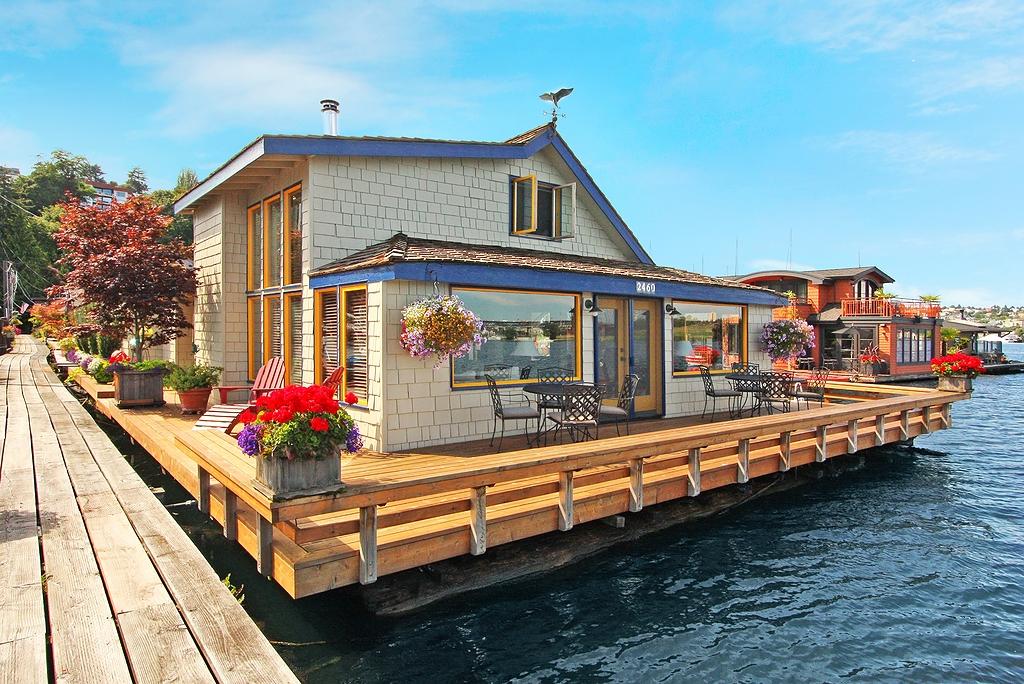
In Seattle, there are streets where cars don’t drive, and water laps beneath the windows. People live here in floating homes—real houses with kitchens, bedrooms, and flowers on the windowsills, but built not on land, but on water. These homes seem like something out of a fairy tale, but there’s a lot more to them: how they stay afloat, how they survived the changes people made to the lake, and how their residents care for it.
How can a house float without sinking?
Imagine filling a bathtub with water and setting a wooden board in it. It doesn’t sink because wood is lighter than water, and also because water “pushes” objects upward. A floating home works on the same principle, only its board is enormous.
Many floating homes in Seattle rest on bundles of large logs or on special floats—like giant fishing bobbers. Logs were often used in the past because they were plentiful: loggers worked nearby. Today, floats made of concrete or foam are increasingly common. But the idea is the same: there’s a “cushion” beneath the house that keeps it above the water.
Logs have an important secret, by the way. Wood that stays underwater can last a very long time. But if it dries out, it starts to deteriorate. So homeowners make sure the house’s “legs” stay wet and sturdy. In a way, the house is like a big organism that needs looking after.
The lake that was “drained”
Now for the most surprising part of the story. Lake Union used to be a little higher than it is today. When people built a large canal in Seattle connecting the lakes to Puget Sound, the water level in the lake was lowered by about nine feet—almost three meters. The canal opened in 1917.
Imagine you’re playing in the bathtub and someone suddenly pulls the plug, letting the water drain away. What happens to a toy? It simply sinks along with the water! The same thing happened to the floating homes. Some houses on the shore were left “sitting” on dry land, but the floating homes simply went down with the water and kept floating. That’s their biggest trick: they’re not fixed at one water level; they move with the lake.
So floating homes don’t have to worry about the water rising or falling. They’re connected to shore by flexible pipes and hoses that can stretch and bend, and by movable walkways that can be raised like ladders.
Streets on the water and caring for the lake
Residents of floating homes visit one another along wooden docks. It’s like a street, but with water on both sides. People greeted one another, talked about the weather, and helped each other repair the docks. Neighbors like these often become a big extended family.
But living on the water means being responsible for it. In the past, wastewater from some homes could flow straight into the lake, making the water dirty. Later, Seattle introduced rules requiring every floating home to connect to the city sewer system. Special pipes were laid underwater so that wastewater would go into the city system, not the lake. Today, around 500 floating homes on Lake Union follow these rules, helping keep the lake cleaner than it used to be.
There was another concern, too. At one point, Seattle decided there were too many floating homes and that they were getting in the way. Many residents fought for the right to stay on the water. They argued that their homes were part of the city’s history. In the end, the floating homes remained, and rules were established so people could live on the water while keeping the lake healthy.
And in 1993, the movie Sleepless in Seattle came out. Its main character lived in a floating home. After that, many people learned about these unusual homes and started coming to see them for themselves.
What I think matters most
I think floating homes teach us one simple thing: we don’t have to fight nature—we can be friends with it. The lake changed, and the homes simply floated along with it. People created rules to keep the water clean and look after it together. If I had a home like that, I’d watch ducks gliding across the water every morning, and I’d probably never get bored.
In conclusion
The story of Seattle’s floating homes is a story about flexibility and care. A house on the water can rise and fall with the lake, and its residents know how to protect the water they live on. Perhaps there will be more homes like these in the future, because they show how people can live close to nature without getting in its way. For now, the homes on Lake Union continue to rock gently, each one holding its own little story.