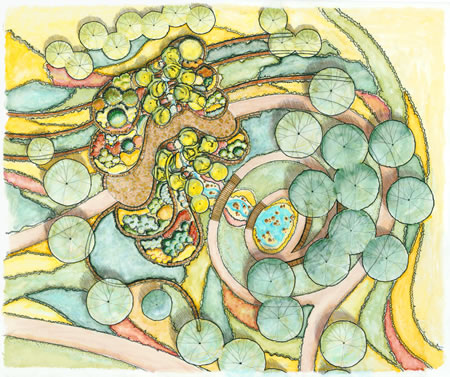
In Seattle there's a garden that looks like a magical place from a fairy tale, but in reality it's a giant water-cleaning machine. And the most surprising thing: it was created not by an engineer but by an artist named Lorna Jordan. She proved that art can do more than hang on a wall — it can solve real urban problems.
The problem adults hid underground
Imagine it's raining. Water falls on roofs, roads, and parking lots. It washes off everything on those surfaces: motor oil, trash, chemicals. All that dirty water is called "stormwater." Usually cities simply bury it in pipes underground and send it straight to rivers or lakes. It's like sweeping trash under a rug — the problem doesn't disappear, it's just out of sight.
In the 1990s Seattle built a new neighborhood in Renton. Adults knew the rainwater would be dirty and planned a typical treatment facility — gray concrete tanks, pipes, fences. Boring and ugly. But then the "1% for Art" program intervened: the law required one percent of construction funds to be spent on something beautiful.
The artist who thought like nature
Lorna Jordan proposed an idea that seemed crazy: "What if the treatment plant looked like a park?" The adults didn't believe it at first. How could art clean water? But Lorna studied how nature does it.
In a forest rainwater doesn't flow through pipes. It slowly soaks through the soil, plant roots filter it, and soil bacteria eat harmful substances. Lorna decided to create an artificial "stomach for the city" — a place where water would travel through different "rooms," and in each one plants would help clean it.
She designed five large ponds connected to each other. Water flows from one to the next, becoming cleaner at each step. In the first pond reeds trap large debris and heavy metals. In the second pond special bacteria "eat" oil. In the third the water rests and sediment settles to the bottom. By the fifth pond the water is so clean that fish and frogs swim in it.
A garden that teaches children to see the invisible
"Waterworks Gardens" (that's the garden's name) opened in 1996. It covers an area larger than three football fields. But the most interesting thing is that Lorna made it possible for people to see how the treatment works.
There are special walkways from which you can watch water flow from pond to pond. There are signs explaining what each plant does. There's even a glass pipe showing dirty water entering the system. For kids it's like a tour inside a giant organism.
One girl who visited with her class said, "I always thought tap water just appears by magic. Now I understand that it needs to be cleaned, and it can be done beautifully." Teachers began bringing students here for biology and ecology lessons. The garden became an outdoor textbook.
| Treatment stage | What happens | Which plants help |
|---|---|---|
| Pond 1 | Large debris and sand are retained | Reeds, cattails |
| Pond 2 | Bacteria break down oil and chemicals | Willows, sedges |
| Pond 3 | Water slows and sediment settles | Water lilies, algae |
| Pond 4 | Plant roots filter remaining pollutants | Irises, bulrush |
| Pond 5 | Clean water is ready to return to nature | Various aquatic plants |
How one garden changed a city's mindset
After Waterworks Gardens started operating something unexpected happened. Other cities began copying the idea. Engineers realized treatment facilities didn't have to be ugly. Architects started inviting artists to help design water systems and sewers.
In Seattle itself several similar projects appeared. For example, the "Ross Dam" sculpture at the dam — it is not just beautiful but also shows how much electricity the water generates. Or the Salmon Bay Natural Area — a park where art helps fish find their way to spawn.
But most importantly, people's attitudes changed. Adults used to think: "First solve the problem, then decorate." Now they understood: you can solve the problem BEAUTIFULLY. This matters for the environment because when people see the beauty of nature every day, they want to protect it more.
Lorna Jordan said, "I didn't want to create a monument. I wanted to create a place where people understand they are part of nature, not its owners." And she succeeded.
Why this matters to you
You might think, "So what? It's just one garden in one city." But it's actually a story about how girls (and boys too!) can change the world in unusual ways.
Lorna Jordan wasn't an engineer. She was an artist. But she wasn't afraid to work with pipes, pumps, and bacteria. She showed that creative people can solve technical problems, and technical people can create beauty.
Today more than 200 cities use similar "green treatment systems." Some look like parks, others like sculptures, and still others like playgrounds. They all came about because one city decided not to hide dirty pipes underground but to turn them into art.
When you grow up, you might become a doctor, programmer, teacher, or astronaut. But whoever you become, remember: the most interesting solutions appear when you connect things no one has connected before. Art and science. Beauty and utility. Dreams and reality.
In the meantime, try a small experiment: the next time it rains, watch where the water from your roof flows. Maybe you'll come up with a way to make its path not only useful but beautiful.